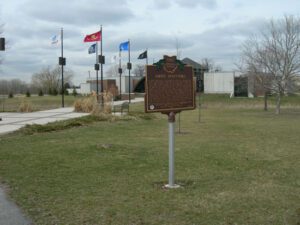
In 1810, early settlers here were Major Amos Spafford (1753-1818), his wife Olive (1756-1823), and their children Samuel, Aurora , Chloe (Mrs. Almon Gibbs), and Anna (Mrs. Richard Craw). In 1796, Spafford, a native of Connecticut, was a surveyor for the Connecticut Land Company. He drew the first map laying out Cleveland and named the city. He left there in 1810 following appointment as custom’s collector and postmaster for the new port at the foot of the Maumee River rapids, Port Miami of Lake Erie. Spafford was granted a 160 acre land patent on River Tracts #64 and #65 in Waynesfield township, signed by President James Monroe and was able to purchase it following the 1817 Treaty of the Rapids that extinguished Native American claim. Two years later, 67 families lived in the area, but most fled at the outbreak of the War of 1812.
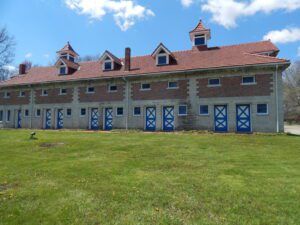
Ohio Columbus Barber, a wealthy Ohio businessman and founder of Barberton, retired in 1905 to develop his Anna Dean Farm. Built in 1910, the colt barn was a part of this 3000-acre estate. Although originally intended for bulls, the building was converted in 1912 to a stable for colts. Akron architects Harpster and Bliss designed the barn, and it was the smallest on the farm. Like many buildings erected by Barber, the colt barn features the patriotic red, white, and blue color scheme he favored. Between Barber’s death in 1920 and the founding of the Barberton Historical Society in 1974, all but nine of the estate’s thirty-five original buildings were razed. The historical society saved the colt barn in 1978, which led to the birth of the city’s historic preservation movement. The society completed restoration of the colt barn in 1998 with a grant from the Barberton Community Foundation.
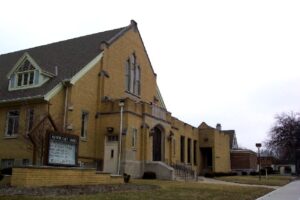
The first African American congregation and first African American Methodist Episcopal (AME) Church in Dayton trace their roots back to the early 1830s. They were organized by Father Thomas Willis and a small group of faithful men and women. After several moves, the congregation settled on Eaker Street and the church was dedicated in the early 1870s. The church was rededicated in 1882 and renamed Wayman Chapel AME Church. The eminent poet Paul Laurence Dunbar and his mother Matilda attended and worshiped at the Eaker Street church. His untimely death in 1906 brought family and friends to his funeral services held at the church. By 1923 church leadership felt the need for more secure space for the growing congregation and moved to a new building at Fifth and Banks streets. Three elegant chandeliers for the sanctuary were donated by the city’s newspaper, the Dayton Daily News. (Continued on other side)
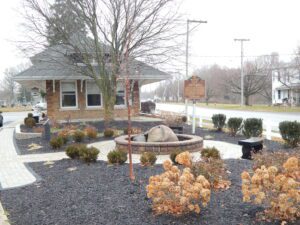
On March 20, 1868, The Ohio General Assembly passed a revision to the Ohio Revised Code allowing for a municipality and a township to join together in purchasing land for a shared cemetery. On April 24, 1868, the Washington Township Trustees passed a resolution creating Forest Hill Union Cemetery. This cemetery was to be shared with the City of Piqua and became the first mutual cemetery between a municipality and a township in Ohio.
Marathon Center for the Performing Arts, 200 W. Main Cross Street
Findlay
, OH
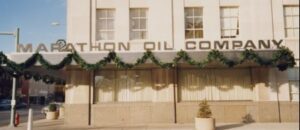
Site of the first Findlay Field Office for what was to become a world-wide oil company, formerly locally owned and operated. 1887: The Ohio Oil Company was incorporated by five independent oil producers in the Lima field. 1901: J.C. Donnell elected President of the Ohio Oil Company. Company’s ‘big well,’ the “Hugh McMurray,” comes in. 1929: Construction begins on new office building at South Main Street and Hardin Streets. 1962: Name changed to Marathon Oil Company to reflect international operations.
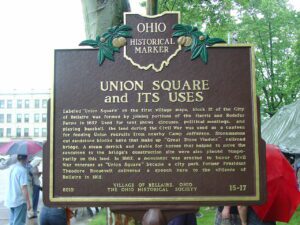
Labeled “Union Square” on the first village maps, block 12 of the City of Bellaire was formed by joining portions of the Harris and Rodefer Farms in 1857. Used for tent shows, circuses, political meetings, and playing baseball, the land during the Civil War was used as a canteen for feeding Union recruits from nearby Camp Jefferson. Stonemasons cut sandstone blocks here that make up “Great Stone Viaduct” railroad bridge. A steam derrick and stable for horses that helped to move the sandstone to the bridge’s construction site were also placed temporarily on this land. In 1882, a monument was erected to honor Civil War veterans as “Union Square” became a city park. Former President Theodore Roosevelt delivered a speech here to the citizens of Bellaire in 1912.
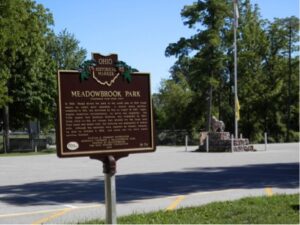
Meadowbrook Park began as a Tiffin, Fostoria & Eastern Electric Railway plan to draw weekend riders. Laura Stephenson Sneath, wife of a major company stakeholder, led the park development. Originally north of Wolf Creek, Meadowbrook included a baseball diamond and a 1902 dance pavilion. In 1923, William Richards purchased the buildings and leased the land from Henry Matthews of Matthews Boat Company. The pavilion was destroyed by fire under suspicious circumstances on October 12, 1925, but no one was charged. James Garfield Haugh, president of the Gem Manufacturing Company, purchased the land in 1925. (Continued on other side)
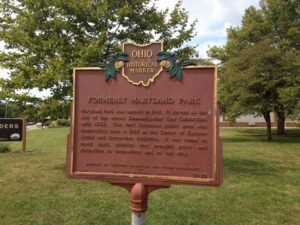
Maryland Park was opened in 1921. It served as the site of the annual Emancipation Day Celebration until 1933. The first Columbus public pool was constructed here in 1929 as the Center of Eastside Social and Recreation Activities. It was home to many black athletes who brought pride and distinction to themselves and to the city.