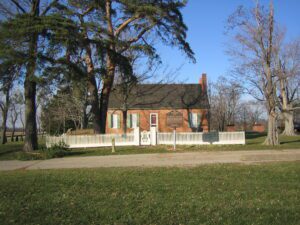
As Oxford Township was developing in the mid-1800s, a cluster of farmsteads near its northern border developed and was designated the “Doty Settlement.” As was the custom, the community took its name from a prominent family in the area. In or near the settlement were a church and cemetery, a school, a blacksmith shop, a sawmill, a distillery, a furniture shop, and a fulling mill for cleansing, shrinking, and thickening cloth. With the frontier spirit of self-reliance, it was seldom necessary to travel several miles into Oxford village for additional goods or services. Working together, the community farmed local fields and bartered for other items. Men, women, and children worked long, hard hours in the fields harvesting corn and wheat. It is evident that these families, living in an agricultural society, possessed many useful skills for surviving in the Ohio country.
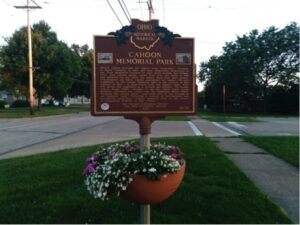
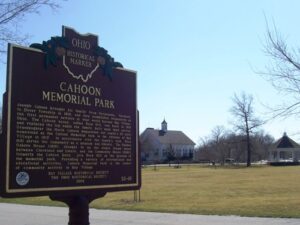
Joseph Cahoon brought his family from Vergennes, Vermont, to Dover Township in 1810, and they established themselves as the first permanent settlers in what would become Bay Village, Ohio. The Cahoon house, called Rose Hill, was built in 1818 and replaced the log cabin the family built upon their arrival. Granddaughter Ida Maria Cahoon bequeathed her family’s 115-acre homestead as the Cahoon Memorial Park to the citizens of Bay Village in 1917. In accordance with the family’s wish, Rose Hill serves the community as a museum and library. The Reuben Osborn House (1815), thought to be the oldest frame house between Cleveland and Lorain, and the Community House (1882), formerly the Cahoon barn, join Rose Hill on the grounds of the memorial park. Providing a variety of recreational and educational activities, Cahoon Memorial Park is the center of community activity in Bay Village.
Joseph Cahoon brought his family from Vergennes, Vermont, to Dover Township in 1810, and they established themselves as the first permanent settlers in what would become Bay Village, Ohio. The Cahoon house, called Rose Hill, was built in 1818 and replaced the log cabin the family built upon their arrival. Granddaughter Ida Maria Cahoon bequeathed her family’s 115-acre homestead as the Cahoon Memorial Park to the citizens of Bay Village in 1917. In accordance with the family’s wish, Rose Hill serves the community as a museum and library. The Reuben Osborn House (1815), thought to be the oldest frame house between Cleveland and Lorain, and the Community House (1882), formerly the Cahoon barn, join Rose Hill on the grounds of the memorial park. Providing a variety of recreational and educational activities, Cahoon Memorial Park is the center of community activity in Bay Village.
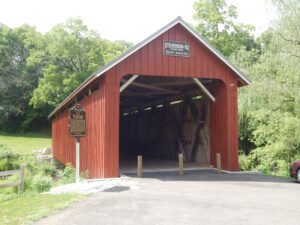
Built in 1877 and spanning approximately ninety-five feet, the Stevenson Road Covered Bridge carried vehicular traffic until 2003. It is one of the few Smith truss bridges left in the United States. The Smith Bridge Company manufactured the bridge using various patents of the company, which were secured by its founder, Robert W. Smith. The company originated in Tippecanoe City, Ohio (Tipp City) and later relocated to Toledo. In 1890 the Toledo Bridge Company Purchased the company from Smith. Robert Smith died in 1898 at the age of sixty-five leaving behind a legacy of unique covered bridges.
The Peter J. Miller House was constructed around 1830 and is one of the last remaining pre-Civil War lakefront houses in Lorain County. The architecture is Greek Revival. Peter Miller married Ruth Houseworth in 1828. They had five children. In 1851 Peter Miller died and it’s believed that his family continued to reside on the property until 1925. The City of Avon Lake purchased the property in 1962. The house was opened for tours, and restoration proceeded, as funds were available. In 1975 the water heating system burst and caused extensive damage. In 1985 a new committee took over and was successful in restoring the house. Volunteer trustees have overseen the operation of the house as a museum since September 1989.
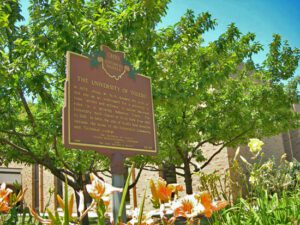
In 1872, Jesup W. Scott donated 160 acres at this site as an endowment for a university to train “artists and artisans” to assume important roles in a growing industrial Toledo. The University held classes at Scott Park from 1922 to 1931. In 1969, the site of Scott’s land donation became the site of the University’s Community and Technical College.
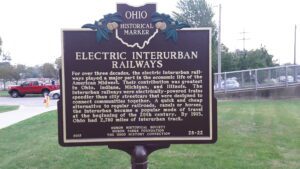
For over three decades, the electric interurban railways played a major part in the economic life of the American Midwest. Their contribution was greatest in Ohio, Indiana, Michigan and Illinois. The interurban railways were electrically-powered trains speedier than city streetcars that were designed to connect communities together. A quick and cheap alternative to regular railroads, canals or horses, the interurban became a popular mode of travel at the beginning of the 20th century. By 1915, Ohio had 2,780 miles of interurban track.
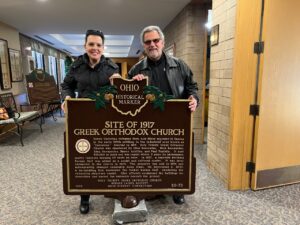
Greek Christian refugees from Asia Minor migrated to Canton in the early 1900s settling in the industrial area known as “Carnahan.” Erected in 1917, Holy Trinity Greek Orthodox Church was chartered by Elies Korosedes, Nick Kessenides, Alex Heropoulos, Harry Achilles, and Paul Paulidis. It cost $50,000 to build and was repaid within 3 years by parishioners, mostly laborers earning 30 cents an hour. In 1927, a separate building Koraes Hall was added as a social and cultural center. It was later connected to the church in 1934. The property was sold in 1976 and subsequently changed ownership many times. On September 2, 2020, a devastating fire destroyed the former Koraes Hall, rendering the remaining structure unsafe. City officials condemned the buildings for demolition and buried the remnants beneath the ground.