Archibald Worthington (1818-1895) was a freed slave from Virginia, a Civil War veteran, and prominent landowner in Highland Township. Census records indicate he was manumitted prior to 1850, and by 1860 owned land in northwest Ohio. Worthington also farmed, boarded freed slaves, and owned apple orchards and livestock. April 1866 township records show that he supported the local school for Black families. He and his wife Elizabeth raised three children: Henry, Mathilda, and James. Henry enlisted in the Massachusetts 54th Volunteer infantry, one of the first Black regiments formed in the Civil War. He died January 8, 1865, in a prison camp and is buried in North Carolina’s Salisbury National Cemetery. Mathilda and James both met partners and married, had children, and left the area. Archibald Worthington died in 1895 and is buried in Wilmington’s Sugar Grove Cemetery.
Born in Chillicothe in 1872, Burton Stevenson’s life was devoted to the written word as a prolific author and anthologist, and as a librarian. Following stints as a journalist while a student at Princeton University and then at newspapers in Chillicothe, Stevenson became the librarian of the city’s public library in 1899. He held the post for 58 years. Stevenson helped secure a Carnegie Library for Chillicothe, completed in 1906, and became prominent for his service during World War I. He founded a library at Camp Sherman (an army training camp north of the city), which became a model for others nationally.
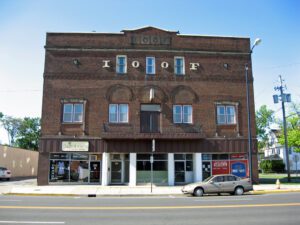
The Independent Order of Odd Fellows (IOOF), a world-wide fraternal organization, was introduced to the United States from England in 1819 and was established in Ohio in 1830. Mahoning Lodge #29 in Warren, Ohio, received its jurisdictional charter on May 21, 1844, and is currently the oldest active lodge in northeast Ohio. The lodge was originally located at the southwest corner of Park Avenue and Market Street, but was subsequently moved several times within the city. The present Odd Fellows Temple was dedicated in 1925. Friendship, Love, and Truth. Erected May 21, 1994, in commemoration of the 150th anniversary of Mahoning Lodge #29 in Warren, Ohio
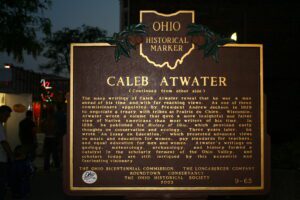
Born in North Adams, Massachusetts on December 23, 1778, Caleb Atwater graduated from Williams College in 1804. He moved to Circleville in about 1814 where he organized the city’s first school board and served as postmaster and prosecuting attorney. His life and work as a teacher, minister, lawyer, legislator, and scholar greatly influenced early 19th-century Ohio. Upon arriving in Circleville, he became interested in local history and the nearby earthworks and in 1820 published his book Descriptions of the Antiquities Discovered in the State of Ohio and Other Western States, the first compilation of prehistoric remains in the Ohio and Mississippi valleys. Elected to the Ohio State Legislature in 1821, Atwater fervently supported canal construction. He also chaired Ohio’s first board of school commissioners and was instrumental in passage of Ohio’s Public School Law. For this, he has been called the “Father of Ohio’s Common Schools.” (continued on other side)
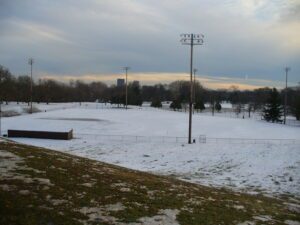
On October 3, 1920 the first game matching two professional teams of the American Professional Football Association, a league that would become the National Football League (NFL), was held on this field within Triangle Park. In that game, the Dayton Triangles defeated the Columbus Panhandles 14-0. The Triangle’s Lou Partlow scored the first touchdown and George “Hobby” Kinderdine kicked the first extra point. Three factories founded by Dayton businessmen Edward Deeds and Charles Kettering sponsored the Dayton Triangles team. The factories were the Dayton Engineering Laboratories Company (DELCO), Dayton Metal Products Company (D.M.P.Co.), and Domestic Engineering Company (DECO), later call Delco-Light. They formed an industrial triangle of plants in downtown Dayton.
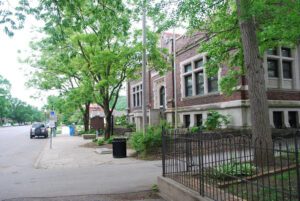
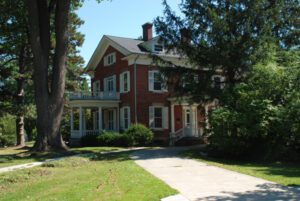
Jabez Lyman Burrell (1806-1900), originally from Massachusetts, built this house in 1852. Burrell made his living as a cattleman and farmer, but devoted much of his time serving the cause of abolitionism, helping slaves, who had escaped the South, get to Sheffield and from there to Lorain and across Lake Erie to Canada. He was also devoted to equal education for all, providing funding to a freedmen’s school in Selma, Alabama, and serving as a trustee of the Oberlin Collegiate Institute, well known for educating African Americans and women. From 1884 to 1934, this was the home of Henry Churchill King (1858-1934), who was the president of Oberlin College from 1902-1927. The Kings added the porches and rear wing and made their home a social center for the college and community. The house is listed on the National Register of Historic Places and is a City of Oberlin Historic Landmark.
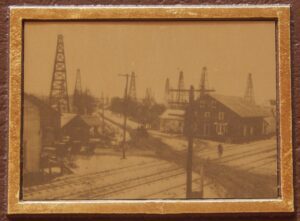
The Bremen Oil Boom commenced in 1907-’08 and the town became a center in the region’s petroleum industry. The area was a forest of oil derricks. From this point south, it was said that one could go down Broad Street from derrick to derrick and not touch the ground. A reconstructed derrick, erected to commemorate Bremen’s sesquicentennial in 1984, may be seen in Howell Park directly east of this marker.
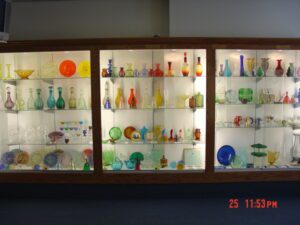
With ready access to raw materials, fuel, skilled labor, and transportation, the Ohio Valley became the center of the American glass industry during the late 1800s. Among dozens of local manufacturers, the Imperial Glass Company, founded in 1901 by river man and financier Edward Muhleman, first made glass in 1904 and distinguished itself for mass production of attractive and affordable pressed glass tableware using continuous-feed melting tanks. One of the largest American handmade glass manufacturers during the 20th century, Imperial also produced blown glass, several lines of art glass, and its trademark “Candlewick” pattern. Bellaire’s glassmaking era ended when the “Big I” closed its doors in 1984, and the building was razed in 1995. Its diverse products remain highly prized by glass collectors.