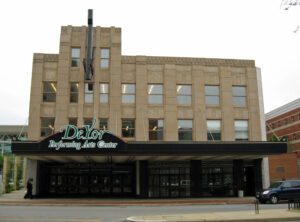
The Warner Brothers – Harry, Albert, Sam, and Jack – were members of a Jewish immigrant family from Poland that settled in Youngstown in the mid-1890s. The brothers attended local schools and worked in their father’s shoe repair shop and meat market before entering the motion picture business. They purchased a projector and opened the first of several theaters in the Mahoning Valley in 1905. The brothers left Youngstown for New York and Hollywood as their company developed into an industry leader. Warner Brothers Pictures, founded in 1923, released Don Juan in 1926, the first “talking picture” using Vitaphone technology. On May 14, 1931, the family gathered in Youngstown to dedicate a luxurious new Warner Theater to the people of the city where it all started, and to memorialize Sam, who died in 1927.
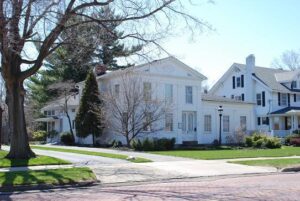
Among the fifty-four buildings that comprise the Mentor Avenue District are examples of Federal, Greek Revival, Early Romanesque Revival, Italianate, Second Empire, Queen Anne, and twentieth century eclectic styles. Renowned master builder Jonathan Goldsmith (1783-1847), whose Federal and Greek Revival designs define the so-called “Western Reserve” style, built at least two of these houses; the Denton-Powers House (ca. 1820) is representative. The Mentor Avenue District was added to the National Register of Historic Places in 1979. The Painesville City Hall, the Sessions House (157 Mentor Avenue) and the Smead House (187 Mentor Avenue) are also listed individually on the National Register.
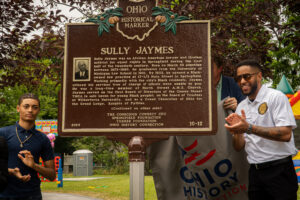
Sully Jaymes was an African American lawyer and tireless activist for equal rights in Springfield during the first half of the twentieth century. Born on March 30 sometime between 1875-1880, he graduated from the University of Michigan Law School in 1901. By 1903, he opened a Black-owned law practice at 17-1/2 Main Street in Springfield. Working primarily with the city’s Black residents, Jaymes offered his services free of charge if clients were unable to pay. He was a long-time member of North Street A.M.E. Church. Jaymes served on the first Board of Directors of the Center Street YMCA (a safe-haven for young Black people), on the Board of Trustees at Wilberforce University, and as a Grand Chancellor of Ohio for the Grand Lodge, Knights of Pythias. (Continued on other side)
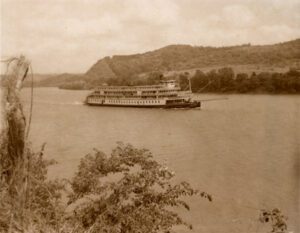
Captain Gordon C. Greene, a veteran riverman, was born in Newport, Ohio, on September 8, 1862. In 1890 he started the “Greene Line” with the “Henry K. Bedford,” a small shallow draft steamer; he owned twenty-five packets in his lifetime. The “Greene Line” later became the “Greene Steamboat Line” then the “Delta Queen Steamboat Company,” with the original port at the Newport Landing. The Greene family launched packets for tours on the Ohio River and its tributaries. Captain Greene died in 1927 at Hyde Park, Cincinnati, and is buried in Newport Cemetery. (continued on other side)
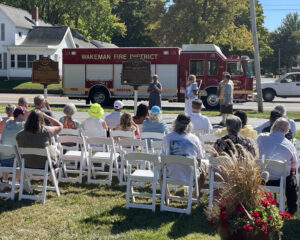
When inventor and entrepreneur Garrett Augustus Morgan sold his Traffic Signal patent to General Electric in 1923, he used the $40,000 to purchase a 121-acre farm in Huron County in 1924. Advertising “a village of our own,” Morgan established the Wakeman Country Club — one of Ohio’s early African American recreation clubs — and offered 247 lots for $60 each in “Wakeman Heights.” Located near the intersection of State Route 60 and Chenango Road, the development provided country pleasures to Blacks excluded from the Country Club lifestyle. Club membership, included in the purchase of a lot, offered fishing, hunting, swimming, and horseback riding. A restaurant, dance hall, and amphitheater provided cultural and boxing events. The club waned during World War II and no buildings from the once-thriving Wakeman Country Club remain.
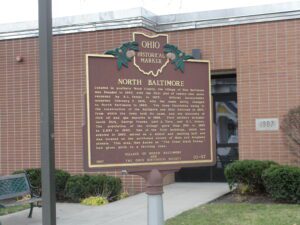
Located in southern Wood County, the village of New Baltimore was founded in 1860, with the first plat of twenty-nine acres recorded by B.L. Peters in 1873. Official incorporation occurred February 7, 1876, with the name being changed to North Baltimore in 1880. The town flourished owing to the construction of the Baltimore and Ohio Railroad in 1873, from which the town took its name, and the discovery of rich oil and gas deposits in 1886. First settlers included: Jacob Dirk, George Franks, Levi A. Tarr, and B.L. Peters. The population of the village grew from 700 in 1880 to 2,857 in 1890. One of the first buildings, which was erected in 1860, served as a school and meeting hall and was located on the northwest corner of Main and Broadway streets. This area, then known as “The Great Black Swamp,” had given birth to a thriving town.
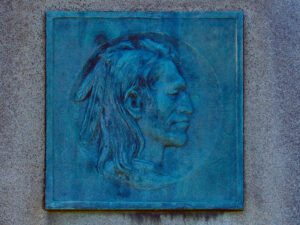
Tah-gah-jute, the Mingo chief named Logan, was a native of Pennsylvania. Logan moved to Ohio in 1770, and settled at the Pickaway Plains. Logan and his father, Shikellimus, had long supported friendships between Native Americans and white men; however, in the spring of 1774, his tribesmen and family were murdered at Yellow Creek, along the Ohio River. Once an advocate of peace, Logan went on the warpath and raided frontier settlements. These and similar raids along the Ohio frontier precipitated Lord Dunmore’s War in October 1774. After the Shawnees and their allies were defeated at Point Pleasant, Virginia governor Lord Dunmore marched up the Hocking River to the Pickaway Plains. Dunmore asked his interpreter, Colonel John Gibson, to assist in negotiations with Cornstalk and other Indian leaders, including Logan. Logan declined to attend the conference, but spoke to Gibson about his anger and betrayal.
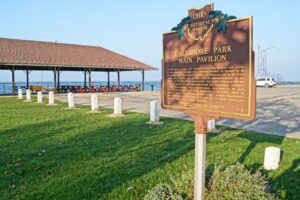
At 440 feet in length, the Lakeshore Park Main Pavilion, now known as the Ashtabula Township Park Lakefront Pavilion, is thought to be the longest and oldest lakefront pavilion in continuous use on the Great Lakes. Built in 1919, the pavilion, with its bandstand/gazebo in the middle, is of steel frame construction, and stood unchanged for the most part except for the swept wing design roof replacement. Extensive Civilian Conservation Corps improvements were made in the park near the pavilion during the Great Depression of the 1930s. Since its founding, people from all over northeast Ohio, western Pennsylvania, and northern West Virginia have chosen this site for family outings and company, union, and political gatherings.