

, OH
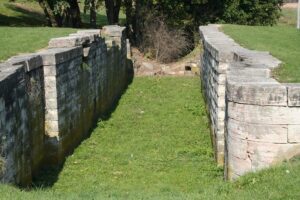
This section of the Miami and Erie Canal, constructed from 1833-1837, was vital to this region’s commerce and development. It allowed for farmers and businesses to get their goods to larger markets at a lower cost and faster speed than by hauling overland. Passengers could also travel across the area by canal boat. John Clark saw the location of the Lock 15, situated in Monroe Township at the junction of the Milton-Carlisle Pike (Main Street), as an opportunity and in 1840, platted the new town of Tippecanoe City (now Tipp City). Many types of commerce and trade grew up around the canal including boarding houses, saloons, a tannery, and a mill. Some of the original buildings still stand, such as a mill to the west of Lock 15, John Clark’s home at the southeast corner of Main and First streets, and the hotel at the northeast corner of Main and Second streets.
, OH
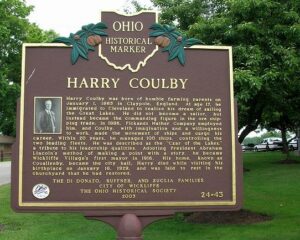
Harry Coulby was born of humble farming parents on January 1, 1865 in Claypole, England. At age 17, he immigrated to Cleveland to realize his dream of sailing the Great Lakes. He did not become a sailor, but instead became the commanding figure in the ore shipping trade. In 1886, Pickands Mather Company employed him, and Coulby, with imagination and a willingness to work, made the movement of ships and cargo his career. Within 20 years, he managed 100 ships, controlling the two leading fleets. He was described as the “Czar of the Lakes,” a tribute to his leadership qualities. Adopting President Abraham Lincoln’s method of making a point with a story, he became Wickliffe Village’s first mayor in 1916. His home, known as Couallenby, became the city hall. Harry died while visiting his birthplace on January 18, 1929, and was laid to rest in the churchyard that he had restored.
, OH
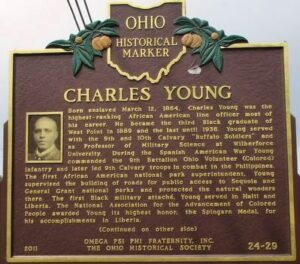
Born enslaved March 12, 1864, Charles Young was the highest-ranking African American line officer most of his career. He became the third Black graduate of West Point in 1889 and the last until 1936. Young served with the 9th and 10th Calvary “Buffalo Soldiers” and as Professor of Military Science at Wilberforce University. During the Spanish American War Young commanded the 9th Battalion Ohio Volunteer (Colored) Infantry and later led 9th Calvary troops in combat in the Philippines. The first African American national park superintendent, Young supervised the building of roads for public access to Sequoia and General Grant national parks and protected the natural wonders there. The first Black military attache, Young served in Haiti and Liberia. The National Association for the Advancement of Colored People awarded Young its highest honor, the Spingarn Medal, for his accomplishments in Liberia. (continued on other side)
, OH
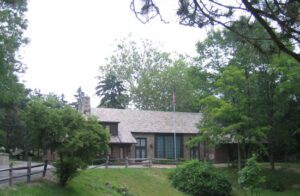
Envisioned by Fairview Village Mayor, David R. Bain, this community center was originally completed in 1937 as a project of the Works Progress Administration (WPA), a Depression-era work relief program initiated by the Federal Government in 1935. A fire destroyed the original log cabin on December 14, 1937, just four days before the planned dedication. With the support of the community, Mayor Bain turned again to the WPA for funding and labor to rebuild the structure. This cabin, constructed of bricks on the original foundation, features an 8’x12′ mural painted by artists of the WPA’s Federal Art Project and which depicts Fairview’s history through the 1930s. The new cabin was dedicated on January 15, 1940, and was named in honor of Mayor Bain in 1957, four years after his death.
, OH
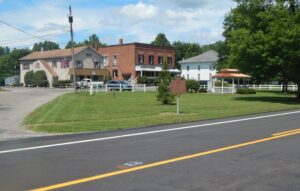
Originally called Westfield Township, Samuel Fowler purchased this area in 1798 from the Connecticut Land Company for $12,903.23 while living in Westfield, Massachusetts. His brother Abner arrived the following year to survey the land and separate it into smaller plots that could be sold to people wanting to settle here. A Revolutionary War veteran, Abner was the first to arrive here and also the first recorded death in 1806, the same year that his son Abner Fowler II married the first school teacher in Fowler Ester Jennings. In 1817, Samuel Fowler gave five acres of land to Fowler Center to be used as a park or “common” with the provision that no permanent building ever be built on it. At about the same time, the township name was changed to Fowler to honor its founding family. Agriculture was and remains the main occupation in the Fowler area.
, OH
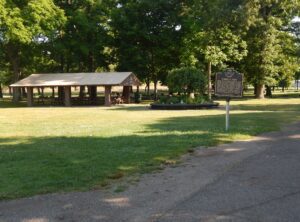
Nimisilla Park was established in 1894. Prior to its founding, the site was the location of the county fair from 1859 to 1893. Throughout its history, Nimisilla Park hosted horse races, live music, soldier reunions, and a zoo, among other events. Prominent political figures, such as Rutherford B. Hayes, James A. Garfield, William McKinley, and Eugene V. Debs, made speeches at the park. In 1918, Debs delivered a famous anti-war speech for which he was arrested and jailed. As of 2016, the park continues to serve as a gathering place for the community.
, OH
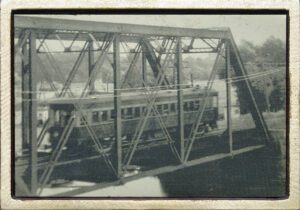
At this site the Lake Shore Electric Railway crossed a bridge that spanned the Vermilion River. The western abutment of the former bridge is plainly visible just below along the river bank. Widely known as the “Greatest Electric Railway in the United States,” the flaming orange trolley cars of the Lake Shore Electric Railway transported people and freight for thirty-seven years (1901-1938) along the southern Lake Erie shores from Cleveland to Toledo often reaching speeds of sixty miles per hour. The interurban line played a primary role in the development of the western Cleveland suburbs and also carried throngs of summer visitors to Lake Erie recreation facilities at Avon Beach Park, Linwood Park, Crystal Beach, Mitiwanga, Ruggles Grove, Rye Beach, and Cedar Point. The power lines still standing along the system’s right-of-way attest to the fact that it also assisted in bringing electric power to the entire region.
, OH
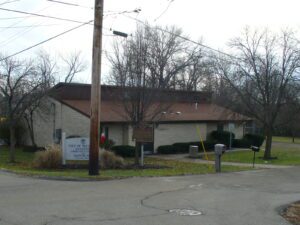
Civic organizations played pivotal roles in the development of the residential community of Hazelwood, founded as a subdivision of Blue Ash in 1888. The Hazelwood Civic Association, initially established as the Brothers Civic Society in 1941, addressed community needs by working for public improvements and promoting civic relations through social events and educational programs. Efforts by the HCA led to the construction of a new civic center and the introduction of the Boy and Girl Scouts and other programs that were previously unavailable to African-American children. Hazelwood’s deterioration and the threat of encroaching industrial development led to the formation of the Hazelwood Improvement Corporation in 1968. The HIC, acting as an agent of the city of Blue Ash, helped to upgrade housing, pave roads, build new homes to ensure a residential nature, install water and sewage systems, and erect streetlights. In 1997, the Hazelwood Community Association was organized to assist residents during Hazelwood’s transition to a racially integrated community.