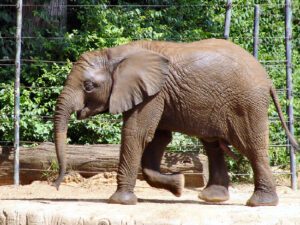
Now ranked among the country’s finest, the zoo began in 1900 with one large woodchuck in a box at Walbridge Park. After the organization of the Toledo Zoological Society, 1905-10, the zoo began its steady growth, particularly after 1923 under the leadership of Percy C. Jones. An ambitious federal construction program during the Great Depression of the 1930s provided several major structures.(See other side)
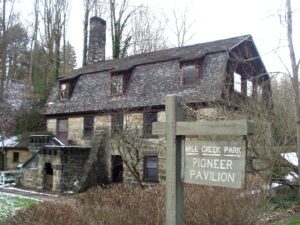
Pioneer Pavilion, one of the oldest structures in Youngstown, is a rare surviving example of early nineteenth-century industry. James Heaton constructed this sandstone building in 1821 as a mill for carding and fulling wool. A millrace from Mill Creek and a waterwheel on the west side supplied the power. In the 1830s and 1840s, the woolen mill was converted to a storage facility for the nearby Mill Creek Furnace and later served as a cattle barn. In 1891, Youngstown attorney Volney Rogers purchased the property for Mill Creek Park, renovating the building in 1893 as a dining and dancing facility, and naming it Pioneer Pavilion. Generations of area residents spanning three centuries have celebrated social events in this historic landmark.
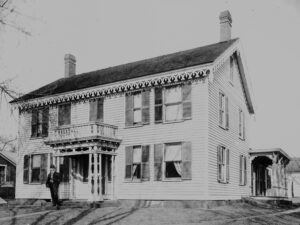
The Johnson House was built in 1852 and its first owner was Henry J. Traver (1827-1911), owner of Traver & Company carriage factory across the street. From 1877 until 1994 the house was the residence and office of four doctors who maintained their practices there. The first was Dr. Daniel Cranz (1854 — 1914); followed by Dr. Thomas Ritter (1855—1928). In 1900, Dr. Robert Johnson (1878 — 1952) purchased the house. His daughter Dr. Myra Johnson (1909 — 1994) took over the practice after he died and until she retired in 1976. After her death, the house was converted into a museum. It is operated by the Wadsworth Area Historical Society and owned by the City of Wadsworth. (Continued on other side)
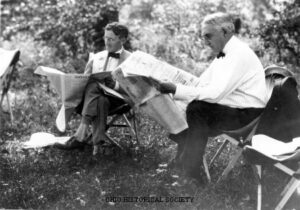
Inventor, industrialist, and philanthropist, Harvey Samuel Firestone (1868-1938) was born on a nearby farm in 1868 and attended school in Columbiana. He founded the Firestone Tire and Rubber Company in 1900 and soon after developed a method for mass-producing tires for the infant automobile industry. Continuing innovation and steady contracts with large automakers led to the company’s lasting success. Firestone Park is his lasting legacy to Columbiana. The Firestone family’s monument is located in nearby Columbiana Cemetery.
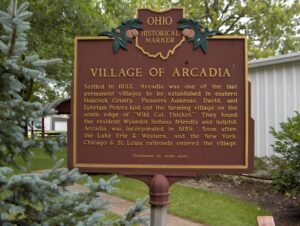
Settled in 1833, Arcadia was one of the last permanent villages to be established in eastern Hancock County. Pioneers Ambrose, David, and Ephriam Peters laid out the farming village on the south edge of “Wild Cat Thicket.” They found the resident Wyandot Indians friendly and helpful. Arcadia was incorporated in 1859. Soon after, the Lake Erie & Western, and the New York Chicago & St. Louis railroads entered the village. (Continued on other side)
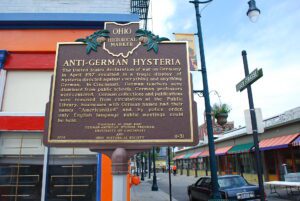
The United States’ declaration of war on Germany in April 1917 resulted in a tragic display of hysteria directed against everything and anything German. In Cincinnati, German teachers were dismissed from public schools, German professors were censored, German collections and publications were removed from circulation at the Public Library, businesses with German names had their names “Americanized” and, by police order, only English language public meetings could be held. (Continued on other side)
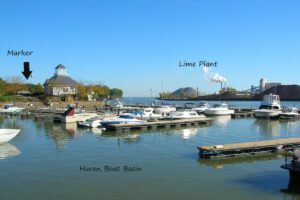
In the early 1800s, Jabez Wright, an early Huron County judge, purchased a large tract of lakeside land on the north side of what is now Cleveland Road. There Wright built an eight-room farmhouse that later served as a “station” on the fabled Underground Railroad, playing a vital role in aiding fugitive African-American slaves to freedom. Beneath Wright’s farmhouse was a sixteen foot-wide and ninety foot-long tunnel. Escaped slaves entered the passage through a trap door in the home’s basement and exited into a corn crib located a mere one hundred feet from Lake Erie. There the slaves awaited the arrival of rowboats transporting them to vessels heading north to Canada. (Continued on side two)
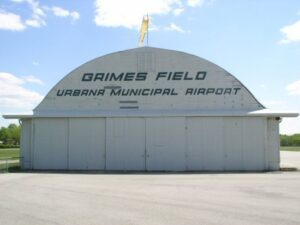
Raised in an Ohio orphanage, Warren G. Grimes (1898-1975) ran away after finishing the ninth grade and at age 16 went to work for the Ford Motor Company in Detroit. He later became a partner in an electrical business where he was instrumental in designing and developing the first lights for the Ford Tri-Motor airplane. In 1930 Grimes moved to Urbana and founded a small lighting fixture plant, Grimes Manufacturing. The inventor of the familiar red, green, and white navigation lights found on the wing tips and tails of aircraft, Grimes, known as the “Father of the Aircraft Lighting Industry,” also developed other aircraft fixtures, including landing, instrumental, and interior lights. Every American-made airplane flown during World War II was equipped with Grimes lights. Grimes served as mayor of Urbana and chairman of the State of Ohio Aviation Board.