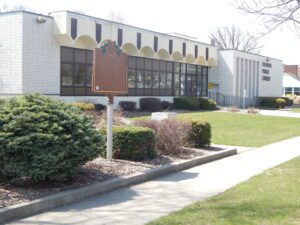
A farm boy with a tenth grade education, Leslie Peltier, born near Delphos in 1900, achieved fame as one of the most famous astronomers of the twentieth century. In 1916, he raised $18 dollars by picking 900 quarts of strawberries on his father’s farm in order to purchase his first telescope. His stargazing abilities led Harvard Observatory’s Dr. Harlow Shapley to proclaim him “the world’s greatest non-professional astronomer.” During his 65 years of stargazing, Leslie Peltier discovered 12 comets and two novae and made 132,000 variable star observations. Peltier made his discoveries on his homemade “merry-go-round” observatory that rotated on a child’s merry-go-round track and housed the optics from a 6-inch, f/8 telescope on loan from Princeton University. To recognize his achievements, the Astronomical League created the annual Leslie C. Peltier Award in 1980 to recognize an amateur astronomer who contributed to astronomy observations of lasting significance.
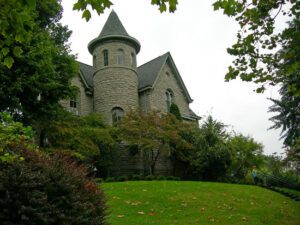
George W. Campbell originally built this highly picturesque structure in 1854. Designed with Romanesque and Norman Revival architectural features – a round tower, arched windows and doorways – and constructed of locally mined blue limestone, the home is representative of the work of architect W. Russell West. Campbell, a nationally eminent horticulturist, had a small vineyard to the east of the house where he developed and improved a variety of fruits, most notably the world famous Delaware Grape. Following Campbell’s death in 1898, the house was sold to Dr. Aaron J. Lyons and Mrs. Abbie Parish and presented to Ohio Wesleyan University, serving for more than 70 years as Lyons Art Hall.
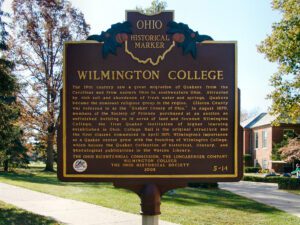
The 19th century saw a great migration of Quakers from the Carolinas and from eastern Ohio to southwestern Ohio. Attracted by rich soil and abundance of fresh water and springs, Quakers became the dominant religious group in the region. Clinton County was referred to as the “Quaker County of Ohio.” In August 1870, members of the Society of Friends purchased at an auction an unfinished building on 14 acres of land and founded Wilmington College, the first Quaker institution of higher learning established in Ohio. College Hall is the original structure and the first classes commenced in April 1871. Wilmington’s importance as a Quaker center grew with the founding of Wilmington College, which houses the Quaker Collection of historical, literary, and genealogical publications in the Watson Library.
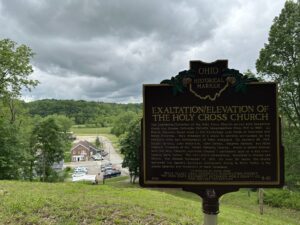
The Exaltation/Elevation of the Holy Cross Church served both Byzantine Greek and Russian Orthodox Catholic congregations from 1915 to 1967. As Slovak migrants found work in the Cambridge coal fields of Guernsey and Noble Counties, they dreamed of a place to worship surrounded by the religious rites and iconography of their homeland. On January 26, 1914, Daniel Varhola, John Fetkovich, John Demko, Stephen Varhola, and Mike Zeleznik (trustees of the “Greek Catholic Church, which is united forever with the Holy Catholic Apostolic Church”) purchased land on a hill overlooking Belle Valley. The two-sided cornerstone, inscribed in Russian and Slovak, was blessed November 15, 1915. For over 50 years, the church anchored the Eastern European immigrants living in Belle Valley to the ethnic identity and traditions of their homeland. (Continued on other side)
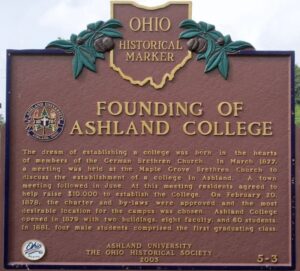
The dream of establishing a college was born in the hearts of members of the German Brethren Church. In March 1877, a meeting was held at the Maple Grove Brethren Church to discuss the establishment of a college in Ashland. A town meeting followed in June. At this meeting residents agreed to help raise $10,000 to establish the College. On February 20, 1878, the charter and by-laws were approved and the most desirable location for the campus was chosen. Ashland College opened in 1879 with two buildings, eight faculty, and 60 students. In 1881, four male students comprised the first graduating class.
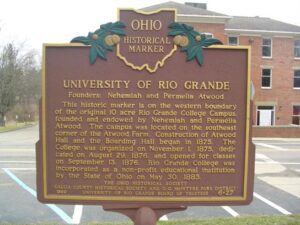
This historic marker is on the western boundary of the original 10 acre Rio Grande College Campus, founded and endowed by Nehemiah and Permelia Atwood. The campus was located on the southeast corner of the Atwood Farm. Construction of Atwood Hall and the Boarding Hall began in 1875. The College was organized on November 1, 1875, dedicated on August 29, 1876, and opened for classes on September 13, 1876. Rio Grande College was incorporated as a non-profit educational institution by the State of Ohio on May 30, 1883.
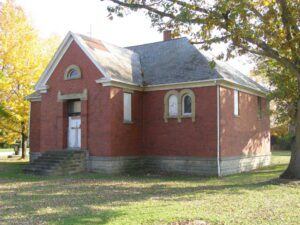
This Little Red Schoolhouse served children from Berea, Brookpark, and Middleburg township. The first mayor and council of Middleburgh Heights were elected here. During its colorful history, the schoolhouse has been a City Hall where town meetings were held, a speak-easy, a railroad way station, and a private residence.
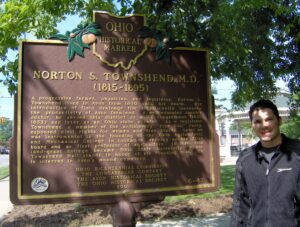
A progressive farmer, physician, and legislator, Norton S. Townshend lived in Avon from 1830 until his death. His introduction of field drainage tile significantly increased the productivity of Avon farmland. A well-educated country doctor, he served this district as a U.S. congressman (1851-1853) and later as an Ohio state senator. As a legislator Townshend, a member of the antislavery “Free Soil” Party, espoused civil rights for women and free blacks. Later he was instrumental in the founding of the Ohio Agricultural and Mechanical College in Columbus, serving on the first board and as its first professor of agriculture. In 1878, this land-grant college became Ohio State University, where Townshend Hall stands in honor of his founding role. He is interred in Avon’s mound cemetery.