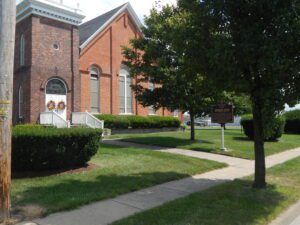
The Rev. Jacob Ward founded the Brunswick Methodist Episcopal Church in April 1817 with 13 members: Rhoda Stow, John and Lucy Stearns, John and Hannah Hulet, Samuel and Sarah Tillotson, Thomas and Phoebe Stearns, Solomon and Polly Harvey, Lydia Crittenden, and Olivia Ashley. In 1830, John and Lucy Stearns donated land for a cemetery, which included space for a church. A new church was completed in 1872. Bricks used for the building were fired locally and the first windows were glazed with clear glass and protected by shutters. In 1916, the church was extensively remodeled and redecorated. Stained glass replaced the clear glass, the church bell was relocated to the newly-added tower, and the main entrance was moved from the center of the building to the vestibule in the tower. (Continued on other side)
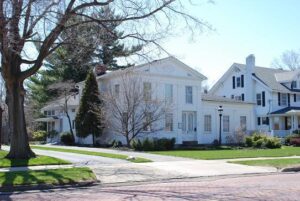
Among the fifty-four buildings that comprise the Mentor Avenue District are examples of Federal, Greek Revival, Early Romanesque Revival, Italianate, Second Empire, Queen Anne, and twentieth century eclectic styles. Renowned master builder Jonathan Goldsmith (1783-1847), whose Federal and Greek Revival designs define the so-called “Western Reserve” style, built at least two of these houses; the Denton-Powers House (ca. 1820) is representative. The Mentor Avenue District was added to the National Register of Historic Places in 1979. The Painesville City Hall, the Sessions House (157 Mentor Avenue) and the Smead House (187 Mentor Avenue) are also listed individually on the National Register.
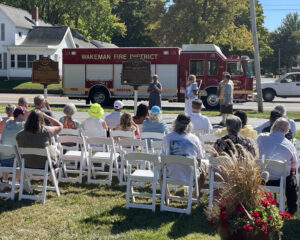
When inventor and entrepreneur Garrett Augustus Morgan sold his Traffic Signal patent to General Electric in 1923, he used the $40,000 to purchase a 121-acre farm in Huron County in 1924. Advertising “a village of our own,” Morgan established the Wakeman Country Club — one of Ohio’s early African American recreation clubs — and offered 247 lots for $60 each in “Wakeman Heights.” Located near the intersection of State Route 60 and Chenango Road, the development provided country pleasures to Blacks excluded from the Country Club lifestyle. Club membership, included in the purchase of a lot, offered fishing, hunting, swimming, and horseback riding. A restaurant, dance hall, and amphitheater provided cultural and boxing events. The club waned during World War II and no buildings from the once-thriving Wakeman Country Club remain.
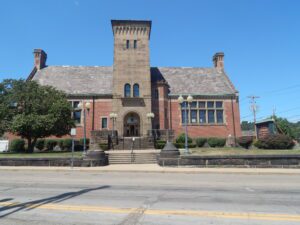
Andrew Carnegie was born in Dunfermline, Scotland. He immigrated to Allegheny City Pennsylvania with his family when he was 13. While operating the telegraphs for the Pennsylvania Railroad, Carnegie perceived the great need for steel in the railroad industry. With this insight, he founded the Carnegie Steel Corporation which operated for 35 years before he sold it to J.P. Morgan in 1901. Andrew Carnegie wrote the article, “Wealth” in 1889 in which he said that a responsible person of wealth should help his fellow man. Carnegie’s philanthropy provided 2,509 libraries throughout the world. Carnegie was already familiar with the city when he wrote a letter to offer funds to build the Steubenville library on June 30, 1899.(Continued on other side)
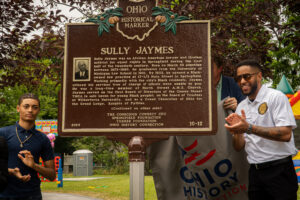
Sully Jaymes was an African American lawyer and tireless activist for equal rights in Springfield during the first half of the twentieth century. Born on March 30 sometime between 1875-1880, he graduated from the University of Michigan Law School in 1901. By 1903, he opened a Black-owned law practice at 17-1/2 Main Street in Springfield. Working primarily with the city’s Black residents, Jaymes offered his services free of charge if clients were unable to pay. He was a long-time member of North Street A.M.E. Church. Jaymes served on the first Board of Directors of the Center Street YMCA (a safe-haven for young Black people), on the Board of Trustees at Wilberforce University, and as a Grand Chancellor of Ohio for the Grand Lodge, Knights of Pythias. (Continued on other side)
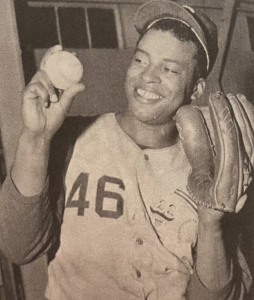
Ulysses Brooks Lawrence was born in Springfield on January 30, 1925. Nicknamed “The Bull,” he broke numerous color barriers throughout his baseball career. In 1976, Lawrence was the first Black player inducted into the Cincinnati Reds Hall of Fame. An all-around athlete at Springfield High School, Lawrence lettered in basketball, track, and football (the school’s first Black starting quarterback). After graduation in 1943, he was drafted into the U.S. Army and earned a Bronze Star in Guam during World War II. Lawrence enrolled at Ohio’s Miami University, becoming that school’s first Black baseball player (1947-1949), before signing with the Cleveland Indians. Acquired by the St. Louis Cardinals (1954), he was assigned to the Columbus Red Birds Triple-A farm team, breaking another team’s color barrier. (Continued on other side)
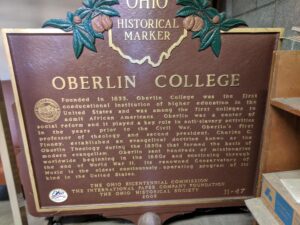
Founded in 1833, Oberlin College was the first coeducational institution of higher education in the United States and was among the first colleges to admit African Americans. Oberlin was a center of social reform and it played a key role in anti-slavery activities in the years prior to the Civil War. Oberlin’s first professor of theology and second president, Charles G. Finney, established an evangelical doctrine known as the Oberlin Theology during the 1850s that formed the basis of modern evangelism. Oberlin sent hundreds of missionaries worldwide beginning in the 1880s and continuing through the end of World War II. Its renowned Conservatory of Music is the oldest continuously operating program of its kind in the United States.
J.W. Denver Williams Jr. Park, 1100 Rombach Avenue
Wilmington
, OH
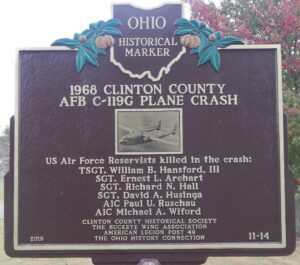
On August 9, 1968, a plane carrying 31 military passengers and crew members left the Clinton County Air Force Base for completion of an annual two-week active duty training held at Otis Air Force Base, Massachusetts. The transport was assigned to the 907th Tactical Airlift Group, 302nd Tactical Airlift Wing. Just after takeoff, the C-119G “Flying Boxcar” lost power, and the pilot attempted to return to the base. The plane crash-landed and caught fire on the Ottie Griffith Farm two miles from the base. Six reservists perished, and many passengers and rescuers were injured.