

, OH
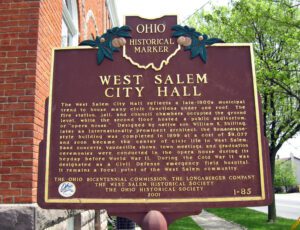
The West Salem City Hall reflects a late-1800s municipal trend to house many civic functions under one roof. The fire station, jail, and council chambers occupied the ground level, while the second floor hosted a public auditorium, or “opera house.” Designed by native son William K. Shilling, later an internationally prominent architect, the Romanesque-style building was completed in 1899 at a cost of $9,077 and soon became the center of civic life in West Salem. Band concerts, vaudeville shows, town meetings, and graduation ceremonies were conducted in the opera house during its heyday before World War II. During the Cold War it was designated as a Civil Defense emergency field hospital. It remains a focal point of the West Salem community.
, OH
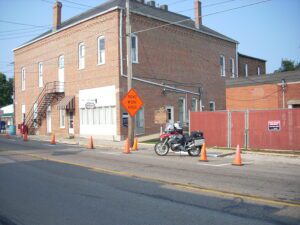
This building was a center of community life from the time of its construction in 1886 to the late 1930s. Once common, such combinations of governmental offices and commercial and entertainment space are today rare. The second floor opera house retains many original features, including stage backdrops, dressing rooms, and seats. Vaudeville, theater companies, and entertainment of all kinds were hosted here and many performers signed the backstage walls: Buffalo Bill dated his signature October 28, 1888. Along with village offices, first floor tenants have included the Vermillion Township Trustees, the Eddie Stover Hat Shop, and the F.L. Smith Watch Repair and Jewelry Store. Hayesville’s citizens approved the hall’s construction on April 18, 1884 by a vote of 100 to 13. Contractor Samuel Craig completed the building two years later at a cost of $4,852.20. Located on the Lincoln Highway, this building was listed on the National Register of Historic Places in 1976.
, OH
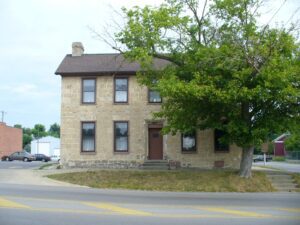
The Smith Tannery is the oldest original structure remaining in Greenfield. Built in 1821 by Revolutionary War veteran William Smith and his son Samuel, the tannery became a noted station on the fabled “Underground Railroad.” The structure, which also served as the family residence, was the birthplace of Dr. Samuel M. Smith, Surgeon General of Ohio during the Civil War, and Dr. William R. Smith, who personally notified Abraham Lincoln of his nomination to the presidency in 1864. The Smiths were active members of the Abolition Society of Paint Valley, which was established in 1833 in Greenfield and reorganized in 1836 as the Greenfield Anti-Slavery Society. In 1844, the Society assisted the efforts of Frederick Douglass, one of the nation’s leading abolitionists. The Society provided an important junction on the Underground Railroad, assisting many fugitive slaves to gain freedom, including, it is said, Eliza Jane Harris of Uncle Tom’s Cabin fame. The Smith Tannery was named to the National Register of Historic Places in 1978.
, OH
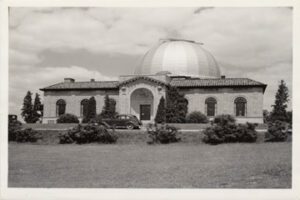
One-half mile east is the site of the former BIG EAR radio telescope. Designed by Dr. John D. Kraus, pioneering radio astronomer at Ohio State University, it had a collecting area of 340 by 70 feet (104 by 21 meters). The observatory was completed in 1963. The Ohio Sky Survey recorded here between 1965 and 1972 was the most accurate, reliable, and complete mapping of cosmic radio signals (the “radio sky”) for many years. BIG EAR gained fame for its ability to detect quasi-stellar radio sources, or “quasars,” and for its discovery of some of the most distant objects known. This observatory conducted a 24-year continuous search for evidence of extraterrestrial intelligence, during which the famous “Wow!” signal was received in 1977. BIG EAR was demolished in 1998. [“Wow!” signal graphic]
, OH
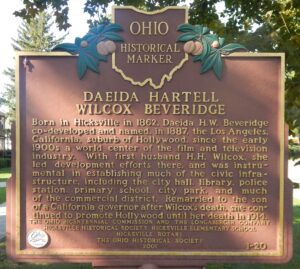
Born in Hicksville in 1862, Daeida H.W. Beveridge co-developed and named, in 1887, the Los Angeles, California, suburb of Hollywood, since the early 1900s a world center of the film and television industry. With first husband H.H. Wilcox, she led development efforts there, and was instrumental in establishing much of the civic infrastructure, including the city hall, library, police station, primary school, city park, and much of the commercial district. Remarried to the son of a California governor after Wilcox’s death, she continued to promote Hollywood until her death in 1914.
, OH
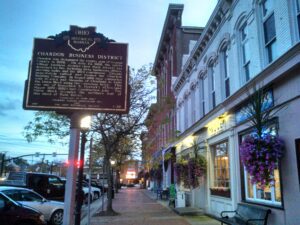
Chardon was designated the county seat of Geauga County in 1808. On July 25, 1868, the entire village business district (now Main Street) was destroyed by fire, including forty businesses, offices, meeting halls, and the 1824 courthouse. Citizens immediately rallied and formed the Chardon Building Company. In August 1868 they contracted with Herrick and Simmons of Cleveland to build the Union Block using fire-resistant brick. This was one of Rensselaer R. Herrick’s (Cleveland Mayor 1879-1882) last construction jobs. The Union Block occupies the northern half of this block of Main Street. (Continued on other side)
, OH
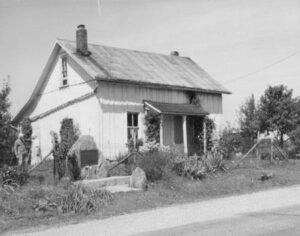
One of America’s best-known sport shooters and entertainers of the late 1800s, Annie Oakley was born Phoebe Ann Mosey (or Mozee) north of Versailles in Darke County in 1860. She achieved local fame for her shooting ability as a hunter while still in her teens. By 1885 Oakley was a star performer in Buffalo Bill’s Wild West. With husband and manager Frank Butler, she refined a shooting act and image that appealed to late 19th century notions of a romanticized but vanishing West. Throughout her 30-year performing career, Oakley provided honest entertainment in a deception-prone industry while demonstrating widening opportunities for women. She retained her Ohio ties throughout her life and is interred at Brock Cemetery, eleven miles north of Greenville.
, OH
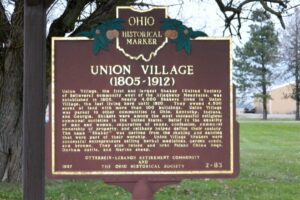
Union Village, the first and largest Shaker (United Society of Believers) community west of the Allegheny Mountains, was established in 1805. Nearly 4,000 Shakers lived in Union Village, the last living here until 1920. They owned 4,500 acres of land with more than 100 buildings. Union Village was parent to other communities in Ohio, Kentucky, Indiana, and Georgia. Shakers were among the most successful religious communal societies in the United States. Believe in equality of men and women, separation of sexes, confession, communal ownership of property, and celibacy helped define their society. The name “Shaker” was derived from the shaking and dancing that were part of their worship. Union Village Shakers were successful entrepreneurs selling herbal medicines, garden seeds, and brooms. They also raised and bred Poland China hogs, Durham cattle, and Merino sheep.