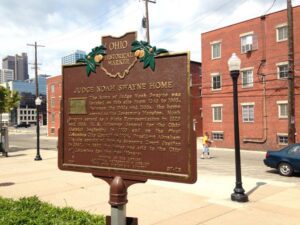
The first tax supported free public library in Columbus was formed in 1873 and housed in City Hall. In 1901, City Librarian John Pugh petitioned Andrew Carnegie for funding and was granted $200,000. In 1903, the Swayne home was razed and construction began. The library opened to the public on April 4, 1907. The library’s purpose is inscribed on the front of the building – Bibliotheca Fons Eruditionis: The library is a fountain of learning; Our Treasures Are Within; and Open To All.
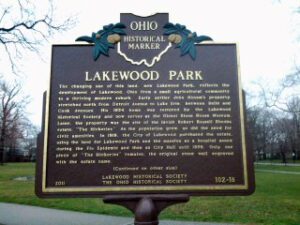
The changing use of this land, now Lakewood Park, reflects the development of Lakewood, Ohio from a small agricultural community to a thriving modern suburb. Early settler John Honam’s property stretched north from Detroit Avenue to Lake Erie, between Belle and Cook Avenues. His 1834 home was restored by the Lakewood Historical Society and now serves as the Oldest Stone House Museum. Later, the property was the site of the lavish Robert Russell Rhodes estate, “The Hickories.” As the population grew, so did the need for civic amenities. In 1919, the City of Lakewood purchased the estate, using the land for Lakewood Park and the mansion as a hospital annex during the Flu Epidemic and then as City Hall until 1959. Only one piece of “The Hickories” remains; the original stone wall engraved with the estate name.
United Colored American Cemetery is among the earliest in situ African American cemeteries in Hamilton County. The 11.6 acres in Madisonville were purchased by the United Colored American Association (UCAA) after the legislated closure of their earlier Avondale cemetery. Many Avondale burials and headstones were moved prior to the new cemetery’s dedication on May 30, 1883. Designed by Adolph Strauch, United Colored American Cemetery features the looping roads and picturesque elements typical of his designs at Spring Grove and Eden Park. After the dissolution of the UCAA, Cincinnati mayor Charles P. Taft asked Union Baptist Church to take ownership and maintenance of the cemetery. Union Baptist assumed ownership in 1968 and burials continued until 2019. United Colored American Cemetery was listed on the National Register of Historic Places in 2022.
NE of the intersection of W Broad Street and Marconi Blvd, along the Scioto River
Columbus
, OH
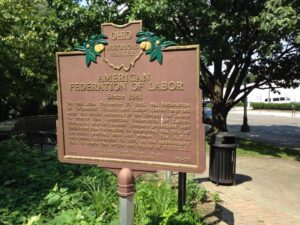
One this site, December 10, 1886, the Federation of Organized Trades and Labor Union merged with the trade unionists of the Knights of Labor to create the American Federation of Labor. Delegates elected Samuel Gompers president and dedicated the Federation to improving the life of America’s working men and women. The A.F.L. recognizes November 15, 1881, as its anniversary date to honor the origin and legacy of F.O.T.L.U.
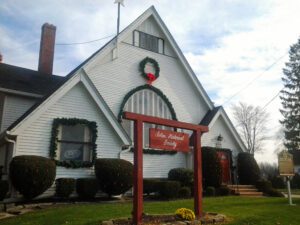
In 1845, the Disciples of Christ built the first of three churches to occupy this site. They built a second, larger structure, to replace the original in 1858. On August 6th, 1860, 29 year-old circuit minister Brother James A. Garfield, the future 20th President of the United States, was paid $250.00 to speak here every other Sunday for one year. An arsonist destroyed both the second church and the Solon Village Hall. Erected in 1899, this building replaced the second church and was occupied by the Disciples of Christ until 1920, when it merged with two local churches to establish the Federated Church of Solon. In 1951, the Pioneer Memorial Church split from the Federated Church to move into the abandoned Disciples Church, which they renovated. The City of Solon purchased the building in 1968, and it has since been the home of The Solon Historical Society.
Puritas Mineral Spring Company bottled and sold mineral water from the natural springs in the area. In 1894, the Cleveland and Berea Street Railway bought Puritas Springs and expanded the area into a picnic grove with a dance hall and pavilion to increase passenger traffic on the inter-urban line. Puritas Springs Park opened June 10, 1900- the first day the railways operated all the way to the entrance gates. John E. Gooding bought Puritas Springs in June 1915 and added and indoor roller rink, amusement rides, and the mighty Cyclone roller coaster. Labor Day 1958 the park closed, and on May 9, 1059 a fire destroyed many parts of the abondoned park.
“Uncle” George Lathrop Cooley (1861-1939) was known as the “Champion of the Farmer” for his advocacy on behalf of rural interests. He was born on a farm at the northwest corner of Dover and Hilliard Roads in Dover Township (Westlake). He attended area schools and Ohio Northern University and, in 1887, married Clara Hall. Cooley served as Dover Township trustee from 1901-1905 and as president of Dover’s village council in 1916. Cooley’s interest in better roads led him to supervise the hard-surfacing of Dover Center Road, which ran by his house. From about 1900 to 1913, he was involved in road construction and helped to organize state highway departments in Ohio, Louisiana and California. (Continued on other side)
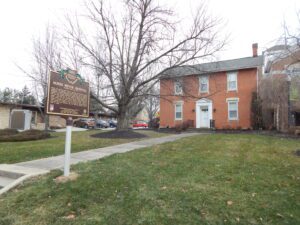
The house at this location, 110 South State Street, was the childhood home of Agnes Meyer Driscoll (1889-1971). Known as “the first lady of naval cryptology,” her career spanned from World War I to the Cold War. Driscoll attended Otterbein University before graduating from the Ohio State University, with majors in physics, math, music, and foreign languages. During World War I, she enlisted in the U.S. Navy as a chief yeoman, the highest rank possible for a woman at the time. After the war, Driscoll rose to become the chief civilian cryptanalyst for the U.S. Navy, breaking major Imperial Japanese Navy codes prior to World War II. (Continued on other side)