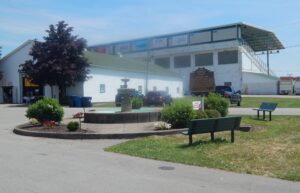
In 1846, the same year that Mahoning County was created, Ohio’s General Assembly passed an act “for the encouragement of agriculture.” An outgrowth of this legislation led to the founding of the Mahoning County Agricultural Society in April 1847. Boasting a membership of 170, the Society agreed to sponsor competitions for premiums to be distributed at an “annual fair and cattle show the next fall.” Canfield was the geographic center of the county and selected as the site for the first fair. In October, from the lawn of the First Congregational Church, Comptroller of the United State Treasury Elisha Whittlesey welcomed participants. Admission was one shilling (twelve and one half cents). The Village Green overflowed with exhibitions of prized livestock, harvests, plowing contests, and horse racing. Early fairs were one-day events attended primarily by gentlemen. However, the church provided a venue for ladies to display their handiwork. (continued on other side)
On March 5, 1817, Lieutenant Almon Gibbs, formerly of Army Lodge No. 24 at Fort Meigs, Perrysburg, formed Northern Light Lodge No. 40 “at Waynesfield” (now Maumee). Gibbs served as Worshipful Master, William Griffith as Senior Warden, and Charles Gunn, Junior Warden. The lodge was founded under a dispensation from Henry Brush, Ohio Grand Master and Captain of the Ohio Militia. Among many prominent early members was General James B. Steadman of Chickamauga fame. Almon Gibbs later became Maumee’s first postmaster and Justice of the Peace. [Masonic Symbol]
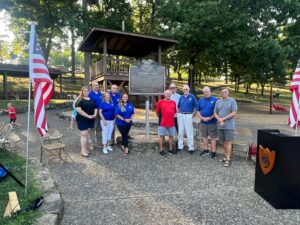
Tuscora Park, on land once owned by Jeremiah Reeves, opened as a private amusement park on June 1, 1907. Despite rain, the grand opening brought thousands of visitors to the park. Throughout the summer months, large crowds enjoyed such features as a swimming pool, sea wave, restaurant, dancing pavilion, and twice-daily free band concerts. The park also featured athletic facilities for running, tennis, baseball, and bowling. After Tuscora Park was sold in a November 1911 Sheriff’s sale, New Philadelphia’s City Council authorized its purchase along with additional surrounding acreage and received the deeds on June 21, 1912. Originally billed as the “Coney Island of Eastern Ohio,” Tuscora continues to operate as a city-owned park that draws both local residents and visitors to its picnic grounds, vintage rides, swimming pool, and athletic facilities. (Continued on other side)
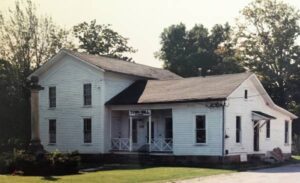
The Village of South Amherst incorporated in 1918. Mayor Fred Ruth and village’s council authorized a special election on February 22, 1919 so that the village could issue bonds to establish a town hall. The village used the funds to buy the house of Jeannette and Alexander Born. Purchased on September 3, 1919 for $3,750, the home-turned town hall served the village for 70 years. As the community grew and the building aged, the need for a new facility became clear. The old town hall was demolished and construction of a spacious $274,000 building begun in September 1988. The village’s government moved into its new 3,200 square-foot hall in February 1989.
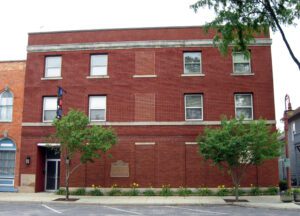
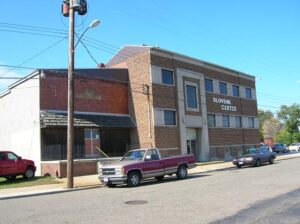
In 1918, early Slovene immigrants organized the Slovenian Independent Society Home and later constructed this hall, which became the center for Barberton Slovene cultural, social, and recreational activities. They formed dramatic and singing clubs, conducting performances in their native language. In the early twentieth century, prior to employers providing insurance or health care for their workers, the society acted to ensure sick and death benefits for its members. It also prepared members for citizenship in their newly chosen country. First generation Slovenes provided the labor that helped spur the growth of local industries while succeeding generations have continued to contribute to the community in various business, industrial, professional, and governmental capacities.
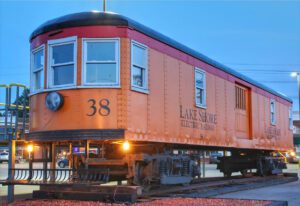
From the 1890s to the 1930s, interurban railways were an important form of travel in the Midwest. Beach Park Station had an interurban carhouse, where repairs were performed and passengers boarded. The Lorain & Cleveland Railway (L&C) built the 65½ by 200 foot brick station in 1897. By 1901, the L&C became part of the Lake Shore Electric Railway (LSE) and Beach Park became stop 65 on a line that ran from Cleveland to Toledo and then to Detroit. Requiring power and water, the LSE built an electric plant and water tower at Avon Lake. This infrastructure spurred the community’s development and growth. (Continued on other side
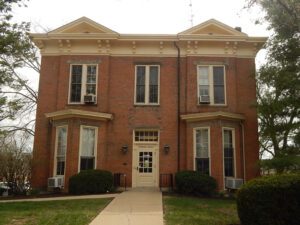
Built by “Old Miami” University President Robert L. Stanton, D.D. (1810-1885) as his private home and president’s office, Stanton’s 1868 Italianate house faced University Square, and welcomed students and guests. The house retains its original symmetrical façade, enclosed portal, grand staircase, double parlors, parlor doors, marbleized slate mantels, and triangular bay windows. Stanton served as president from 1866-1871. Stanton’s son, Robert Brewster Stanton, MU ’71, famed civil engineer, lived here as an undergraduate. His Miami mentor, mathematics professor Robert W. McFarland (1825-1910), purchased the house in 1873. McFarland rented it while distinguishing himself at Ohio State University during Miami’s twelve-year closure, and then resided here while first president of “New Miami” (1885-1888) and until his death. McFarland’s daughter Frances and her husband Llewellyn Bonham sold the home to Miami in 1940.
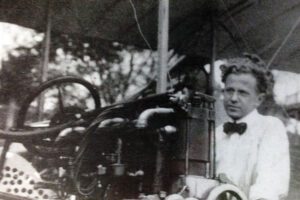
Ernest “Ernie” C. Hall, a pioneer of early flight who is widely recognized for his long career in aviation, was born near Warren, Ohio in 1890. A friend of the Wright brothers, Hall built his first powered airplane in 1909 and flew in 1911. He began his career as a civilian flight instructor in 1913, opening a flying school in Pennsylvania in 1915. During World War I, he transferred to Call Field in Wichita Falls, Texas, where he trained over 500 military pilots for combat. In 1922, Hall relocated his flight school to Warren, Ohio, where he taught until his death in 1972. His 1911 monoplanes have been displayed at the Smithsonian’s National Air & Space Museum in Washington D.C. and the National Museum of U.S. Air Force in Dayton, Ohio.