

, OH
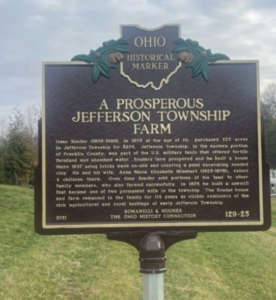
Isaac Souder (1809-1889), in 1835 at the age of 26, purchased 225 acres in Jefferson Township for $674. Jefferson Township, in the eastern portion of Franklin County, was part of the U.S. military lands that offered fertile farmland and abundant water. Souder’s farm prospered and he built a house there 1837 using bricks made on-site and creating a pond excavating needed clay. He and his wife, Anna Maria Elizabeth Minehart (1825-1878), raised 4 children there. Over time Souder sold portions of his land to other family members, who also farmed successfully. In 1874 he built a sawmill that became one of two permanent mills in the township. The Souder house and farm remained in the family for 114 years as visible reminders of the rich agricultural and rural heritage of early Jefferson Township.
, OH
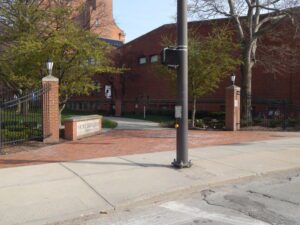
In 1886, Bishop Richard Gilmour (1824-1891) of the Roman Catholic diocese of Cleveland requested that the Jesuit superior of Buffalo establish a high school on Cleveland’s west side. The Jesuits, an order of the Roman Catholic Church founded by St. Ignatius Loyola in 1540, sought to establish schools that instilled a zeal for the Gospel and a love of learning. Under the leadership of Father Henry Behren, S.J. (1815-1895), the twentieth Jesuit secondary school in the United States opened in September 1886. Named Saint Ignatius College, the school grew from 76 students in 1886 to 490 in 1924. In 1924, the College split into two separate institutions: John Carroll University, which moved to University Heights in 1935, and Saint Ignatius High School, which remains on its original site. (Continued on other side)
, OH
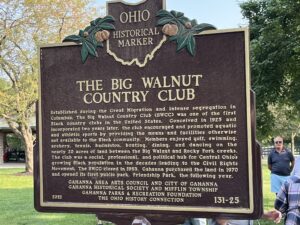
Established during the Great Migration and intense segregation in Columbus, The Big Walnut Country Club (BWCC) was one of the first Black country clubs in the United States. Conceived in 1925 and incorporated two years later, the club encouraged and promoted aquatic and athletic sports by providing the means and facilities otherwise not available to the Black community. Members enjoyed golf, swimming, archery, tennis, badminton, boating, dining, and dancing on the nearly 20 acres of land between the Big Walnut and Rocky Fork creeks. The club was a social, professional, and political hub for Central Ohio’s growing Black population in the decades leading to the Civil Rights Movement. The BWCC closed in 1963. Gahanna purchased the land in 1970 and opened its first public park, Friendship Park, the following year.
, OH
Bethel A.M.E. Church was the first African American church in Worthington. Black residents joined Worthington’s established churches as early as 1847 or worshipped together in their homes. Peter Banks with D.H. Taborn, Charles Kiner, J.T. Horton, and James Birkhead organized the A.M.E. congregation in 1896. Rapid growth moved their meetings to the Worthington Town Hall by 1897. A lot was purchased from Millie Alston on September 24, 1897, and a house relocated to serve as Bethel Chapel. Local carpenter Chester Hard constructed a new building that was dedicated as St. John A.M.E. in 1914. The church has served as the religious and social hub of Worthington’s Black community for more than a century. While St. John A.M.E. Church retains their original location, worship services moved to 7700 Crosswoods Drive in 2004.
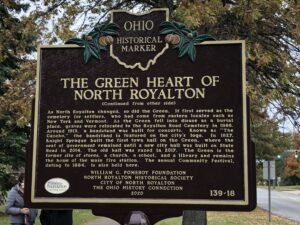
, OH
Bounded by Ridge, Royalton, and Bennett Roads, the Green has been the heart of North Royalton even before it was incorporated. Once part of Brecksville Township, Royalton became its own township in 1818. Local lore says that settlers David and Knight Sprague paid a gallon of whiskey to name the community after their hometown of Royalton, Vermont. In 1825, John Watkins sold five acres to create this Green, so that the township could have a cemetery, a public square, and a place for public buildings. In 1885, “North” was added to “Royalton” to distinguish it from another Royalton in Ohio. Formerly a small agricultural community known for milk and cheese production, as well as nurseries, North Royalton became a Cleveland suburb following World War II. North Royalton incorporated as a village in 1927 and became city in 1961. (Continued on other side)

, OH
The Greater Abyssinia Baptist Church (GABC) organized with 250 members on December 16, 1945, at a Phillis Wheatley Association meeting. Led by its first pastor, Rev. John Rollins Plummer, the congregation raised $47,000 to purchase the Jewish Synagogue at East 105th Street and Tacoma Avenue from the Beth Hamedrosh Hagodel Beth Israel Congregation in 1946. It later purchased a parsonage, land for parking, and created a Federal Credit Union. Tragically, Rev. Plummer was killed in a car accident on October 22, 1951. The church’s lower auditorium was remodeled and dedicated as J.R. Plummer Memorial Hall. Honoring its missionary and pastoral care foundations, the church built a $3M senior citizens complex nearby. An endowment fund, instituted by its pastor’s savings in 1995, ensures that this commitment to civic leadership endures.