

, OH
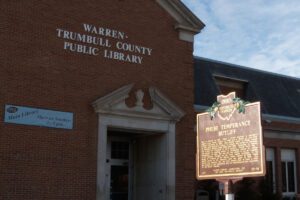
Born in Warren in 1859, Phebe T. Sutliff received a Bachelor’s degree from Vassar College in 1880 and a Master of Arts from Cornell University in 1890. Miss Sutliff taught at Hiram College in Ohio and Rockford College in Illinois and served as President of Rockford College from 1896 until 1901. Returning to Warren, she turned her attention to civic matters. During World War I, she started an evening school of citizenship classes for foreign immigrants. In 1924, she was the first woman to run for Congress in her district. Elected as the first woman president of the Board of Trustees of the Warren Public Library in 1938, Phebe Sutliff served in this capacity until her death in 1955. Miss Sutliff was inducted into the Ohio Women’s Hall of Fame in 1990. Her legacy to the community was the establishment and endowment of the Sutliff Museum.
, OH
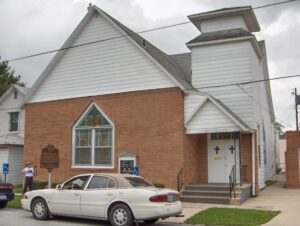
In spite of small numbers and being welcomed by the mostly white congregation of First Methodist Episcopal Church, African Americans in Findlay in the 1880s wanted to express their faith in ways that best reflected their freedoms and traditions. By the mid-1880s, the congregation was meeting in members’ homes and the Odd Fellows Hall, but began fund raising to build their own church in 1885. The congregation was admitted to the North Ohio Conference of the Third Episcopal District of the African Methodist Church in 1885, one of the first churches to be so admitted. The building on Liberty Street was well underway by the end of 1887 on a lot donated by Judge D. J. Cory. The original twenty foot by forty foot building cost $2,000 and immediately became a focal point for religion and social events for Findlay’s African American community. (Continued on other side)
, OH
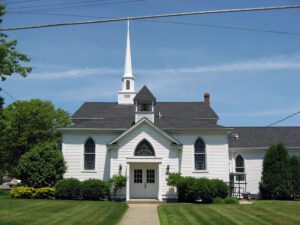
The Canfield Christian Church began as a Baptist congregation in 1822 and church met for worship in William Dean’s home. The Mahoning Baptist Association Meeting of 1826 was held in David Hayes barn. In 1827, Walter Scott was asked by the Association to be the first paid traveling evangelist in the Mahoning Valley area of Ohio. Scott accepted the offer and moved his family to a house next to the Canfield Church. By June of 1829, the Canfield Church voted to lay aside the Baptist name for the name Disciples of Christ. They believed all creeds were unnecessary and took the Bible alone as their sole rule of faith and practice. In 1847, a new church was built. Charter members of the church include James and Sarah Caldwell, Ann Winfield, Mr. and Mrs. Benjamin Caldwell and daughter, Mr. and Mrs. Andrew Flick, Mr. and Mrs. Walter Clark, Mr. and Mrs. John Flick, and Mr. and Mrs. Simmon Sackett and daughter. (Continued on other side)
, OH
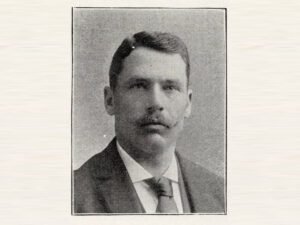
William Ellsworth “Dummy” Hoy was born in Houcktown on May 23, 1862. Although spinal meningitis as a toddler left him deaf and mute, Hoy became one of the great 19th century professional baseball players. He played centerfield for such teams as the Chicago White Stockings, Louisville Colonels, and Cincinnati Reds. In his 1888 Washington Senators season he led the league with 82 stolen bases and is one of the all-time leaders in that art. The defensive star’s record includes: 3,959 outfield putouts; 73 double plays; 2,054 hits; 40 home runs; 597 stolen bases; and, 210 strike-outs. Hoy is a member of the American Athletic Association for the Deaf Hall of Fame, as well as those of the Cincinnati Reds, Ohio Baseball, and Ohio School for the Deaf. He died in Cincinnati at the age of 99.
, OH
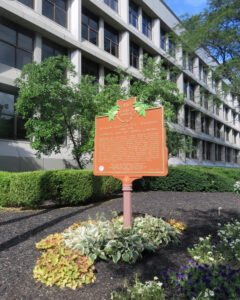
Industrialist and entrepreneur Franklin Augustus Seiberling (1859-1955) named his fledgling rubber goods manufacturing company “Goodyear” to honor Charles Goodyear, the man who invented the vulcanization process for curing rubber. Seiberling founded the company with his brother, Charles Willard, because of their desire to participate in an enterprise that afforded an “opportunity for invention.” Incorporated in 1898, Goodyear Tire and Rubber Company rapidly grew with the young automotive industry and helped establish Akron as the “Rubber Capital of the World.” Among Seiberling’s many significant inventions were the tire-making machine and the detachable wheel rim. He resigned from Goodyear in 1921 and went on to found the Seiberling Rubber Company. Stan Hywet Hall, F.A. Seiberling’s estate in west Akron, is a National Historic Landmark.
, OH
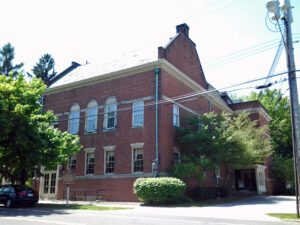
The Canfield WPA Memorial Building was constructed by the Works Progress Administration, a federal government program instituted by President Franklin D. Roosevelt as an effort to aid the United States in its recovery from the Great Depression of the late 1920s and 1930s. Local merchant Arron Weisner donated lands on the west side of Broad Street for the proposed project. A six member committee, comprised of two persons each representing the Argus Masonic Lodge, the American Legion, and the Village of Canfield, determined that the building be “a community building built around community projects.” Through local subscription and $60,000 in federal funds, the WPA project moved forward. The Youngstown architectural firm of W.H. Cook and W. Canfield designed the building in the Colonial Revival style. A ground breaking ceremony was held on December 20, 1935. During World War II, the United States government maintained offices in the building. (Continued on other side)
, OH
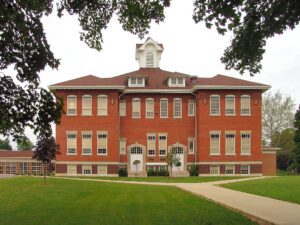
The first school in what is now Pataskala was a “subscription school” operated by Amariah Cubberly on the nearby banks of the South Fork of the Licking River in the 1820s. Subscription schools, which charged fees, were the forerunners of rural public schools in many parts of Ohio. By the 1830s several one-room public schools served the children of the area, but in 1870 the civic minded citizens of Pataskala provided a centralized building for grades one through twelve on Main Street, where the old Town Hall now stands. This school was moved to the new building on this site in 1908. When the Southwest Licking Local School District was established in 1953, Pataskala Elementary School continued in the building. Additions in 1968 and 2000 enhanced its educational capabilities. This 1908 Queen Anne architectural style building was listed on the National Register of Historical Places in 1983.
, OH
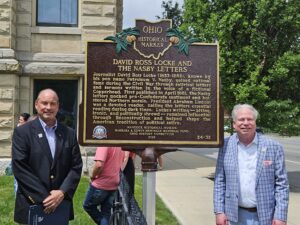
Journalist David Ross Locke (1833–1888), known by his pen name Petroleum V. Nasby, gained national fame during the Civil War through satirical letters and sermons written in the voice of a fictional Copperhead. First published in April 1861, the Nasby letters mocked pro-Confederate sentiment and bolstered Northern morale. President Abraham Lincoln was a devoted reader, calling the letters essential reading during dark times. Locke’s writing—biting, ironic, and politically shrewd—remained influential through Reconstruction and helped shape the American tradition of political satire.