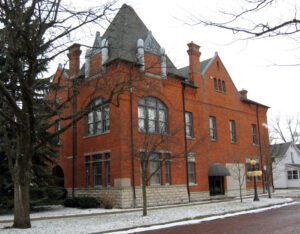
Completed in 1892 at the height of the region’s oil boom, the Pemberville Town Hall followed a late-1800s municipal trend to house many civic functions under one roof. The fire station, jail, and council chambers occupied the ground level, while the entire second floor hosted a public auditorium, or “opera house,” that seated 250. The 1897 debut of The Mikado featured new electric lighting. The ornate Opera House was the center of Pemberville’s social activities for decades, hosting dances, plays, socials, graduation ceremonies, political meetings, lectures, and husking bees. Traveling companies performed concerts, vaudeville, minstrel, and medicine shows. Following World War II the Opera House fell into disuse. It was restored in 1999 to both its former grandeur and its place in Pemberville’s cultural life.
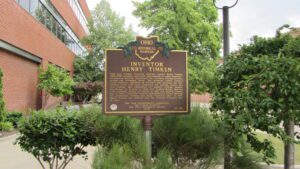
Born near Bremen, Germany, carriage builder Henry Timken (1831-1909) designed significant improvements in roller bearings–fundamental machine components that minimize friction between moving and stationary parts. His patented (1898) tapered roller bearings improved on standard ball bearings by controlling heavy side loads generated by steered axles, and thus became key components of modern vehicle design. Established in St. Louis in 1899, the Timken Roller Bearing Axle Company moved to Canton in 1901 and quickly became one of Ohio’s industrial leaders, manufacturing roller bearings for automotive, railroad and many industrial uses. In 1998, Henry Timken was inducted into the National Inventors Hall of Fame.
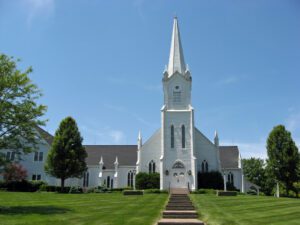
Aurora’s first church was established on December 31, 1809 under the guidance of the Connecticut Missionary Society. The congregation called the Rev. John Seward of Granby, Massachusetts to be the first minister in 1812. Built on land donated by Samuel Forward and dedicated in 1824, the original brick church was replaced by a wood-frame building in 1872. The First Congregational Church and the Aurora Disciples of Christ formed an association called the Federated Church in Aurora in 1913. These three entities merged to form The Church in Aurora in 1933, serving the community as more than a landmark.
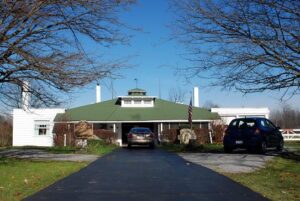
Southern Park Stables, at 126 Washington Boulevard in Boardman, was the private training stable of Attorney David Arrel and was built circa 1912 to house his standardbred horses racing at Southern Park Trotting Track one block south. The Stables is the last remaining structure of a large complex known as Southern Park, which included not only the racetrack and accompanying stables, grandstand, and outbuildings, but a dance hall, picnic pavilions, and baseball diamonds. The park was a favorite destination for Youngstown city residents wishing to relax in the country, and many company picnics were held here. Janie S. Jenkins has lived at Southern Park Stables since 1946 and deeded it and 8.33 acres to the Boardman Township Park District in 1993 with restrictions that it be forever preserved. The wrought iron gates at the driveway entrance were originally the main entrance gates for the racetrack.
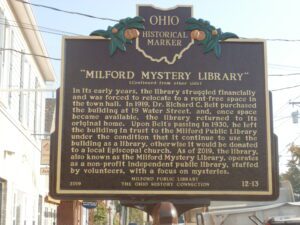
The Milford Public Library, Clermont County’s oldest continuously operating library, was founded in 1900 by a local civic organization, the Milford Village Improvement Society. It was preceded by a circulating library–one that charges patrons for renting books–that was chartered in 1822. At the time of the Milford Public Library’s founding, circulating libraries were in decline and public libraries were increasing in number as an inexpensive alternative. To obtain support for their proposed “reading room,” the Society’s Literary Committee travelled door-to-door, soliciting members and books. To become a member of the library, adults paid 25 cents and children paid 10 cents in annual dues. The library’s first–and current–home is the stone building at 19 Water Street. (Continued on other side)
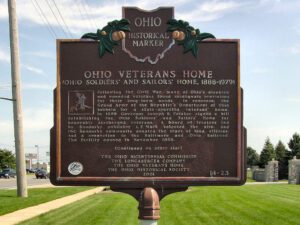
Following the Civil War, many of Ohio’s disabled and wounded veterans found inadequate provisions for their long-term needs. In response, the Grand Army of the Republic’s Department of Ohio lobbied for a state-operated veterans’ home. In 1886 Governor Joseph B. Foraker signed a bill establishing the Ohio Soldiers’ and Sailors’ Home for honorably discharged veterans. A board of trustees led by Sandusky publisher I.F. Mack selected the site, and the Sandusky community donated the tract of land, utilities, and a connection to the Baltimore and Ohio Railroad. The facility opened in November 1888. (continued on other side)
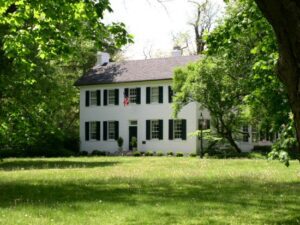
John Anderson Ward had this Federal style house constructed from 1823-1825 on land inherited from his father, Urbana’s founder Colonel William Ward. The Colonel’s will stipulated that a local mason use 26,500 bricks to build the house and be paid $80.00. The original house is thought to have had four rooms, two rooms each on the first and second floors and both divided by central hallways. John and his wife Eleanor Ward reared seven children in the house, two of whom became nationally recognized artists, John Quincy Adams Ward and Edgar Melville Ward. The farmstead, consisting of 172 acres, was also the site of a huge feast held in honor of General William Henry Harrison’s visit to Champaign County during his 1840 presidential campaign. Twelve 300 foot-long tables were spread across the lawn where thousands of people from the surrounding countryside dined on barbecued beef and lamb and drank barrels of cider.
In April 1797, a committee of Marietta citizens, led by General Rufus Putnam, met to establish an academy suitable for preparatory instruction for their youth. Muskingum Academy, completed late that year, became the first institution of its kind in the Northwest Territory, providing “classical instruction… in the higher branches of an English education.” Its first instructor was David Putnam, a 1793 Yale graduate. The building also served as the home of the Congregationalist Church until 1808. Growing and expanding with Ohio’s first city, the academy served Marietta’s educational needs for more than thirty years as the forerunner of Marietta College.