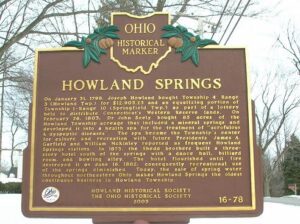
On January 31, 1798, Joseph Howland bought Township 4-Range 3 (Howland Twp.) for $12, 903.23 and an equalizing portion of Township 1-Range 10 (Springfield Twp.) as part of a lottery held to distribute Connecticut’s Western Reserve lands. On February 26, 1803, Dr. John Seely bought 85 acres of the Howland Township acreage that included a mineral springs and developed it into a health spa for the treatment of “scrofulous & dyspeptic diseases”. The spa became the Township’s center for culture and recreation with future Presidents James A. Garfield and William McKinley reported as frequent Howland Springs visitors. In 1873, the Shedd brothers built a three-story hotel south of the springs with a dance hall, billiard room, and bowling alley. The hotel flourished until fire destroyed it on June 16, 1882; consequently recreational use of the springs diminished. Today, the sale of spring water throughout northeastern Ohio makes Howland Springs the oldest continuous business in Howland Township.
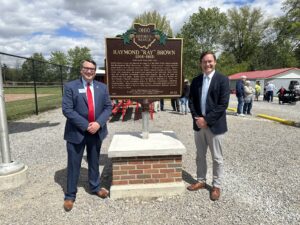
Raymond “Ray” Brown was a star in the Negro Leagues 1930-1948. Born in Alger on February 23, 1908, Brown graduated from Alger High School in 1926. He made his professional baseball debut playing for the Dayton Marcos in 1930. Brief stints with the Indianapolis ABCs and Detroit Wolves followed. In 1932, Brown joined Pittsburgh’s Homestead Grays mid-season and became a mainstay of their pitching staff for the next fourteen years. Utilizing a devastating curveball, he led the Grays to eight Negro National League pennants in a nine-year span (1937-1945). In 1938, he won the pitching triple crown and lead the league in wins, earned run average, and strikeouts. When the Negro League World Series was re-instituted in 1942, Brown’s team competed four straight years, winning twice. (Continued on other side)
Joseph Carter Corbin’s work in the Reconstruction-era south after the Civil War created many educational opportunities for African Americans. Corbin (1833-1911) was a professor, administrator, journalist, linguist, and musician. Born in Chillicothe, Ohio to free African American parents, he earned his bachelor’s degree and two masters’ degrees from Ohio University, in 1853, 1856, and 1889, respectively. In 1872, Corbin and his wife Mary moved to Arkansas where he served as the state superintendent of public education. In 1875, Corbin was appointed principal of Branch Normal College, which became the University of Arkansas at Pine Bluff. In 1898, he co-founded and became president of the Arkansas Teachers Association. He was also a leader in the Prince Hall Masons, an African American Masonic order. He served as a secretary and Grand Master of the lodge’s Arkansas chapter.
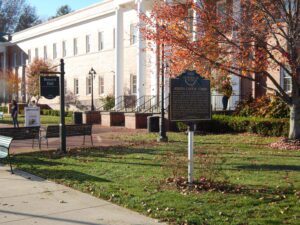
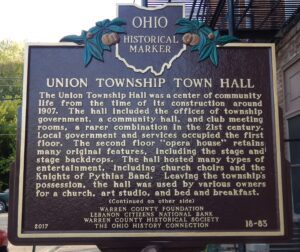
The Union Township Hall was a center of community life from the time of its construction around 1907. The hall included the offices of township government, a community hall, and club meeting rooms, a rarer combination in the 21st century. Local government and services occupied the first floor. The second floor “opera house” retains many original features, including the stage and stage backdrops. The hall hosted many types of entertainment, including church choirs and the Knights of Pythias Band. Leaving the township’s possession, the hall was used by various owners for a church, art studio, and bed and breakfast.(Continued on other side)
Garbry Conference Center and Learning Center, US 36
Piqua
, OH
J. Scott Garbry, a 1986 inductee into the Ohio Conservation Hall of Fame, had a lifelong commitment and passion for conservation, historic preservation, and education. His gift of land and artifacts to the Upper Valley JVS led to the creation of the Willowbrook Environmental Education Center and Garbry Museum. He was also instrumental in providing land for the site of the Piqua High School and for Garbry Woods of the Miami County Park District. These gifts make it possible to appreciate and experience Ohio’s natural and historic heritage.
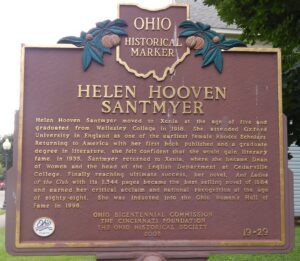
Helen Hooven Santmyer moved to Xenia at the age of five and graduated from Wellesley College in 1918. She attended Oxford University in England as one of the earliest female Rhodes Scholars. Returning to America with her first book published and a graduate degree in literature, she felt confident that she would gain literary fame. In 1935, Santmyer returned to Xenia, where she became Dean of Women and the head of the English Department at Cedarville College. Finally reaching ultimate success, her novel, And Ladies of the Club with its 1,344 pages became the best selling novel of 1984 and earned her critical acclaim and national recognition at the age of eighty-eight. She was inducted into the Ohio Women’s Hall of Fame in 1996.
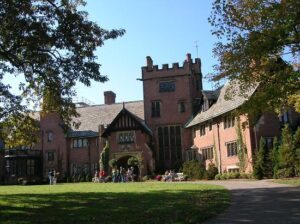
The former “country estate” of the Frank A. Seiberling family, Stan Hywet Hall is one of the finest examples of Tudor Revival architecture in the United States. “F.A.” Seiberling (1859-1955) co-founded the Goodyear Tire & Rubber Company in 1898 and later the Seiberling Rubber Company, thus greatly contributing to Akron’s distinction as “The Rubber Capital of the World.” Built between 1912 and 1915, The 65-room Manor House and service buildings are situated on more than 70 acres of restored historic gardens and wooded landscapes, all reflecting the Seiberlings’ tastes in the decorative and cultural arts. Stan Hywet Hall and Gardens was listed on the National Register of Historic Places in 1975 and designated a National Historic Landmark in 1982.
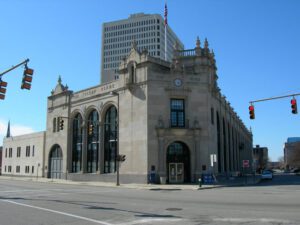
The Toledo Blade is the city’s oldest continuing business. The newspaper was first published on December 19, 1835, during the Ohio-Michigan boundary dispute known as the “Toledo War.” The name is derived from that conflict and the famous swords of Toledo, Spain. A copy of the first edition and two gift swords from that Spanish city are displayed inside the Blade Building.