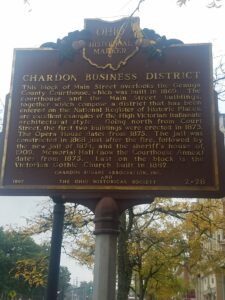
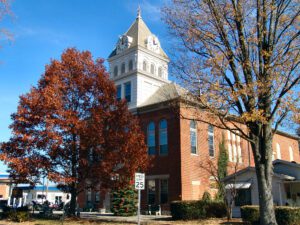
This block of Main Street overlooks the Geauga County Courthouse, which was built in 1869. The courthouse and the Main Street buildings, together which compose a district that has been entered on the National Register of Historic Places, are excellent examples of the High Victorian Italianate architectural style. Going north from Court Street, the first two buildings were erected in 1873. The Opera House dates from 1875. The jail was constructed in 1868 just after the fire, followed by the new jail of 1874, and the sheriff’s house of 1909. Memorial Hall (now the Courthouse Annex) dates from 1875. Last on the block is the Victorian Gothic Church built in 1882.
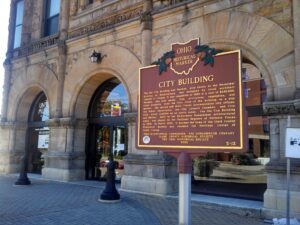
The Old City Building and Market, also known as the Municipal Building or Marketplace, was designed by local architect Charles A. Cregar. It was completed in 1890 at a cost of $250,000. Vendors, who sold meats, fish, provisions, vegetables, and other products, used the first floor of the building as a city market. The second and third floors accommodated city offices, the police department, the City Council Chamber, and City Hall, which doubled as an opera house. The Old City Building and Market, built in the Richardson Romanesque architectural style, was placed on the National Register of Historic Places in 1973. In March 2001, it became the home of the Clark County Historical Society and renamed the Heritage Center of Clark County.
As a member of the Connecticut Land Company, Judge Samuel Hinckley of North Hampton, Massachusetts purchased township 4N Range 13W of the Western Reserve in 1795 for a sum equivalent to 23 cents an acre. The township remained unsettled until Abraham Freeze was commissioned by Judge Hinckley in 1819 to survey the township into 100 plots of 160 acres each. In return for having the township, founded in 1825, named “Hinckley,” the judge gave land for two burying grounds and one-half acre for a public square. In 1919, upon the 101st anniversary of the “Great Hinckley Hunt,” where men from surrounding counties gathered on Christmas Eve to rid the township of wild animals, Judge Amos Webber spoke for the deceased Judge Hinckley: “When I last saw this country, it was a howling wilderness – by industry and frugality you and your ancestors have made these ever lasting hills and pleasant valleys blossom as the rose.”
Described as a Columbus “institution” when he died in 1969, Emerson C. Burkhart was born on a farm in Union Township, Putnam County in 1905. The son of Albert and Nora Burkhart, Emerson graduated from Kalida High School in 1924 and from Ohio Wesleyan University in 1927. After studying art in Provincetown, Massachusetts and in New York City, he settled in Columbus and, in 1937, married Mary Ann Martin, an artists’ model who devoted herself to his career. Burkhart was a prolific painter and completed an estimated 3,000 pictures during his 40-year career, including street scenes, rural landscapes, and more than 250 self-portraits, once noting his face was “cheaper than a model’s and always there.”
The Richwood Opera House and Town Hall was erected in 1890 as a community center designed to house the town council chambers, fire department, jail and opera house. The Richardsonian Romanesque styled building served Richwood in all these capacities for nearly 75 years. The Opera House was the site of minstrel shows, concerts, movies, lecture courses, revivals, farmers’ institutes, commencements, and community meetings. The second floor gymnasium was used for a men’s independent basketball league, dance classes, and as a teen center after World War II. Construction of an interurban railway running between Richwood and the resort town of Magnetic Springs in 1906 provided an expanded audience for the Opera House. (continued on other side)
The West Liberty area, in the Mad River Valley, was the location of at least seven Shawnee Indian villages. This elevated site was the location of one of those villages. Several septs or divisions of the Shawnee nation lived in this area after being forced from their homes in southern Ohio. In 1786, together with Simon Kenton, Colonel Benjamin Logan’s army destroyed all the Shawnee villages in retaliation for the Indian raids in southern Ohio and Kentucky. Consequently, the remaining Shawnees moved to northwest Ohio near the present-day site of Maumee.
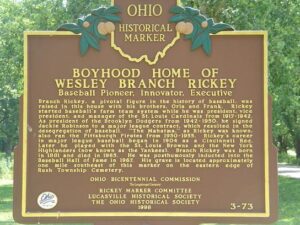
Branch Rickey, a pivotal figure in the history of baseball, was raised in this house with his brothers, Orla and Frank. Rickey started baseball’s farm team system while he was president, vice president, and manager of the St. Louis Cardinals from 1917-1942. As president of the Brooklyn Dodgers from 1942-1950, he signed Jackie Robinson to a major league contract, which resulted in the desegregation of baseball. “The Mahatma,” as Rickey was known, also ran the Pittsburgh Pirates from 1950-1955. Rickey’s career in major league baseball began in 1904 as a Cincinnati Red. Later he played with the St. Louis Browns and the New York Highlanders (now known as the Yankees). Branch Rickey was born in 1881 and died in 1965. He was posthumously inducted into the Baseball Hall of Fame in 1967. His grave is located approximately one mile southeast of this marker on the eastern edge of Rush Township Cemetery.
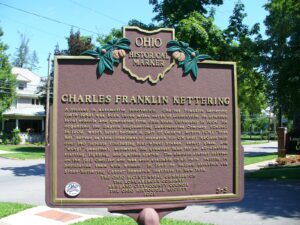
A pioneer in automotive innovation, Charles Franklin Kettering (1876-1958) was born three miles north of Loudonville. He attended local schools and graduated from Ohio State University in 1904. He organized the Dayton Engineering Laboratories Company (Delco) in 1909, which later became a part of General Motors (GM). “Boss Ket” served as vice-president of research for GM until 1920 and held over 140 patents (including four-wheel brakes, safety glass, and “ethyl” gasoline), achieving his greatest fame for an all-electric starting, lighting, and ignition system. The electric starter debuted on the 1912 Cadillac and was soon available on all cars, helping to popularize them with women. In 1945 he helped establish the Sloan-Kettering Cancer Research Institute in New York.