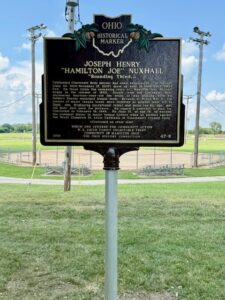
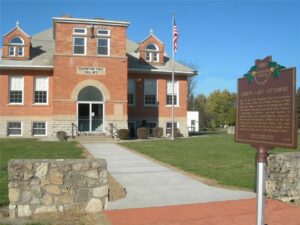
Celebrated Cincinnati Reds pitcher and radio broadcaster, Joe Nuxhall (July 30, 1928 – November 15, 2007) grew up here in Hamilton’s North End. On these fields the endearing story of “Hamilton Joe” Nuxhall began in the summer of 1943. Scouts from the Cincinnati Reds discovered fourteen-year-old Joe while he was playing with his father’s Sunday municipal league team. Because of World War II, the rosters of major league teams were depleted as players went off to fight. Joe, displaying exceptional talent and poise for his age, met the Reds’ dire need for pitchers. He signed a contract to play for Cincinnati on February 18, 1944. On June 10, at age 15, he became the youngest player in major league history when he pitched against the World Champion St. Louis Cardinals at Cincinnati’s Crosley Field. (Continued on other side)
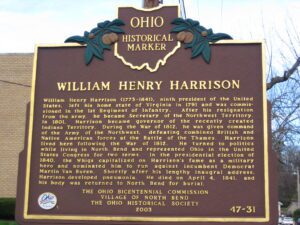
William Henry Harrison (1773-1841), ninth president of the United States, left his home state of Virginia in 1791 and was commissioned in the 1st Regiment of Infantry. After his resignation from the army, he became Secretary of the Northwest Territory. In 1801, Harrison became governor of the recently created Indiana Territory. During the War of 1812, he was given command of the Army of the Northwest, defeating combined British and Native American forces at the Battle of the Thames. Harrison lived here following the War of 1812. He turned to politics while living in North Bend and represented Ohio in the United States Congress for two terms. In the presidential election of 1840, the Whigs capitalized on Harrison’s fame as a military hero and nominated him to run against incumbent Democrat Martin Van Buren. Shortly after his lengthy inaugural address, Harrison developed pneumonia. He died on April 4, 1841, and his body was returned to North Bend for burial.
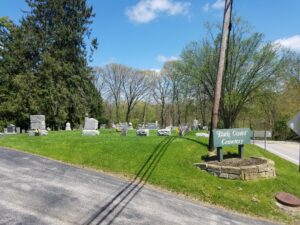
Settlers from New England purchased this land in 1817 for use as a burying ground and to build a meeting house. Located in the center of Bath Township, a part of the Connecticut Western Reserve, the site provided a convenient place for public and religious gatherings and for a cemetery. Out of need, the cemetery was established before the township was founded in 1818. Many of Bath Township’s farming families, as well as both owners and operators of businesses of Bath, are interred in the cemetery. In a tradition originating with Civil War veteran Perry Alexander, the graves of all veterans are marked with an American flag on Memorial Day as a tribute to their service.
Intersection of DiFranco Boulevard and E. Schaaf Road
Brooklyn Heights
, OH
With its favorable seasons and fertile soils, the northern Ohio frontier attracted settlers to the Western Reserve from the beginning of the nineteenth century. With a well-established agricultural heritage, “truck farming” became popular as wagons hauled produce to stands at the Central Market on Public Square in Cleveland around 1860. Thirty years later, to extend the growing season, Martin Ruetenik, who was inducted into the Ohio Agricultural Hall of Fame, introduced the concept of greenhouse growing by constructing a 550-square foot greenhouse. Following his lead, nearly every farmer along Schaaf Road became a greenhouse farmer making Brooklyn Heights one of the leading greenhouse areas in the United States with over 4 million square feet or 100 acres “under glass.” With its concentration of greenhouse farming, Brooklyn Heights became synonymous with fine, high quality, greenhouse tomatoes.
Here in the Oak Openings Region of northwest Ohio, some of the last Ottawa villages in Ohio lined the banks of Swan Creek during the 1830s. These Native Americans were led by Chief Ottokee (Autokee), a descendant of Pontiac, and half brother to another Ottawa Chief named Wauseon. Known for being honest and friendly, Ottokee was the last Ottawa chief in the Maumee Valley, for years refusing to go when the last of his people were removed to lands west of the Mississippi River.
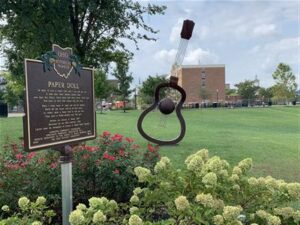
John Stewart Black (1891-1936) was a Vaudeville performer and songwriter who penned the classic “Paper Doll.” He is also remembered for “Dardanella,” which he called his “gift to the musical world.” “Dardanella”, recorded by the Ben Selvin Novelty Orchestra, debuted in 1919 and is believed to have sold more than five million copies. In 1942, the Piqua-born Mills Brothers recorded Black’s tune “Paper Doll.” It sold over 6 million records, was number one on the Billboard charts for twelve weeks in 1943 and became one of the most memorable records of the World War II era. Many artists, including Frank Sinatra and Bing Crosby, recorded “Paper Doll” and the song was inducted into the Grammy Hall of Fame in 1998.
Toledo State Hospital opened in January 1888 as the Toledo Asylum for the Insane. Originally located immediately south of this cemetery, the hospital was designed to function as a self-contained community for 650 people. Patients lived in large cottages, surrounded by a post office, church, library, male and female hospital, strong wards, bakery, and dining hall. People were admitted with mild to severe forms of mental illness, and a variety of other disabling conditions, including developmental, medical or neurological, as well as for addictions, injuries, and old age. Work became a form of treatment, with patients involved in construction, farming, laundry, and other jobs to help maintain the hospital. Patients could also participate in recreational activities from gardening to playing in the hospital band. The State Hospital became home for many, as hospitalization could last a lifetime, often spanning decades. (continued on other side)
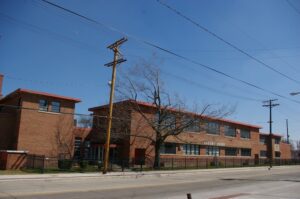
Karamu House, Incorporated was established in 1915 as the Playhouse Settlement, one of Cleveland’s many settlement houses for migrant and immigrant communities. Initiated by the Men’s Club of the Second Presbyterian Church, in 1915 Oberlin College and University of Chicago social work graduates, Russell and Rowena Woodham Jellliffe were hired as the founding directors. Originally located at 2239 East 38th Street, the Playhouse Settlement offered children’s theater and other social, recreational, and educational activities. It soon developed a partnership with the Dumas Dramatic Club, a local African American theater company that later became known as the Gilpin Players. (continued on other side)