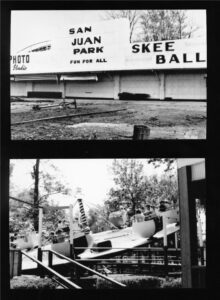
Nicknamed “Ohio’s Million Dollar Playground” or “Atlantic City of the Midwest,” Sandy Beach Amusement Park opened here on May 29, 1924. The park at Indian Lake featured a 2,000-foot long roller coaster and other popular rides, a boardwalk, and the Minnewawa Dance Hall. The Minnewawa and its succeeding dance pavilions hosted the greatest names of the Big Band era, and thousands of people came from all over Ohio to listen and dance to these popular entertainers. Societal turmoil and rioting in the 1960s affected the popularity of the park. Diminishing crowds, plus competition from larger theme parks such as Cedar Point and Kings Island, led to the park closing in the early 1970s. The lone remnant of the park is the steel arch bridge that spans the harbor.
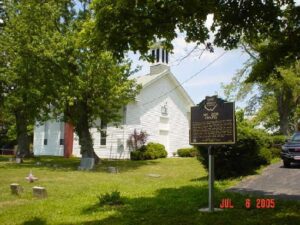
The Mount Zion Chapel of the Christian Church was built in 1872 on this hill adjacent to the members’ cemetery outside of Clermontville. The site was part of a two-acre parcel that had been secured from the farm of William R. Clark, Sr. for church and cemetery purposes. The Mount Zion Chapel replaced the Boat Run Christian Church that was organized in 1842 by a sect called the Christians, or the New Lights. Their first meeting house in Clermontville was dedicated on June 4, 1843 and damaged by floods in 1871. Worship was first held in the new frame church with the new name on October 6, 1872 and the church remains active today.
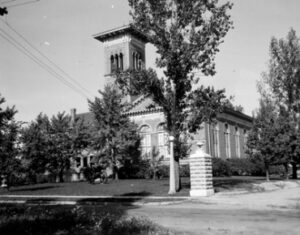
At the turn of the twentieth century, increased enrollment in the Combined Normal and Industrial Department at Wilberforce University (which later became Central State University) spurred construction of new teaching and dormitory facilities. Galloway Hall, which included an auditorium and a tower with chimes and a clock, was completed in 1906. Many famous personalities performed in Galloway Hall’s auditorium, including the renown opera singer Leontyne Price; Robert McFerrin, the first African American male lead with the New York Metropolitan Opera; actors Ruby Dee and Ossie Davis; comedian and civil rights activist Dick Gregory; and composer and conductor Duke Ellington. Noted authors and intellectuals addressed audiences there, including historian John Hope Franklin; writer, poet, actor, and playwright Maya Angelou; Lerone Bennett, author, historian, and editor of EBONY Magazine; and writer and essayist James Baldwin. (continued on other side)
SW Corner of Sunbury Square near S. Columbus St & E. Granville St.
Sunbury
, OH
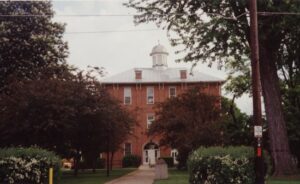
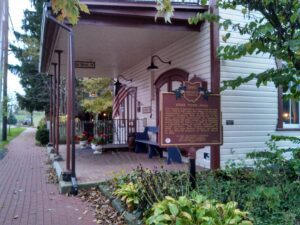
When Sunbury was platted in 1816, a town square was set aside for public use with the intention of constructing a town hall on the site. The first two stories of the Town Hall were built, as a school, in 1868 for $5,000. The Masons added the third story for $1,500 and occupied it for 91 years, until a lodge was constructed. Since 1868, the Town Hall has served Sunbury as a village office building, jail, fire station, and community library. Church services as well as Farmer’s Institutes were held in the building, and at one time it housed a bank. In 2002, the Town Hall was renovated for use as a community room and village offices.
The Society of Separatists of Zoar built the Zoar Town Hall in 1887 when the village was formally incorporated. Established in 1817 by German religious dissidents, Zoar became one of the most successful experiments in communal living during the 19th century. Early hardships encouraged the Zoarites, in 1819, to establish a communal system to ensure economic and social security. The Society disbanded in 1898. The Zoar Historic District was added to the National Register of Historic Places in 1969.
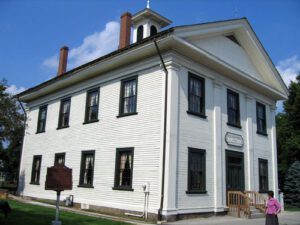
The Village of Tallmadge was founded in 1807. The first Academy building was erected in 1815. The first home of the Academy was located on the second floor of this Town Hall, which was erected in 1859. The Academy served students from northeast Ohio, who desired advanced courses not offered by local school systems, until 1876.
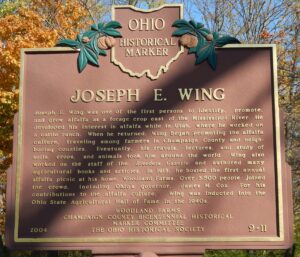
Joseph E. Wing was one of the first persons to identify, promote, and grow alfalfa as a forage crop east of the Mississippi River. He developed his interest in alfalfa while in Utah, where he worked on a cattle ranch. When he returned, Wing began promoting the alfalfa culture, traveling among farmers in Champaign County and neighboring counties. Eventually, his travels, lectures, and study of soils, crops, and animals took him around the world. Wing also worked on the staff of the Breeders Gazette and authored many agricultural books and articles. In 1913, he hosted the first annual alfalfa picnic at his home, Woodland Farms. Over 3,500 people joined the crowd, including Ohio’s governor, James M. Cox. For his contributions to the alfalfa culture, Wing was inducted into the Ohio State Agricultural Hall of Fame in the 1940s.
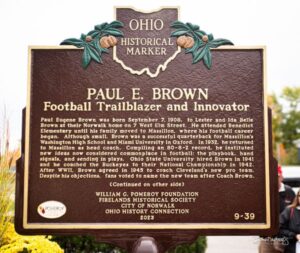
Paul Eugene Brown was born September 7, 1908, to Lester and Ida Belle Brown at their Norwalk home on 7 West Elm Street. He attended Benedict Elementary until his family moved to Massillon, where his football career began. Although small, Brown was a successful quarterback for Massillon’s Washington High School and Miami University in Oxford. In 1932, he returned to Massillon as head coach. Compiling an 80-8-2 record, he instituted new ideas now considered commonplace in football: the playbook, hand signals, and sending in plays. Ohio State University hired Brown in 1941 and he coached the Buckeyes to their National Championship in 1942. After WWII, Brown agreed in 1945 to coach Cleveland’s new pro team. Despite his objections, fans voted to name the new team after Coach Brown. (Continued on other side)