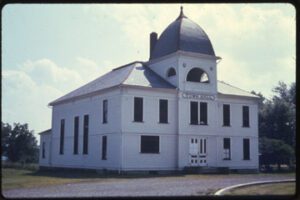
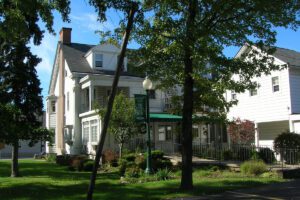
Major buildings dating from 1832 to 1898 surround the village green, the geographic center of Gustavus Township. Built in 1832 on the northwest quadrant, the George Hezlep House features Federal-Greek Revival architecture and has a closet reputedly used on the Underground Railroad. Built in 1840, the Farmers’ Exchange Store was originally a double entrance Greek Revival structure. The Storekeeper’s House, also a Greek Revival structure, was built next to the exchange store in 1840. South of this house is the Fraternal Hall, built in 1870. There were once four churches in Gustavus including the Methodist Church, built in 1856 with a temple front and a belfry, and the Congregational Church, built east of the center in 1854. The eclectic Town Hall was built in 1890 and fronts the southeast quadrant. The Gustavus Centralized School, reported as the first centralized school in the United States, was built in 1898 and was replaced by the current building in 1928.
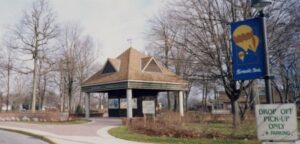
One of the earliest and largest amusement parks in Northwest Ohio dedicated in 1906 on site of old waterworks. Trains brought visitors from as far away as Cleveland. 1907: Dance Pavilion and 2,000 seat auditorium built. 1908: Bathing beach made in old reservoir. 1925: Green Mill Dance Hall built on side near dam. Big name bands highlight entertainment. 1936: Shelters, band shell, and pool bath house made from bricks of old waterworks. 1978: Renovation of waterfront begins new era.
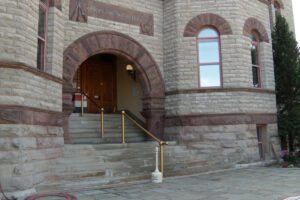
Following the Civil War, many of Ohio’s disabled and wounded veterans found inadequate provisions for their long-term needs. In response, the Grand Army of the Republic’s Department of Ohio lobbied for a state-operated veterans’ home. In 1886 Governor Joseph B. Foraker signed a bill establishing the Ohio Soldiers’ and Sailors’ Home for honorably discharged veterans. A board of trustees led by Sandusky publisher I.F. Mack selected the site, and the Sandusky community donated the tract of land, utilities, and a connection to the Baltimore and Ohio Railroad. The facility opened in November 1888. (continued on other side)
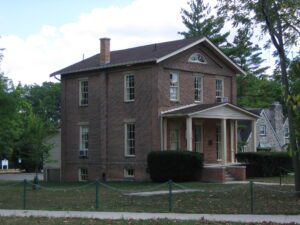
Reverend Lorenzo Langstroth, renowned as “The Father of American Beekeeping,” lived in this simple two-story, eight-room house with his wife, Anne, and their three children from 1858 to 1887. Unchanged externally, the Greek Revival cottage features brick pilasters and pediments and a fan-shaped front window. In his garden workshop, Langstroth made experimental beehives, established an apiary, and on the ten acres that surrounded his home, grew buckwheat, clover, an apple orchard, and a “honey garden” of flowers. He imported Italian queen bees in efforts to improve native bees and shipped his queens to keepers across the United States and around the world. The Langstroth Cottage was placed on the National Register of Historic Places in 1976 and designated a National Historic Landmark in 1982. (Continued from other side)
Monteith Hall was built in 1835 as the residence of Reverend John Monteith (1788-1868) and family. Before coming to Elyria as the first superintendent of the new high school, Rev. Monteith was an educator and minister in Detroit, Michigan. He was instrumental in founding the University of Michigan, originally located in Detroit, and became its first president. William Gates, Rev. Monteith’s grandson, enlarged Monteith Hall in 1897. Monteith Hall was a station on the Underground Railroad on the route that extended from Oberlin. A tunnel, which ran from the basement of the home to the Black River, was used to help slaves escape to the shore of Lake Erie. Rev. Monteith managed the network on the southern shore of Lake Erie, and aided fugitive slaves in boarding ships to cross the lake to Canada.
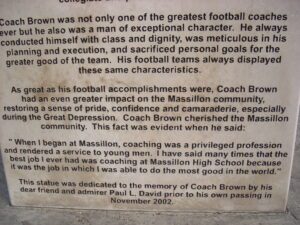
Paul E. Brown, born September 7, 1908 in Norwalk, Ohio, and raised in Massillon, is a member of the Professional Football Hall of Fame and was one of the greatest coaches in the history of football at all levels. From 1932 until 1940, he led Massillon High School to a record of 80-8-2. He coached Ohio State to the 1942 national collegiate championship, and joined the professional football ranks in 1946 as coach of the new franchise in Cleveland. He coached his namesake Cleveland Browns to seven league championships in 17 seasons.
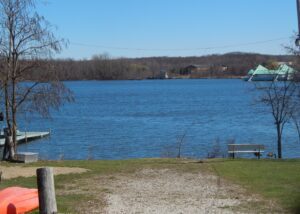
Geauga Lake, a scenic destination for visitors to northeast Ohio, was initially named “Giles Pond” after settler Sullivan Giles (1809-1880). In 1856, the predecessor of the Erie Railroad stopped at “Pond Station,” spurring the area’s growth. In the 1880s, locals established picnic grounds, a dance hall, and other facilities for those seeking a country getaway. Picnic Lake Park, later Geauga Lake Park, opened in 1887 and thereafter offered rides, a roller rink, photo gallery, billiard hall and bowling alley, among other attractions. In 1888, the Kent House hotel opened on the southeast side of the lake. In the century that followed, more attractions were added, including SeaWorld of Ohio, and the park expanded. In 2007, the melodic sounds of the carousel and the echoing screams from the “Big Dipper” roller coaster ceased when the park closed. (Continued on other side)
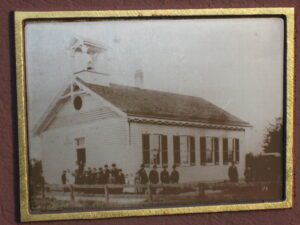
A school has stood on this site almost continuously since the late 1840s. The first school here was the Newell School, a white-frame, one-room school in use from approximately 1847 to 1939. The building was a part of the Newell Rural School District, which extended from the north border of Greenhills to present-day Interstate 275. Area schools consolidated in 1939 and the Newell district was absorbed into the Science Hall Rural School District and then into the Greenhills Rural School District (later renamed the Greenhills/Forest Park School District). The site of the old Newell School is now a part of the Winton Woods City Schools. The building directly behind this marker opened in 1968 as Forest Park High School and later became Winton Woods High School.