Ohio’s first female county sheriff, Maude Charles Collins (1893-1972) of Vinton County was appointed to finish her husband Fletcher’s term after he was killed in the line of duty in October 1925. In 1926, she ran for the office in her own right on the Democratic ticket and handily beat males in both the primary and general elections. “Sheriff Maude” investigated crimes, answered calls, patrolled roads, and performed the duties of her office, all while raising five children. She gained national attention for solving an intriguing double murder case in 1926, later featured in Master Detective and Startling Detective magazines. In 1927 she was the first woman to deliver inmates to the Ohio State Penitentiary in Columbus. Collins, a pioneering woman in law enforcement, was inducted into the Ohio Women’s Hall of Fame in 2000. She is buried in Hamden Cemetery.
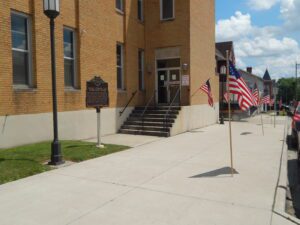
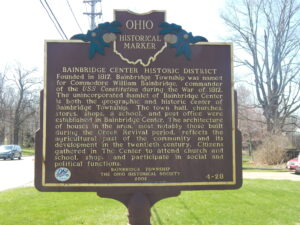
Bainbridge Center Historic District. Founded in 1817, Bainbridge Township was named for Commodore William Bainbridge, commander of the USS Constitution during the War of 1812. The unincorporated hamlet of Bainbridge Center is both the geographic and historic center of Bainbridge Township. The town hall, churches, stores, shops, a school, and post office were established in Bainbridge Center. The architecture of houses in the area, most notably those built during the Greek revival period, reflects the agricultural past of the community and its development in the twentieth century. Citizens gathered in The Center to attend church and school, shop, and participate in social and political functions.
Bainbridge Center Historic District. Founded in 1817, Bainbridge Township was named for Commodore William Bainbridge, commander of the USS Constitution during the War of 1812. The unincorporated hamlet of Bainbridge Center is both the geographic and historic center of Bainbridge Township. The town hall, churches, stores, shops, a school, and post office were established in Bainbridge Center. The architecture of houses in the area, most notably those built during the Greek revival period, reflects the agricultural past of the community and its development in the twentieth century. Citizens gathered in The Center to attend church and school, shop, and participate in social and political functions.
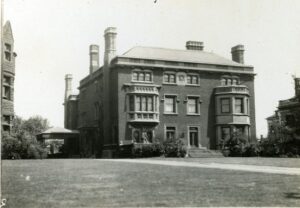
The 43-room Tudor mansion represents a fine example of stately homes in Cleveland at the turn of the century and is the last of the “Millionaire Row” homes that once lined Euclid Avenue. It was designed by Charles F. Schweinfurth, a world-renowned Cleveland architect, in 1905-06 and completed in 1910 at a cost of $1,200,000. Following Samuel Mather’s death in 1931, the building was occupied by the Cleveland Institute of Music until 1940 then by the Cleveland Automobile Club until 1967 when it was purchased by The Cleveland State University. The mansion was entered into the National Register of Historic Places on February 20, 1973.
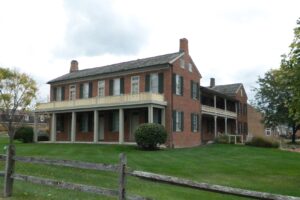
David Snively built the Federal-style Pennsylvania House in 1839 along the newly constructed National Road. This tavern and inn was an important stopover for livestock drovers and pioneers traveling by foot, on horseback, or in Conestoga wagons during the westward expansion of the United States in the nineteenth century. Dr. Isaac K. Funk, of Funk & Wagnalls fame, lived in the house in the 1840s while his father served as its tavern keeper. Closed as an inn after the Civil War, it then served as a doctor’s clinic, boarding house, and secondhand shop before falling into total disrepair. The Lagonda Chapter of the Daughters of the American Revolution saved it from demolition and has owned and operated it as a museum since 1941. The Pennsylvania House was put on the National Register of Historic Places in 1972.
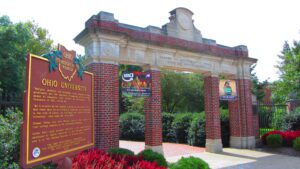
Manasseh Cutler, Rufus Putnam, Winthrop Sargeant, and Benjamin Tupper of the Ohio Company conceived Ohio University, which was encouraged by the Ordinance of 1787 and the Northwest Territorial Legislature in 1799, incorporated as the American Western University in 1802, and chartered by the Ohio State Legislature on February 18, 1804. The university is the first institution of higher learning in the Northwest Territory, second west of the Allegheny Mountains, and the first in the United States to be endowed with land by the government with proceeds used to pay for its operations-revenue from two townships was set aside to support the university. Opened on June 1, 1809, as an academy with three students, Ohio University awarded its first undergraduate degrees in 1815.
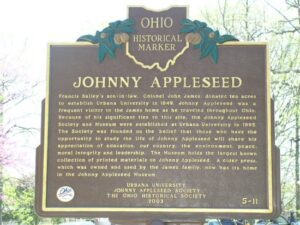
Urbana University was established by the Swedenborgian Church in 1850. Bailey Hall (1853), named after Francis Bailey (1735-1815), was designed by W. Russell West, architect of the Statehouse of Ohio. Bailey was an American Revolutionary War hero, official printer of the Continental Congress and printer of The Freeman’s Journal or the North American Intelligencer. He also printed The True Christian Religion papers. John (Johnny Appleseed) Chapman (1774-1845) distributed The True Christian Religion papers along with his famous apple trees throughout Ohio as a missionary for the Swedenborgian Church. Barclay Hall (1883) was named after Hester Barclay, a ward of Francis Bailey. It was Hester Barclay’s brother-in-law, John Young, who converted Chapman to the Swedenborg faith. Francis Bailey and Hester Barclay were the first male and female Swedenborgian converts in North America. Both Bailey and Barclay halls appear on the National Register of Historic Places.
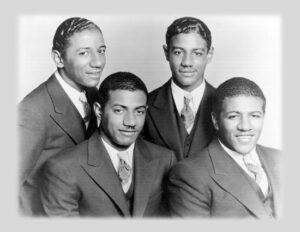
Born in Piqua, Ohio, the Mills Brothers grew up and attended school in Bellefontaine. The brothers — John, Jr., Herbert, Harry, and Donald Mills — were the first African-American vocal group to perform on a national radio broadcast and achieve commercial success. Enjoying worldwide fame throughout their career, the Mills Brothers popularized such hits as “Tiger Rag,” “Paper Doll,” and “You Always Hurt the One You Love.” After the death of John, Jr. in 1936, the remaining brothers were joined by their father, John, Sr. In all, the Mills Brothers recorded over 1,200 songs.