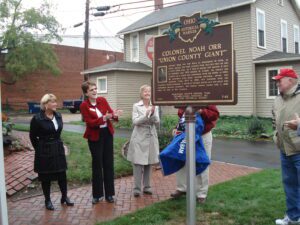
Cyprian Lee (1792-1854) settled in the Union County wilderness in 1820 and purchased the 118 West Sixth Street lot in 1828 for $6. County treasurer, coroner, shoemaker, and anti-slavery activist, Lee lived here in a log cabin until 1832 when this Greek Revival two-story brick house was completed. Other notable citizens to have resided in this oldest brick house in Marysville were showman Noah Orr (1836-1882), also known as the “Union County Giant,” and Josiah Jacob Morelock (1833-1899), a member of the Marysville City Council and the first Fire Department in Marysville. The Morelock family tannery business and stables were located behind this house.
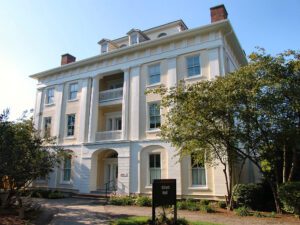
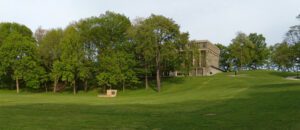
Built in 1833 as a health resort named the Mansion House Hotel, Elliott Hall is noted as Ohio’s oldest collegiate Greek Revival building. The closure of the Bank of the United States and an economic panic in 1837 created nation-wide financial difficulties, which led to the decline of the luxury resort. Under the leadership of Reverend Adam Poe, minister of William Street Methodist Church, the citizens of Delaware purchased the building for the establishment of a Methodist college for men. Ohio Wesleyan University was chartered on March 7, 1842, and the founding building was named for Dr. Charles Elliott, Ohio Conference leader who helped examine the site and establish the university. In 1877, Ohio Wesleyan University and the Ohio Wesleyan Female College merged into a co-educational institution. Elliott Hall was moved to its present location in 1892 when University Hall was built.
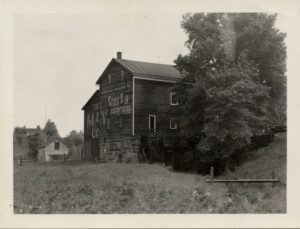
Fowlers Mill (originally Fowler’s Mills) developed around a group of mills built in the 1830s on the Chagrin River. Opportunities from these mills led to Fowlers Mill becoming the commercial center of Munson Township. From the 1830s into the twentieth century, the community expanded with construction of churches, a post office, township hall, stores, hotel, blacksmith shop, schools, and houses built in such styles as Federal, Greek Revival, Italianate, and Queen Anne. This type of community center was common in rural, nineteenth century America, but rarely survives with so much original fabric intact. On Mayfield Road, the Disciple Church was built in 1842. East of the church, the brick central school built in 1913 replaced earlier one-room schoolhouses. The gristmill is the only mill standing in Geauga County. The cemetery contains burials dating from the 1830s. The Fowler’s Mills Historic District was placed on the National Register of Historic Places in 2002.
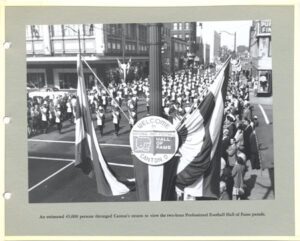
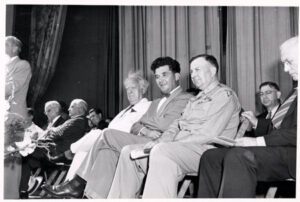
On September 17, 1920, representatives from ten professional football teams met in Canton and formed the American Professional Football Association, which in 1922 became the National Football League (NFL). Pro football evolved from club football in the 1890s, and by the early 1900s had begun to spread across the country, concentrating in the Midwest. Jim Thorpe, the first nationally prominent pro, started with the Canton Bulldogs-an early pro football power-in 1915. In 1959, Canton citizens launched a well-organized and ultimately successful effort to have their city, “the cradle of professional football,” designated as the site of a monument to the sport’s historic stars. The Professional Football Hall of Fame opened on September 7, 1963, inducting seventeen charter members. The Hall of Fame interprets and promotes the study of the role of professional football in American culture.
In 1968, Richard Nixon won the presidency partly based on a campaign promise to end the Vietnam War. Though the war seemed to be winding down, on April 30, 1970, Nixon announced the invasion of Cambodia, triggering protests across college campuses. On Friday, May 1, an anti-war rally was held on the Commons at Kent State University. Protestors called for another rally to be held on Monday, May 4. Disturbances in downtown Kent that night caused city officials to ask Governor James Rhodes to send the Ohio National Guard to maintain order. Troops put on alert Saturday afternoon were called to campus Saturday evening after an ROTC building was set on fire. Sunday morning in a press conference that was also broadcast to the troops on campus, Rhodes vowed to “eradicate the problem” of protests at Kent State. (Continued on other side)
A prominent early 20th century illustrator and artist, Howard Chandler Christy was born on a farm in Morgan Township. He first gained notice as an illustrator during the Spanish-American War, but achieved lasting fame for his trademark “Christy Girls,” dream girls who idealized feminine beauty during this era. Between 1908 and 1915, he worked from a studio perched above the Muskingum River near Duncan Falls. In the 1920s Christy began to paint portraits and historical scenes. The Signing of the Constitution of the United States, displayed in the Capitol, is his most famous work. The Signing of the Treaty of Green Ville hangs in the Ohio Statehouse.
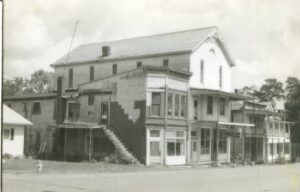
The commercial building that stood at 305 Main Street for over a century was built by Justus S. Law in 1897. On April 1, 1897, Law leased the Odd Fellows and Knights of Pythias joint-use of the third floor, rent-free, for 99 years after they completed its construction and added a slate roof to the building. Although the Pythians purchased the remainder of the building in 1921, they continued to share their “Castle Hall” with the Odd Fellows until 1965. In July 1974, the Pythians assigned their Pleasant City property to the Ohio Knights of Pythias Home in Springfield. From 1974 to 2012 the property exchanged private ownership multiple times until forfeited to the state in 2020. After the dilapidated Victorian building was demolished in 2021 the land was donated to the Village of Pleasant City.
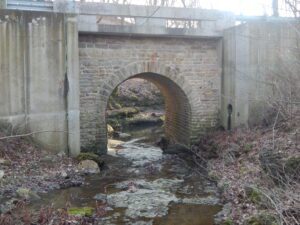
Listed on the National Register of Historic Places in 2009, the span is the oldest in Clark County a traveler can cross. It is also one of the oldest stone bridges in use in Ohio. Stone mason Samuel S. Taylor (1837-1930) built the culvert from locally quarried limestone in 1871, his first public works project. A Civil War veteran, Taylor worked on several projects, including the Mill Run underground sewer (1877), Champion’s East Street shops (1883), and the foundation for Springfield’s city hall (1890).