

, OH
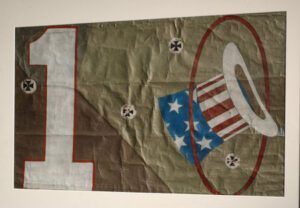
America’s World War I “Ace of Aces,” Edward Vernon Rickenbacker was born in Columbus in 1890 to Swiss immigrant parents, leaving school at age 12 to help support his family. Working for several Columbus automobile companies initiated his love of racing, and he achieved fame as a race driver and team owner between 1910 and 1916. Enlisting in the U.S. Army in 1917, he went to France as staff driver for General John Pershing with ambitions of becoming a combat flier. He managed a transfer to the American Expeditionary Force’s Aviation Instruction Center, learned to fly, and was assigned to the 94th Aero Squadron, the famed “Hat in the Ring” squadron led by ace Raoul Lufbery. (continued on other side)
, OH
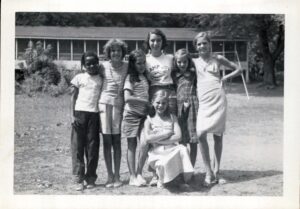
Camp Joy was born at the site of Seven Hills Neighborhood House and original location of St. Barnabas Episcopal Mission Church. Displacement and loss caused by Ohio River flood of 1937 inspired St. Barnabas’ rector and his wife, Laurence “Cap” and Sadie Hall, to act on behalf of the children of Cincinnati’s West End. The Halls conceived of Camp Joy as a haven where kids could find a respite from impoverished surroundings in the city and its sweltering summer heat. The camp was a success and continued after the Halls’ assignment to another parish. From 1940-1944, Rev J. Brooke and Mrs. Betty Mosley continued to nurture the people of the West End through St. Barnabas and Camp Joy. (Continued on other side)
, OH
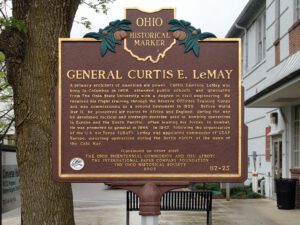
A primary architect of American air power, Curtis Emerson LeMay was born in Columbus in 1906, attended public schools, and graduated from The Ohio State University with a degree in civil engineering. He received his flight training through the Reserve Officers Training Corps and was commissioned as a second lieutenant in 1929. Before World War II, he pioneered air routes to Africa and England; during the war he developed tactical and strategic doctrine used in bombing operations in Europe and the South Pacific, often leading his forces in combat. He was promoted to general in 1944. In 1947, following the organization of the U.S.Air Force (USAF), LeMay was appointed commander of USAF Europe, directing operations during the Berlin Airlift at the dawn of the Cold War. (continued on other side)
, OH
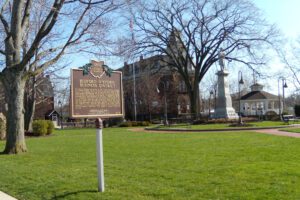
The town of Bedford was settled in 1837. Early residents, Hezekiah and Clarissa Dunham donated the land that serves as Bedford Public Square. The Dunhams built one of the area’s first homes in 1832, which stands at 729 Broadway with the letters H & D above the doorway. Early settlers were attracted to the area by the abundance of natural resources and a large waterfall for mill sites. Bedford also served as a stagecoach stop on the route from Cleveland to Pittsburgh. The road or Turnpike Road as it was called was originally part of the Mahoning Indian Trail. By 1895 the road was renamed Main Street (and later Broadway) when the Akron, Bedford, and Cleveland Railway Company (ABC) traversed the middle of the street carrying passengers. The interurban is called “America’s first high speed long distance electric interurban” with speeds in excess of 60 miles per hour. [continued on other side]
, OH
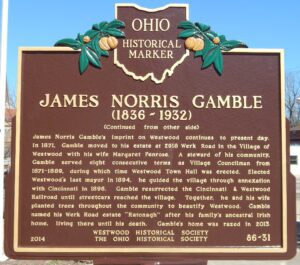
James Norris Gamble, entrepreneur, industrialist, philanthropist and civic leader, is best known for inventing Procter & Gamble’s Ivory Soap, the “soap that floats,” in 1878. Applying a scientific approach, Gamble transformed P&G into a nationally recognized corporate leader and creator of consumer products for a rapidly growing America. Beyond P&G, Gamble financed early efforts to educate freed southern slaves as an original sponsor of the Freedmen’s Aid Society. Later, he underwrote civil rights leader Mary McLeod Bethune’s work to educate poor African American women. In Cincinnati, Gamble’s philanthropy included endowment of Christ Hospital and the founding of its Institute of Medical Research. Gamble funded completion of University of Cincinnati’s Nippert Stadium in 1924 as a tribute to his late grandson.
, OH
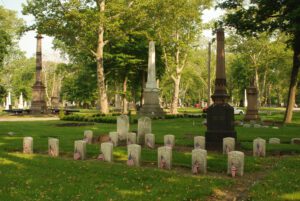
Howard Daniels, who lived from 1815-1863, was a noted architect and landscape gardener. Over the course of his life, he designed six Ohio and New York cemeteries, including Woodland that began in 1852 when he laid out 20 of its 60 acres into fashionable “rural cemetery” style. Later acreage in the cemetery adapted his curvilinear design. “As beautifully prepared for a burial place as fancy and taste could desire,” Woodland was dedicated on June 14, 1853, and became Cleveland’s primary cemetery. An ornate gatehouse, chapel, and fountains came later. Generations of Clevelanders, pioneering and prominent, as well as veterans onward from the War of 1812, are buried here. For more than a century, Woodland, in its original and newly platted sections, has embraced people from every race, the rich and poor, natives and immigrants, and the famous and obscure. It has truly become a community cemetery. [continued on other side]
, OH
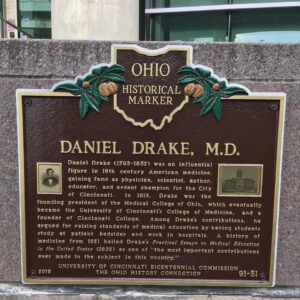
Daniel Drake, M.D.. Daniel Drake (1785-1852) was an influential figure in 19th century American medicine, gaining fame as physician, scientist, author, educator, and ardent champion for the City of Cincinnati. In 1819, Drake was the founding president of the Medical College of Ohio, which eventually became the University of Cincinnati’s College of Medicine, and a founder of Cincinnati College. Among Drake’s contributions, he argued for raising standards of medical education by having students study at patient bedsides and work in hospitals. A history of medicine from 1921 hailed Drake’s Practical Essays on Medical Education in the United States (1832) as one of “the most important contributions ever made to the subject in this country.”
, OH
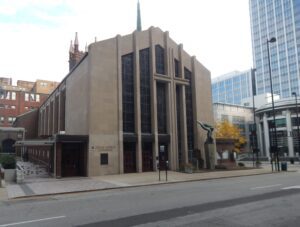
In 1817 twenty-two men, including future President William Henry Harrison, chartered Cincinnati’s first Episcopal parish, Christ Church. In 1835 members erected a Gothic Revival-style church on this site. The neighborhood evolved as the city grew with the influx of immigrants. Parish women raised funds to teach, feed, clothe, and shelter tenement families, and alleviate suffering during floods and disease outbreaks. In 1883 the women helped establish what became Cincinnati Children’s Hospital. In 1909 members opened the Late Gothic-style Parish House, a community center with kitchen, classrooms, library, auditorium, clinic, gymnasium, and bowling alley. By the parish’s centennial in 1917, music had expanded beyond worship to public concerts. In 1940 the annual Boar’s Head Festival of music and pageantry began. Since the 1960s, members have collaborated with local agencies to advocate for social and economic justice, a mission continuing into the 21st century. (Continued on other side)