

, OH
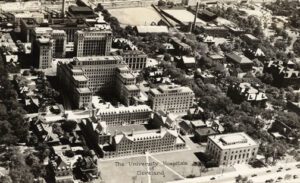
Named for the streetcar turnaround once located at Euclid Avenue and East 107th Street, University Circle is a 600-acre district that is home to many of Cleveland’s major cultural, educational, medical, and service institutions. The area was first settled in 1799 by tavernkeeper Nathaniel Doan and became known as Doan’s Corners. In 1882, Western Reserve College moved here from Hudson, followed in 1885 by the Case School of Applied Science from downtown Cleveland. These two colleges federated in 1967 to become Case Western Reserve University. (continued on other side)
, OH
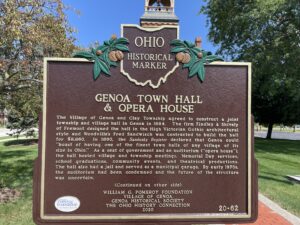
The Village of Genoa and Clay Township agreed to construct a joint township and village hall in Genoa in 1884. The firm Findley & Shively of Fremont designed the hall in the High Victorian Gothic architectural style and Woodville’s Fred Sandwisch was contracted to build the hall for $8,860. In 1890, the Sandusky Register declared that Genoa could “boast of having one of the finest town halls of any village of its size in Ohio.” As a seat of government and an auditorium (“opera house”), the hall hosted village and township meetings, Memorial Day services, school graduations, community events, and theatrical productions. The hall also had a jail and served as a municipal garage. By early 1970s, the auditorium had been condemned and the future of the structure was uncertain. (Continued on other side)
, OH
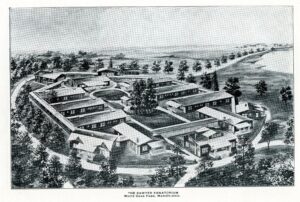
Doctors Charles Elmer Sawyer and his son, Carl Walker Sawyer, opened Sawyer Sanatorium on White Oaks Farm in 1911. Built to provide physical and emotional healing in a unique environment, the complex incorporated six patient bungalows, houses for the two doctors, offices, a large dining and social hall, and treatment buildings. An enclosed quarter-mile-long cloister connected these buildings around a large courtyard. Each bungalow, given botanical names such as “Ivy” and “Rose,” contained individual patient rooms, a communal living room, and bathing facilities. Hydropathic and electropathic treatments buildings were added later. A shady ten-acre knoll on the farm featured a grove of white oak trees that served as a picnic area for patients. Over the years, the facility also hosted local and national social and political events. (Continued on other side)
, OH
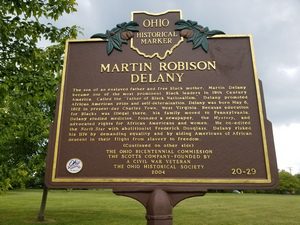
The son of an enslaved father and free Black mother, Martin Delany became one of the most prominent Black leaders in 19th Century America. Called the “Father of Black Nationalism,” Delany promoted African American pride and self-determination. Delany was born May 6, 1812 in present-day Charles Town, West Virginia. Because education for Blacks was illegal there, his family moved to Pennsylvania. Delany studied medicine, founded a newspaper, the “Mystery,” and advocated rights for African Americans and women. He co-edited the “North Star” with abolitionist Frederick Douglass. Delany risked his life by demanding equality and by aiding Americans of African descent in their fight from slavery to freedom. (Continued on other side)
, OH
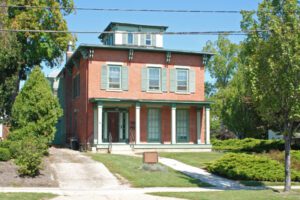
Aluminum pioneer Charles Martin Hall was born in 1863 in Thompson, Ohio (Geauga County), and moved with his family to Oberlin in 1873. Hall graduated from Oberlin College in 1885, studying chemistry under Professor Frank Fanning Jewett (1844-1926). Jewett, who lived in this house from 1884 to 1923, encouraged Hall’s interest in chemistry and aluminum, then a semi-precious metal. Hall discovered an electrochemical reduction process for producing metallic aluminum from aluminum oxide dissolved in molten cryolite in his woodshed laboratory at his family’s home at 64 East College Street on February 23, 1886. This process, the culmination of research with Jewett, became the basis for the aluminum industry in America. In 1888 Hall co-founded the Pittsburgh Reduction Company, later the Aluminum Company of America (ALCOA). Upon his death in 1914, Hall left one-third of his estate to Oberlin College.
, OH
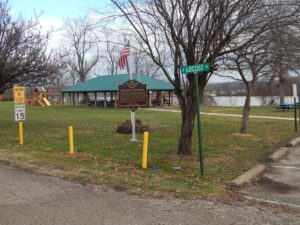
In 1955, at the age of 67, Emma Rowena “Grandma” Gatewood became the first woman to hike the 2,050 mile Appalachian Trail alone and in one season. The Gallia County, Ohio resident hiked the Appalachian Trail again in 1957 and 1964, becoming the first to walk its length three times. In 1959, she hiked the Oregan Trail, from Independence, Missouri to Portland, Oregon. She was a founder of the Buckeye Trail and life member of the Buckeye Trail Association, which named part of the trail after her. Grandma Gatewood was born in 1887 on a farm near Mercerville, one of 15 children, and died in 1973 at the age of 85, the mother of 11 and “grandma” to many more. SHe was inducted into the Appalachian Trail Hall of Fame in 2012.
, OH
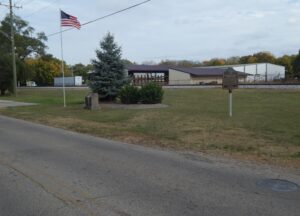
Carlisle Station Depot. The Carlisle depot for the Cincinnati, Hamilton & Dayton (CH&D) railroad was located nearby. The CH&D started operations in 1851 and was the second railroad through Warren County. Carlisle Station was a passenger and freight-shipping depot and was joined in 1872 by another, when Cincinnati & Springfield Railroad (later part of the Big Four and the New York Central Railroads) erected a depot in nearby Franklin. Carlisle was originally known as the “Jersey Settlement,” because many settlers in the early 1800s were from New Jersey. George Carlisle, vice-president of the CH&D, purchased a large tract of land here. After Carlisle and his wife Sarah donated a lot to the community in 1856, residents renamed the place “Carlisle Station.” The Carlisle Literary Association built a hall on the lot c. 1856, which, as of 2019, remains as the older section of Carlisle’s municipal building. Side B: Schenck-Stanton Rally, October 3, 1868.
, OH
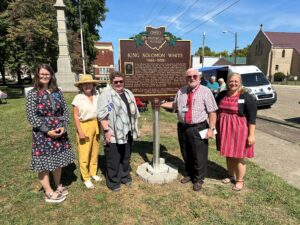
King Solomon “Sol” White was born in Bellaire on June 12, 1868. A Baseball legend, he was an all-around player, manager, and organizer in the Pre-Negro Leagues (1887-1912) and the Negro Leagues (1920-1926). White first played with integrated baseball clubs the Bellaire Globes (1884-1886) and Wheeling Green Stockings (1887). After 1887-1888 color barriers were imposed on baseball, White played on segregated minor league teams. They included: the Pittsburgh Keystones, Cuban Giants, York Colored Monarchs, Cuban X-Giants, Page Fence Giants, and Chicago Columbia Giants. As a coach, he helped organize and lead the powerhouse Philadelphia Giants to their 1904-1907 championships. White died on August 26, 1955, and was buried in an unmarked grave in Staten Island’s Frederick Douglas Memorial Cemetery. In 2006, “Sol” White was posthumously inducted into the Baseball Hall of Fame.