

, OH
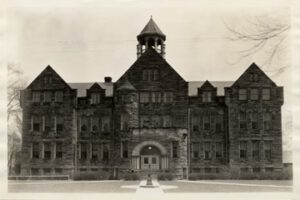
In 1845, Baldwin Institute, one of the first schools in the area open to all students regardless of gender, race, or creed, was chartered. The wealth generated by the sandstone and grindstone industries of Berea allowed John Baldwin to found the school. Ten years later, officials rechartered the school and renamed it Baldwin University. By the 1880s, the expanding quarries began to encroach on the original campus of the university, forcing it to relocate. In 1891, ground was broken for the new campus at the corner of Front Street and Bagley Road. Recitation Hall, renamed Wheeler Hall, was the first new building, followed by the Philura Gould Baldwin Memorial Library in 1894. In 1905, through the funding of the Carnegie Foundation, the Ladies Hall, renamed Carnegie Hall, was moved stone by stone to the new campus to serve as the science building. Baldwin University merged with German-Wallace College in 1913 to become Baldwin-Wallace College.
, OH
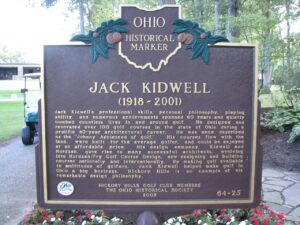
Self-educated golfer Jack Kidwell grew up in central Ohio. From 1937 until 1971, he owned and operated the Beacon Light Golf Course, where he started as a caddie. In 1943, he married Geraldine “Jerry” Kidwell, his wife of 57 years, and had four daughters, Sally, Shirley, Kathy, and Jody. Kidwell became a Class “A” golf course superintendent and earned life membership status as a Class “A”PGA professional. His peers selected Kidwell as president of the American Society of Golf Course Architects in 1980. A member of the Ohio Turf Grass Association, he was honored as Man of the Year in 1982. His accomplishments gained him induction into the Southern Ohio PGA Hall of Fame in 1977 and the Ohio Golf Association Hall of Fame in 1997.
, OH
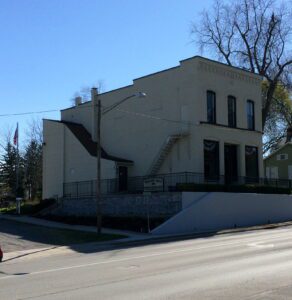
Henry Hanford Wakeman (1840-1879) of New York came to Waterville and became a successful businessman. He conceived the idea of a local Masonic Lodge, which became Wakeman Lodge No. 522 Free and Accepted Masons in 1879, and bequeathed $1,000 toward the construction of a meeting place. In 1880, a cornerstone was laid and this building was dedicated on October 21, 1881. For over 100 years, the Masons held their meetings upstairs while the lower floor was often rented out to a succession of businesses or used for public gatherings. Rising maintenance expenses and lower membership numbers caused the Masons to put Wakeman Hall up for sale in 1995. The Waterville Historical Society purchased the building in 1997 and spent several years rehabilitating it to serve as a local history archive and the Historical Society’s meeting place.
, OH
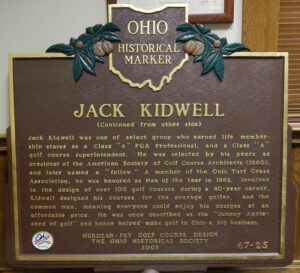
Born on September 21, 1918, golf course architect Jack Kidwell attended Columbus Central High School where he became the Ohio School State Golf Champion in 1937. Kidwell was the owner and operator of Beacon Light Golf Course from 1937-1971. He was inducted into both the Southern Ohio PGA Hall of Fame and the Ohio Golf Association Hall of Fame in 1997. He was the founding father of Hurdzan/Fry Golf Course Design and the inspirational leader to this day. Kidwell was a true giant of the golf industry and has been named the person having the most influence on golf in the state of Ohio over the past 200 years. He was married to his wife Geraldine “Jerry” Kidwell for 57 years and they had four daughters, Sally, Shirley, Kathy, and Jody. Jack Kidwell died on April 29, 2001.
, OH
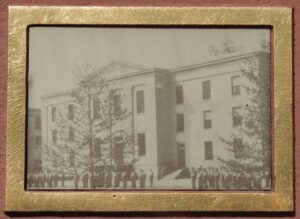
The first in a succession of schools that eventually gave College Hill its name was CARY’S ACADEMY FOR BOYS. Freeman Cary opened this school in his home on Hamilton Avenue in 1832. Success necessitated larger quarters and in 1833 PLEASANT HILL ACADEMY was built at the corner of Hamilton and Colerain (now Belmont) Avenues. Continuing growth and a distinguished faculty led to formation of a college. Money was raised by selling shares, mostly bought by local farmers. FARMERS COLLEGE OF HAMILTON COUNTY was chartered on February 23, 1846 and Cary Hall was built on this Belmont Avenue site in 1847. Future President of the United States, Benjamin Harrison, attended the college from 1848 to 1850. During the 1860s Cary Hall served as a station on the Underground Railroad. (Continued on other side)
, OH
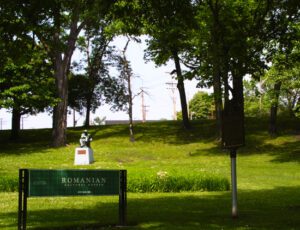
The Union and League of Romanian Societies, Incorporated was formed in 1928 from a unification of two separate fraternal organizations, the Union and the League. The Union, founded on July 4, 1906, was originally organized for the purpose of promoting the general welfare of its members through life insurance policies obtained through individual societies located in the United States and Canada. The societies of the Union and League offer social interaction within their local lodges and through the strength of the larger parent organization. The purpose of the current Union and League is to maintain and encourage Romanian cultural heritage by promoting interest in Romanian ethnic values through cultural activities and to sustain loyalty to the United States and Canada among its respective members.

, OH
Ella Nora Phillips Myers Stewart was one of the first practicing Black women pharmacists in the United States. After she married William Stewart in 1920, the couple settled in Youngstown, then moved to Toledo where they opened Stewart’s Pharmacy in 1922. Having broken professional barriers, Ella Stewart became a tireless civil rights champion. Advocating for Black women she was active in the Enterprise Charity Club and was a 1937 charter member of Beta Lambda and Toledo Alumnae chapters of Delta Sigma Theta Sorority. She served on the National Association of Colored Women Clubs, the Women’s Advisory Committee of U.S. Department of Labor, and Pan-Pacific Southeast Asia Women’s Association. Toledo’s Ella P. Stewart Academy for Girls was named in her honor in 1961. She was inducted into the Ohio Women’s Hall of Fame in 1978.
, OH
George Bellows (1882-1925) is widely recognized as one of America’s premier artists. His vivid portrayals of modern urban life have become indelible icons of American art. Born and reared in Columbus, he retained close ties here throughout his life. Bellows gained fame while a young artist in New York, becoming a key figure among a group of artists nicknamed the “Ashcan School” because of their preference for commonplace subjects painted in dark colors. Bellows also excelled at printmaking, and it was largely through his efforts that lithography came to be accepted as a fine art in America. Bellow’s career was unexpectedly cut short by his death from complications following an appendectomy at the age of forty-two.