

, OH
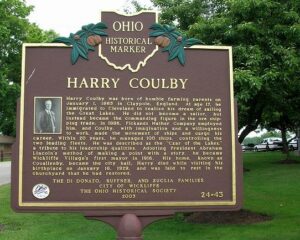
Harry Coulby was born of humble farming parents on January 1, 1865 in Claypole, England. At age 17, he immigrated to Cleveland to realize his dream of sailing the Great Lakes. He did not become a sailor, but instead became the commanding figure in the ore shipping trade. In 1886, Pickands Mather Company employed him, and Coulby, with imagination and a willingness to work, made the movement of ships and cargo his career. Within 20 years, he managed 100 ships, controlling the two leading fleets. He was described as the “Czar of the Lakes,” a tribute to his leadership qualities. Adopting President Abraham Lincoln’s method of making a point with a story, he became Wickliffe Village’s first mayor in 1916. His home, known as Couallenby, became the city hall. Harry died while visiting his birthplace on January 18, 1929, and was laid to rest in the churchyard that he had restored.
, OH
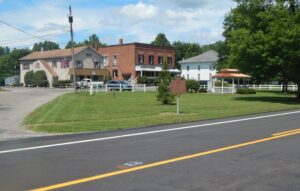
Originally called Westfield Township, Samuel Fowler purchased this area in 1798 from the Connecticut Land Company for $12,903.23 while living in Westfield, Massachusetts. His brother Abner arrived the following year to survey the land and separate it into smaller plots that could be sold to people wanting to settle here. A Revolutionary War veteran, Abner was the first to arrive here and also the first recorded death in 1806, the same year that his son Abner Fowler II married the first school teacher in Fowler Ester Jennings. In 1817, Samuel Fowler gave five acres of land to Fowler Center to be used as a park or “common” with the provision that no permanent building ever be built on it. At about the same time, the township name was changed to Fowler to honor its founding family. Agriculture was and remains the main occupation in the Fowler area.
, OH
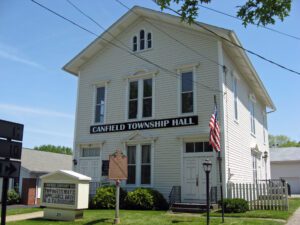
The Canfield Township Hall was erected in 1884. It served as the first public building in which the Canfield citizens could conduct town business, elections, and public meetings. An example of Renaissance Revival or “Italianate” architecture, the building is typical of late Victorian commercial buildings, but constructed of wood rather than of the customary brick. Drafted by Colonel S. Kinney, it was originally constructed for the sum of $2,389 by G.W. Strock at the corner of South Broad and East Main streets, on a lot purchased for $500. In 1936, R.J. Neff moved the hall several hundred feet south to its present location. In addition to official township meetings, the second floor has been used for a variety of activities, including social meetings, lectures, contests, dances, and roller-skating. The building served as an early home of the Canfield Historical Society and operated continuously for over one hundred and twenty-five years.
, OH
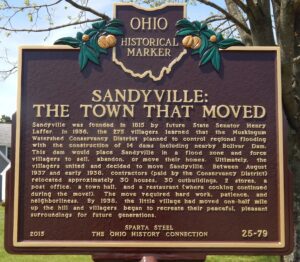
Sandyville was founded in 1815 by future State Senator Henry Laffer. In 1936, the 275 villagers learned that the Muskingum Watershed Conservancy District planned to control regional flooding with the construction of 14 dams including nearby Bolivar Dam. This dam would place Sandyville in a flood zone and force villagers to sell, abandon, or move their homes. Ultimately, the villagers united and decided to move Sandyville. Between August 1937 and early 1938, contractors (paid by the Conservancy District) relocated approximately 30 houses, 30 outbuildings, 2 stores, a post office, a town hall, and a restaurant (where cooking continued during the move!). The move required hard work, patience, and neighborliness, By 1938, the little village had moved one-half mile up the hill and villagers began to recreate their peaceful, pleasant surroundings for future generations.
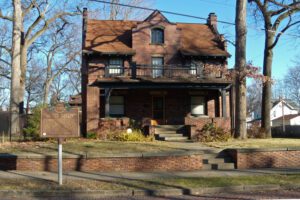
, OH
Akron, an industrial boomtown in the early twentieth century, grew in population nearly fivefold between 1900 and 1920. As the city industrialized, middle class residents sought homes on West Hill, away from the smoke and soot of heavy industry on the East Side. The Hall Park Allotment Historic District in West Hill represents a notable early twentieth century neighborhood. Developed by Philander Hall between 1902 and 1919 during the height of Akron’s “rubber boom,” it consists of several houses representing the picturesque styles of the period, including the American Foursquare, Craftsman, Colonial, and Medieval Revival Styles. With its gently curving brick streets, hilly topography, and mature trees, the Hall Park Allotment Historic District evokes the feeling of a distinct period of time in Akron’s history and constitutes a neighborhood of distinctive historical character and architectural merit.
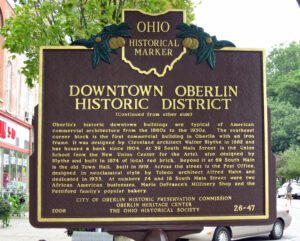
, OH
The intersection of Main and College streets has been the center of Oberlin since the town and college were founded in 1833. The first downtown buildings were made of wood and were destroyed by a series of spectacular fires. The first college building, Oberlin Hall, stood on the southwest corner of College and Main and included recitation rooms, a dining hall, chapel, offices, and lodging. In 1887, Akron architect Frank Weary designed the large brick building at numbers 5 to 13 West College. Number 23 West College (Gibson Block) once housed a silent movie theater on the second floor. East College Street’s historic buildings include the Apollo Theater, which showed Oberlin’s first talking movie on May 11, 1928. From 1897 to 1929, an interurban streetcar line connected Oberlin’s downtown to Cleveland. Oberlin’s downtown historic district was placed on the National Register of Historic Places in 2003.
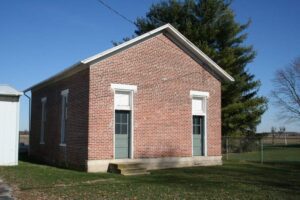
, OH
Elizabeth Township was founded in 1807. The Elizabeth Township House was built about 1870, serving as the community’s assembly hall. The building is similar to the seven remaining one-room, brick schoolhouses, built throughout the township between 1868 and 1873. In 1997, the township was added to the National Register of Historic Places as Ohio’s first rural historic district. The district includes all of Elizabeth Township and parts of Staunton and Bethel townships. This marker erected to commemorate the 200th anniversary of the township’s founding.
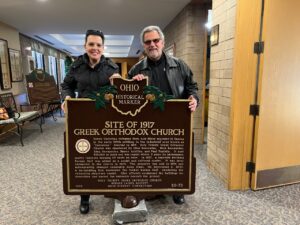
, OH
Greek Christian refugees from Asia Minor migrated to Canton in the early 1900s settling in the industrial area known as “Carnahan.” Erected in 1917, Holy Trinity Greek Orthodox Church was chartered by Elies Korosedes, Nick Kessenides, Alex Heropoulos, Harry Achilles, and Paul Paulidis. It cost $50,000 to build and was repaid within 3 years by parishioners, mostly laborers earning 30 cents an hour. In 1927, a separate building Koraes Hall was added as a social and cultural center. It was later connected to the church in 1934. The property was sold in 1976 and subsequently changed ownership many times. On September 2, 2020, a devastating fire destroyed the former Koraes Hall, rendering the remaining structure unsafe. City officials condemned the buildings for demolition and buried the remnants beneath the ground.