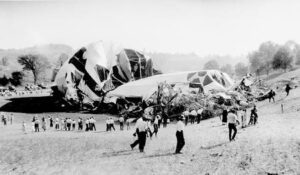
On a stormy autumn morning in 1925, the giant Navy airship, christened Shenandoah, crashed near this site. Initially, the Shenandoah was commissioned to perform scouting missions for the Navy; however, she would soon be flying promotional missions. The Shenandoah had recently begun a six-day publicity tour across the Midwest when she crashed. The turbulent weather of late summer created strong winds, which ripped the 680-feet long Shenandoah in two and tore the control car from the keel. A majority of the 14 crewmen who died in the crash, including the captain, Lt. Commander Zachary Lansdowne of Greenville, Ohio, were killed when the control car plummeted to the ground. The stern section fell in a valley near Ava and the bow was carried southwest nearly twelve miles before landing near Sharon, Ohio. The Ohio National Guard was called in to control the crowds of spectators who traveled to the crash sites.
After American militia troops forcibly ended the 1812 siege of Fort Wayne, General James Winchester’s Army of the Northwest marched down the north side of the Miami [Maumee] River to stop or retard advancing British troops sent to aid in the siege of Fort Wayne. After three days of difficult march, Ensign James Liggett of the 17th Regiment, volunteered to lead a group of four spies or scouts to the site of the old Fort Defiance. Liggett’s small force was surprised and killed on or about September 25 near here. The Americans tried twice to recover the bodies, but met with ambush from hostile Native Americans sympathetic to the British. Their bodies were finally recovered and buried in a common grave. Besides Liggett, they included Wyatt Stepp, Guy Hinton, William Bevis, and Nathaniel Mitchell of Woodford County, Kentucky, all of Captain McCracken’s Company, 1st Rifle Regiment, Kentucky Volunteer Militia.
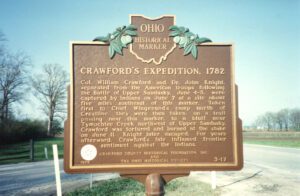
Col. William Crawford’s army of 480 Pennsylvania volunteers passed near this site on June 3 to attack the Indians near Upper Sandusky. On June 4-5 they encountered a combined force of Shawnees, Delawares, Wyandots, and, unexpectedly, Butler’s Rangers, a British unit from Detroit. The expedition was a disaster; about 300 Americans escaped. On June 6, about six miles west of this marker, the opposing forces met again at the “Battle of Olentangy.” With minor losses, the Americans continued their retreat, reaching the Ohio River on June 13. Crawford was captured, and burned at the stake on June 11.
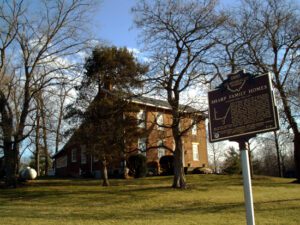
The Sharp family homes and their locations on N. State Street and Africa Road mark an important route through Westerville on the Underground Railroad. The family patriarch, Garrit Sharp, was an original settler of Sharp’s Settlement, now Westerville, and donated land for and helped organize the first Methodist church. He is also associated with the founding of Blendon Young Men’s Seminary, which was acquired by Otterbein College, an institution with enrollment open to African Americans and women from its inception in 1847. He and his sons were all noted abolitionists who, along with Bishop William Hanby and Otterbein president Lewis Davis, assisted southern slaves on their road to freedom. From the Sharp homes, slaves would have proceeded north to the house of Samuel Patterson on Africa Road and along Alum Creek to the Quaker settlement near Marengo in Morrow County.
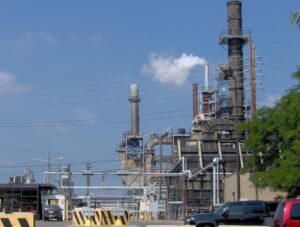
Oil became a valuable resource in Ohio when significant quantities were discovered in Lima in 1885. The discovery brought an economic boom to Lima and northwest Ohio. News of the Lima oil field spread, attracting the attention of John D. Rockefeller, co-founder of Standard Oil. Against the advice of his board, Rockefeller invested heavily in Lima crude, despite its high sulfur content and foul odor. Storage tanks and pipelines for the crude sprung up rapidly. Having great faith in the ingenuity of his engineers and scientists, Rockefeller stockpiled the crude and sent Standard’s chief refining specialist, J.W. Van Dyke, to Lima to construct and manage the new Solar Refinery. Together with Herman Frasch, a German chemist, the two men perfected the technique to desulphurize the crude and turn it into quality kerosene and fuel oil.
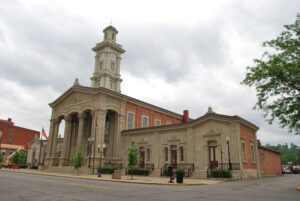
Ross County’s first courthouse was Ohio’s first statehouse. The courthouse was erected on the Public Square in 1801. Thomas Worthington, one of the building’s superintendents, laid out the foundation. Chillicothe was the last capital of the Northwest Territory, and the final session of the territorial legislature met in the courthouse in 1801. Ohio’s first constitution was written here in 1802. On March 1, 1803, Ohio’s first General Assembly convened in the building, making it the statehouse. During a time of strained relations between Native Americans and settlers in Ohio, the great Shawnee leader Tecumseh delivered a speech here in 1807 to reassure citizens that the Indians would remain peaceful. The courthouse served as the statehouse from 1803 to 1810 and from 1812 to 1816. The building was razed in 1852 to make way for the present courthouse.
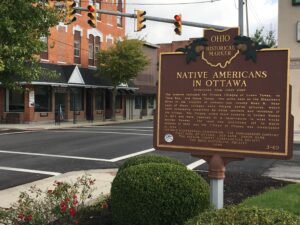
The Ottawa, or “Tawa” Indians had inhabited the Maumee Valley since the middle of the 1700s. By the 1790s, Ottawa settlements included villages along the Blanchard River at the present-day Village of Ottawa. During the War of 1812, Colonel James Findlay destroyed these villages because the Ottawa aided British forces. In 1817, the United States government established a reserve for the Ottawa in exchange for their lands in Northwest Ohio. The reserve encompassed a five-mile square area; its center was the intersection of the Blanchard River and an Indian trace near what is now Old State Route 65. (Continued on other side)
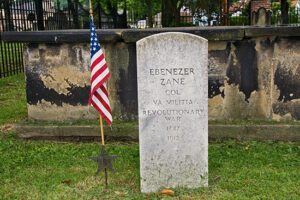
The Walnut Grove Cemetery is the burial place of members of the Zane and Martin families. Their graves lie within the brick enclosure. The cemetery is also the resting-place of many early Martins Ferry residents, including veterans of the Revolutionary War, the War of 1812, the Mexican War, and the Civil War. The Zane and Martin families were significant in the pioneer history of the region. Betty Zane’s legendary heroism at Fort Henry (now Wheeling, West Virginia) helped settlers resist an attack by the British and their Native American allies in September 1782. (Continued on other side)