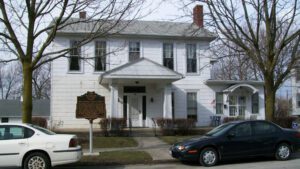
The Shannon Stock Company, also known as Shannon’s Famous Players, was a traveling theatre company based in Wapakoneta from 1913 until the Great Depression. Founded by Harry Shannon, the group included his wife Adelaide, their children, Harry Jr. and Hazel, and a company of twenty people or more. The Company performed in theatres in southern states during the winter and in a tent in Ohio, Indiana, and other Midwest states during the summer. When not performing, the Shannons prepared for the next tour while at home here in Wapakoneta. [continued on other side]
The history of New Knoxville provides one of the best examples of chain migration to America. After the Shawnee were removed from what would become Auglaize County, James Knox Lytle, cousin to James Knox Polk, purchased land in Washington Township. Lytle platted a village of 102 lots in 1836, calling it Knoxville to honor his mother’s family. Meanwhile, newly married Wilhelm and Elisabeth Fledderjohann Kuckhermann (later Kuck) immigrated from Ladbergen in northwest Germany. Having missed their boat to St. Louis, the couple lived briefly in Stallostown (Minster) and Bremen (New Bremen). They wrote home, encouraging others to emigrate; in the summer of 1835 the Fledderjohanns (Elisabeth’s family), Meckstroths, and Lutterbecks arrived. The families bought land near the site of Knoxville. (continued on other side)
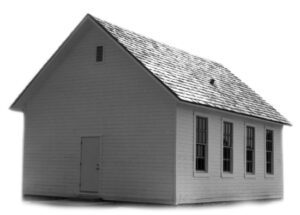
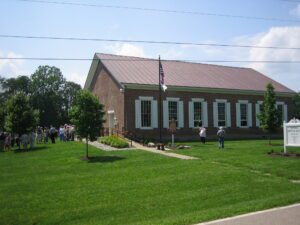
Descendants of slaves, who may have reached Ohio through the Underground Railroad, and other African Americans, formed the community of Flatwoods in the southwest part of Bokescreek Township. This one-room schoolhouse was built circa 1868 for African American children of Flatwoods and remained open until 1923. Remnants of past lessons remain inscribed on the chalkboard. The schoolhouse was threatened with demolition in 1999 and later moved to Veteran’s Park. The Logan County Historical Society owns and maintains the site as a living history museum.
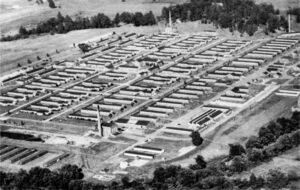
During the Second World War, the U.S. Army constructed a 131-building hospital on level farmland a quarter mile northwest of this marker. The army built the facility as a 1,520-bed hospital in the winter and spring of 1942-’43. It was later expanded to 168 buildings with a 2,000-bed capacity, including a German POW camp for 234 prisoners engaged in hospital work. Between June 1943 and March 1946, when the facility closed, 17,608 veterans were treated here, most having returned with injuries received in the European or Pacific theaters of war. Convalescence and rehabilitation were the hospital’s primary missions. Most patients returned to active duty when they recovered. After the war, the facility became the Cambridge State Hospital, which treated mentally ill and developmentally disabled Ohioans until 2008. Thereafter, the facility became the privately-operated Cambridge Behavioral Hospital and the state-operated Cambridge Developmental Center.
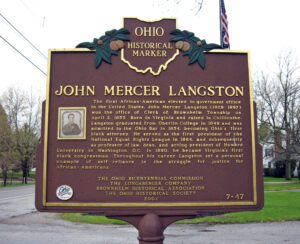
The first African-American elected to government office in the United States, John Mercer Langston (1829-1897) won the office of Clerk of Brownhelm Township on April 2, 1855. Born in Virginia and raised in Chillicothe, Langston graduated from Oberlin College in 1849 and was admitted to the Ohio Bar in 1854, becoming Ohio’s first black attorney. He served as the first president of the National Equal Rights League in 1864, and subsequently as professor of law, dean, and acting president of Howard University in Washington, D.C. In 1890, he became Virginia’s first black congressman. Throughout his career Langston set a personal example of self-reliance in the struggle for justice for African-Americans.
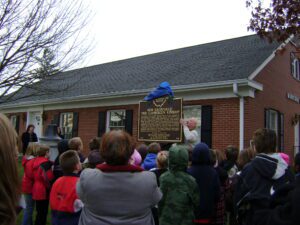
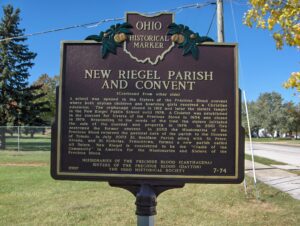
St. Boniface Catholic Church began in 1834 as a mission of several area churches and in 1836, the parish built its first church. In 1844 Bishop John Purcell commissioned Swiss born, Father Francis de Sales Brunner, a Missionary of the Precious Blood, to take pastoral charge of St. Boniface. Under the leadership of Father Brunner, the Missionaries of the Precious Blood, established in Italy in 1815, and the Sisters of the Precious Blood, founded in Switzerland in 1834, began ministry here in New Riegel (Wolfscreek) in 1844. Over two hundred acres of land were purchased for the priests, brothers, and sisters. The Missionaries brought spiritual support, farm labor, and education to the German immigrants of New Riegel. The sisters began their ministry of prayer in the convent, Mary at the Crib, on December 22, 1844. (Continued on other side)
The Hopewell Associate Reformed Church and Cemetery, now known as Historic Hopewell, was founded in 1808 in a log building that was replaced in 1826 with the present building. It was built by the area’s first settlers, mainly Scotch-Irish who left Kentucky and South Carolina because of their opposition to slavery. The church encouraged worship by African Americans and played an important role in the Underground Railroad. It became the parent church for four “Daughter” Presbyterian congregations: Fairhaven in 1835, Oxford in 1837, College Corner in 1849, and Morning Sun in 1876. Reverend Alexander Porter, the first pastor, was committed to education and constructed a school near the Hopewell Spring that still produces clear water. “Old Hopewell” was completely refurbished in 1880, but by 1915 the membership declined and regular services discontinued. Today Hopewell holds Sunday services in the summer and is maintained by a generous and devoted group of volunteers.
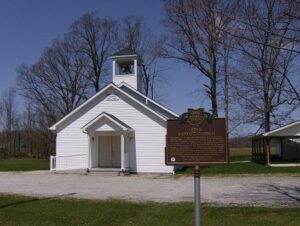
Thirteen African American families migrated to Pebble Township in Pike County in the early 1820s from Virginia. Some of the families were former slaves while others were freeborn people of color. Their farm knowledge and skill helped to make them prosperous, angering some of their white neighbors who began a campaign of harassment. Ten of the original African American settlers eventually moved away, but despite the difficulties with the white population, other African Americans continued to arrive to the settlement. They founded a church, later known as the Eden Baptist Church, built a meeting hall, and organized a school. Several of the families were also involved in the activity of the Underground Railroad. The PP Settlement thrived until the 1950s when, for economic reasons, residents moved to other communities.