

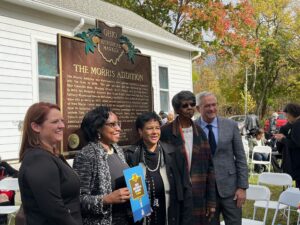
, OH
Bethel A.M.E. Church was the first African American church in Worthington. Black residents joined Worthington’s established churches as early as 1847 or worshipped together in their homes. Peter Banks with D.H. Taborn, Charles Kiner, J.T. Horton, and James Birkhead organized the A.M.E. congregation in 1896. Rapid growth moved their meetings to the Worthington Town Hall by 1897. A lot was purchased from Millie Alston on September 24, 1897, and a house relocated to serve as Bethel Chapel. Local carpenter Chester Hard constructed a new building that was dedicated as St. John A.M.E. in 1914. The church has served as the religious and social hub of Worthington’s Black community for more than a century. While St. John A.M.E. Church retains their original location, worship services moved to 7700 Crosswoods Drive in 2004.
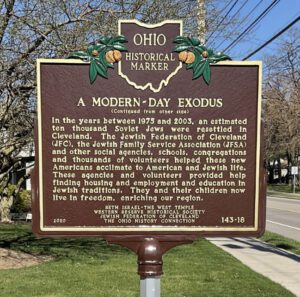
, OH
Here in 1963 congregants of Beth Israel-The West Temple, led by Louis Rosenblum, Herb Caron, and Rabbi Daniel Litt, founded the Cleveland Committee (later Council) on Soviet Anti-Semitism, the first American organization created to advocate for freedom for Soviet Jews. In 1970 this work led to the formation of the Union of Councils for Soviet Jews (UCSJ) under the leadership of Louis Rosenblum. The UCSJ, whose national office was located here 1970-1973, became the largest independent Soviet Jewry organization in the world. By the turn of the 21st century, the efforts begun here helped 1.6 million Jews leave the former Soviet Union. (Continued on other side)
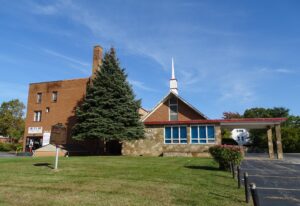
, OH
“…on Sunday morning, especially in the African American community, you could go down the street and hear The Wings Over Jordan just coming from everybody’s house….” Glenn Brackens, 2017. Upholding the sanctity of traditional African American spirituals, believing in the power of radio to uplift listeners, and recognizing his choir’s rich talent, Rev. Glenn T. Settle (1894-1967), pastor of Gethsemane Baptist Church, originated the “Negro Hour” on Cleveland’s WGAR in 1937. The Sunday morning radio show featured the choir’s moving renditions of spirituals and was originally directed by James Tate (1918-1986). Williette Firmbanks Thompson (1910-1992) was assistant director and a soloist (Continued on other side)
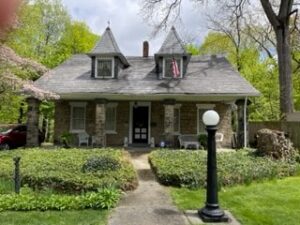
, OH
The Curtis-Preyer Stone House takes its name from two families associated with its early history. Richard and Clarissa Dille Curtis purchased 70 acres in the Connecticut Western Reserve from veteran Elias Lee in 1819. The Euclid Township “Turkey Knob” settlement soon thrived around Dugway Brook, springs sites, and an American Indian crossroads. The Curtis, Dille, Lee, and Stillman families, related by marriage, helped each other succeed by harnessing the creek to power their grist and saw mills and selling quarried stone and felled timber. Sometime between 1819 and 1835 Curtis built his stone house using the Berea sandstone quarried on site. The roof was created of ax-hewn “pegged” tree timbers, and the thick stone walls fashioned of uncoursed, chiseled stones. A central chimney fed seven fireplaces and a bake oven.
, OH
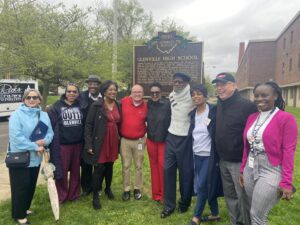
Invited to speak at three Cleveland high schools, Dr. Martin Luther King Jr. delivered his powerful “Rise Up!” speech to students at Glenville High School on April 26, 1967. It signaled King’s opening drive to elect African Americans to prominent government positions in northern cities. Encouraging students to “develop a sense of somebodiness,” King challenged them to “work passionately and unrelentingly for first-class citizenship.” Recognizing the fear of racial unrest in the city, King underscored the significance of nonviolence. “Our power lies in our ability to say non-violently that we’re not going to take it any longer,” he asserted. Making Carl Stokes’ mayoral bid the focus of his push for Black voters to elect Black leaders, King urged Glenville’s students to join civil rights organizations and community action programs.
, OH
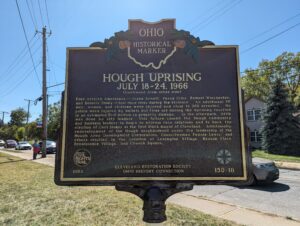
Civil unrest rocked the Hough neighborhood for five nights during the summer of 1966.When the white owners of the Seventy-Niners Cafe refused to serve a Black customer a glass of water, a sign bearing a racial epithet subsequently appeared outside the bar. Decades of institutionalized racial practices that had caused Hough’s substandard and overcrowded housing, high unemployment, economic exploitation, lack of access to quality education, and systemic police harassment sparked an urban uprising in response on July 18. Angry crowds gathered outside the bar only to be confronted by the owners brandishing firearms. When the police belatedly responded, tensions escalated into targeted firebombing, looting, and vandalism. On Tuesday night, July 19, Cleveland’s Mayor Ralph Locher requested that the Ohio National Guard restore order. (Continued on other side)
, OH
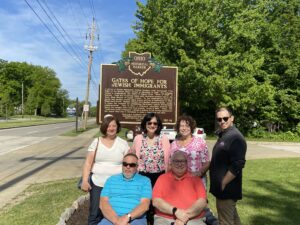
A group of Jewish immigrants fleeing Germany after Kristallnacht (The Night of the Broken Glass) settled in Cleveland in 1940. The refugees formed a congregation and named it Shaarey Tikvah, “Gates of Hope” in Hebrew. They met in private homes until obtaining premises above the Tasty Shop Bakery on Euclid Avenue. As the congregation thrived it moved and merged several times before settling in Beachwood in 1986. Rabbi Jacob Shtull, Shaarey Tikvah’s first English-speaking Rabbi, sought to honor the founders by establishing Cleveland’s annual Kristallnacht commemoration. “Face to Face,” a Holocaust education program that shares the refugee story with local schools, began in 1994. Today, this “Small Shul. Large Community” remains a tribute to the German immigrants that found their way to Cleveland to unite in friendship and faith.