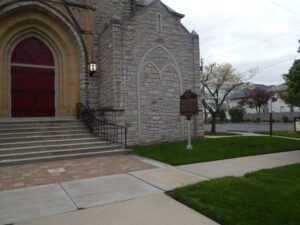
Saint Lucas Evangelical Lutheran Church, 745 Walbridge Ave
Toledo
, OH
In 1886, thirty-six members from Toledo’s downtown Lutheran church, St. Paul’s, met to form a German-speaking Lutheran congregation for immigrants from Pommern, Mecklenburg and Hanover. Initially worshipping at St. Stephen’s at the corner of Harrison and Oliver Street, the congregation built a frame church on this site in 1887. That same year St. Lucas pioneered an early form of health insurance, The Mutual Sick Benefit Society, that later became a larger fraternal organization called The Mutual Sick Benefit Society for Ohio and Other States. In 1999, after joining a program called Reconciling in Christ, St. Lucas became the first Lutheran congregation in northern Ohio to publicaly welcome the LGBT communities. Named after Saint Luke, the patron saint of physicians, the church’s history is one of healing.
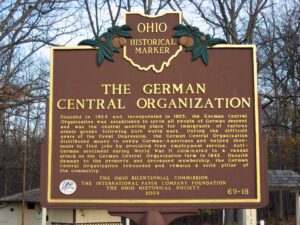
Founded in 1924 and incorporated in 1925, the German Central Organization was established to serve all people of German descent and was the central meeting place for immigrants of various ethnic groups following both world wars. During the difficult years of the Great Depression, the German Central Organization distributed money to needy German-Americans and helped thousands to find jobs by providing free employment service. Anti-German sentiment during World War II culminated in a vandal attack on the German Central Organization farm in 1942. Despite damage to the property and decreased membership, the German Central Organization rebounded and remains a solid pillar of the community.
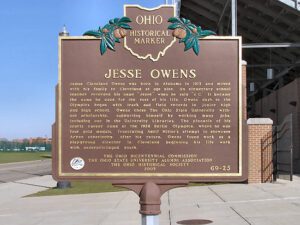
James Cleveland Owens was born in Alabama in 1913 and moved with his family to Cleveland at age nine. An elementary school teacher recorded his name “Jesse” when he said “J.C.” It became the name he used for the rest of his life. Owens’ dash to the Olympics began with track and field records in junior high and high school. Owens chose The Ohio State University without scholarship, supporting himself by working many jobs, including one in the University Libraries. The pinnacle of his sports career came at the 1936 Berlin Olympics, where he won four gold medals, frustrating Adolf Hitler’s attempt to showcase Aryan superiority. After his return, Owens found work as a playground director in Cleveland beginning his life work with underprivileged youth.
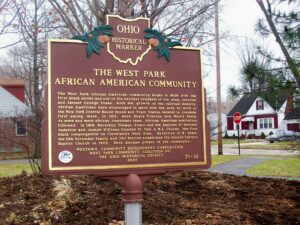
The West Park African American community began in 1809 with the first black settler and one of the earliest residents of the area, inventor and farmer George Peake. With the growth of the railroad industry, African Americans were encouraged to move into the area to work at the New York Central Round House and Train Station located in Linndale. First among these, in 1912, were Beary Frierson and Henry Sharp. As more and more African Americans came, African American institutions followed. In 1919, Reverend Thomas Evans and the families of Herndon Anderson and Joseph Williams founded St. Paul A.M.E. Church, the first black congregation on Cleveland’s West Side. Reverend D.R. Shaw, the Ebb Strowder family and Iler Burrow established the Second Calvary Baptist Church in 1923. Both became pillars of the community.
The Brewery District contains the majority of Cincinnati’s remaining breweries and associated structures such as icehouses, bottling buildings, offices, and stables. With the first brewery north of Liberty Street founded in1829, German immigrants fueled the growth of the brewing industry; by 1891, Cincinnati breweries produced over four barrels of beer per resident annually, almost twice as much as any other city in the nation. The brick breweries were typically designed in the Romanesque Revival style, and larger complexes often covered multiple city blocks. To produce the lager style beer common by 1860, typically very deep basements were dug or tunnels were cut into hillsides for the lagering process. At the height of production, 18 of the 36 breweries in greater Cincinnati were operating in Over-the-Rhine and the West End. Prohibition in 1919 closed most of the breweries permanently.
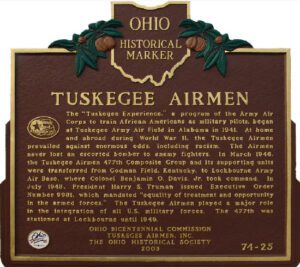
The “Tuskegee Experiment,” a program of the Army Air Corps to train African Americans as military pilots, began at Tuskegee Army Air Field in Alabama in 1941. At home and abroad during World War II, the Tuskegee Airmen prevailed against enormous odds, including racism. The Airmen never lost an escorted bomber to enemy fighters. In March 1946, the Tuskegee Airmen 477th Composite Group and its supporting units were transferred from Godman Field, Kentucky, to Lockbourne Army Air Base, where Colonel Benjamin O. Davis, Jr. took command. In July 1948, President Harry S. Truman issued Executive Order Number 9981, which mandated “equality of treatment and opportunity in the armed forces.” The Tuskegee Airmen played a major role in the integration of all U.S. military forces. The 477th was stationed at Lockbourne until 1949.
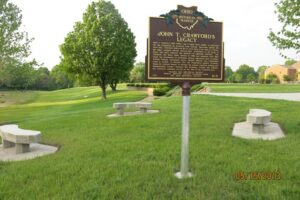
John T. Crawford (1813-1880), was a white Union soldier. In gratitude for the kindnesses he received from African-Americans during the Civil War, Crawford willed his 18 1/2-acre farm to be used as a “home, for aged, indigent worthy colored men, preference to be given to those who have suffered the miseries of American Slavery.” The Crawford Old Men’s Home opened in 1888 and operated until 1964 under the trusteeship of prominent African-Americans such as lawyer William Parham, newspaper editor Wendell Dabney, and Ambassador Jesse D. Locker. It merged with the Progressive Benefit Society’s Home for Colored Women to become the Lincoln Crawford Nursing and Rehabilitation Center. Pleasant Hill Academy, College Hill Library, and Crawford Commons are all on the site of the Crawford farm.
Fr. John Henni founded St. Aloysius Orphanage in 1837 to care for German-speaking Catholic children who were left abandoned by the cholera epidemics of the 1830s. The orphanage has occupied its main building since 1856. All of the orphanage’s other buildings were constructed by 1930. In 1864, additional land was purchased, making the orphanage a self-sufficient farm growing fruits and vegetables as well as livestock.