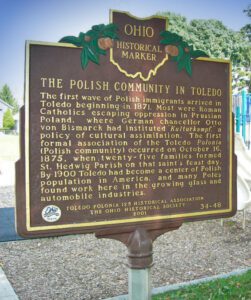
The first wave of Polish immigrants arrived in Toledo beginning in 1871. Most were Roman Catholics escaping oppression in Prussian Poland, where German chancellor Otto von Bismarck had instituted “Kulturkampf,” a policy of cultural assimilation. The first formal association of the Toledo Polonia (Polish community) occurred on October 16, 1875, when twenty-five families formed St. Hedwig Parish on that saint’s feast day. By 1900 Toledo had become a center of Polish population in America, and many Poles found work here in the growing glass and automobile industries.
On May 1, 1950, the Akron Community Service Center and Urban League building opened to the public. The Center was a gathering place for African Americans of the community, where they addressed workplace, education, and other issues dividing the city. Directors included the late George W. Thompson, Raymond Brown, and Vernon L. Odom. The Center provided space for meetings, classes and receptions and had a swimming pool and gymnasium. The Center also hosted talent shows, which included the musicians who became Ruby and the Romantics. The group scored a #1 hit in 1963 with “Our Day Will Come.”
The land on which Coventry Township is situated was ceded in 1785 to the United States by the Delaware, Chippewa, Ottawa, and Wyandot tribes under the Treaty of Fort McIntosh. The area was a choice location for Native Americans, settlers, and fur traders due to the abundant bodies of water and proximity to the Portage Path, a land connection between the Tuscarawas and Cuyahoga rivers and Lake Erie. In 1788, Coventry Township was initially part of Washington County, the first county formed in the Ohio Territory. After Moses Warren finished a survey in 1797, a succession of county splits located Coventry Township in Jefferson County, Trumbull County, Portage County, and, finally, Summit County in 1840. The township originally encompassed Summit Lake and the lands south to the southern line of the Western Reserve (Green-New Franklin lines). Daniel Haines was the first resident to settle in Coventry Township in 1806.
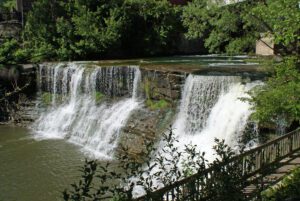
The Chagrin River was named for Francois Seguin, a Frenchman who traded with Native Americans in Northeast Ohio circa 1742. The “High Falls” of the Chagrin River primarily attracted settlers from New England (circa 1833) seeking a location with ample waterpower. By the mid-nineteenth century an axe factory, a foundry, 2 flour mills, 4 woolen mills, 2 sawmills, 3 paper mills, and a woodenware factory had been built along the riverbanks in Chagrin Falls. The “High Falls” provided a power source for a gristmill, built in 1836 at this location. Today, only one factory remains in operation in the Village of Chagrin Falls.
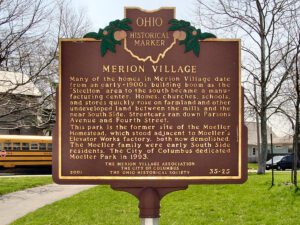
Merion Village was named for the Nathaniel Merion family, who in 1809 settled what is now the South Side of Columbus on 1800 acres of the Refugee Lands. Entrepreneur William Merion operated “Merion’s Landing” in the 1830s to capitalize on the canal trade from the Columbus Feeder Canal. This area saw a large influx of German immigrants as the South Side industrialized in the mid-nineteenth century. Later, many Irish, Italian, and eastern European immigrants who worked in the local steel mills and foundries made their homes here.
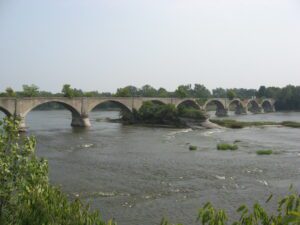
The Lima and Toledo Traction Company Bridge was construted in 1907 by the National Bridge Company of Indianapolis, and it was considered to be a revolutionary type of bridge construction. The Old Electric Bridge, as it was called, was built of steel reinforced concrete and filled with earth. In fact, for this period some considered the bridge to be the longest such railroad bridge in the world. Twelve spans of Roman aqueduct architectural design anchor the 1220-foot bridge in solid river bedrock. The bridge linked Lucas and Wood counties and connected a busy Toledo with points south by means of an electric trolley. This Interurban Bridge was placed on the National Register of Historic Places in 1972.
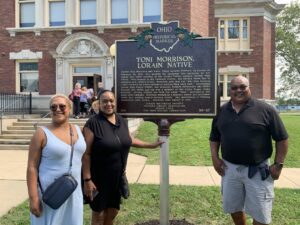
Author Toni Morrison was born, Chloe Ardelia Wofford, in Lorain on February 18, 1931. Her passion for language was nurtured by her family and while working at the Lorain Public Library during high school. Then housed in the Carnegie Center, the library hired her to reshelve and catalog books. Morrison said that she “was slow because I kept reading the books instead of putting them back fast.” Graduating Lorain High School (1949), she attended Howard University (BA 1953), Cornell (MA 1955), and she was a member of the Alpha Kappa Alpha sorority. During college she took the name “Toni,” shortening her saint name Anthony. Morrison worked as a literary editor and professor while also writing award-winning novels. She maintained a lifelong connection with Lorain. Morrison died August 5, 2019.
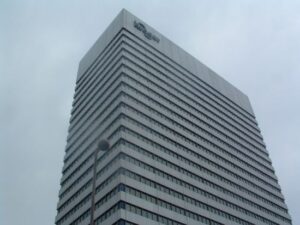
Near this site in Over-The-Rhine was one of the original Kroger Grocery & Baking Company stores, where Bernard H. Kroger began serving the Over-the-Rhine area in 1902. Kroger was 23 years old when he opened his first store, The Great Western Tea Company, at 66 East Pearl Street near the Cincinnati Riverfront in July of 1883. By 1902, when the company was incorporated as the Kroger Grocery & Baking Company, Kroger operated 40 stores. By 1908, the company had grown to a chain of 136 stores in Cincinnati, Dayton, Columbus, and Northern Kentucky, and began making deliveries to customers with 200 mule-drawn wagons. Kroger was the first to combine meats and groceries under one roof and the first grocery company to operate its own bakery. Currently called the Kroger Co., the grocer is a major contributor to the local economy.