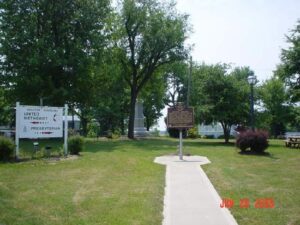
Originally called St. Clairsville and platted in 1801, Decatur was named for early 19th century naval hero Stephen Decatur. It is among the oldest villages in Brown County, which before 1817 was a part of Adams County. Among its notable early residents were Nathaniel Beasley (1774-1835), the first surveyor of Adams County, and Sarah Boone Montgomery (1763-1848), a heroine of the border wars in Kentucky. Decatur and Byrd Township supported at least four known stations on the Underground Railroad. Many area residents helped conduct escaping slaves northward to freedom.
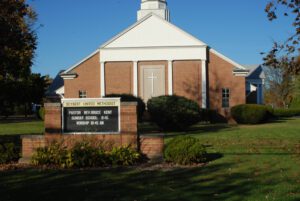
Born in Pennsylvania in 1791, Bishop John Seybert came to Ohio in 1822 and preached throughout the mid-west. Seybert served the faith for forty years as an itinerant preacher, a presiding elder, and the first bishop of the Evangelical Association, one of the original denominations that is now part of the United Methodist Church. As a circuit rider, he traveled on foot, horseback, and spring wagon a distance of 175,000 miles, preached 9,850 sermons, held 8,000 prayer and class meetings, and made about 46,000 pastoral calls and 10,000 calls on the sick. Seybert often paid his own expenses on the meager salary of $100 per year. He died in 1860 and is buried in the Bellevue – Flat Rock area.
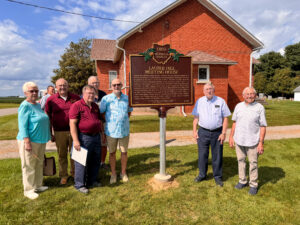
In 1834, immigrant families from the Upper Rhine River Valley villages of Mulhausen (France) and Schaffhausen (Switzerland) first met in Marshallville, Ohio. They decided to travel west by canal boat and purchase farmland in what became Fulton County in 1850. Joseph Bates, a knowledgeable hunter and navigator, brought them to German Township. On August 22, 1834, Bates and his hired men erected a log cabin for Christian Lauber and the first families arrived at “Lauber Hill” the following day. The farming community grew and by the 1880s included a Reformed Mennonite Church, a German Baptist Church, a Froehlich Evangelical Church, the Barneth (Bernath) one-room school, the Werrey Cabinetmaker’s Shop, the Roth Sawmill, the Uhlrich Wagon Shop, the Wise Brickworks, and the Leu Blacksmith Shop.
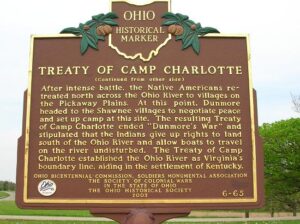
In an effort to maintain peace with Native Americans, the British imposed the Proclamation Line of 1763, which prohibited colonial settlement west of the Appalachian Mountains. Some settlers did not recognize British authority and continued to move westward. Virginia Governor Lord Dunmore, realizing that peace with Native Americans was improbable, amassed troops and headed west, camping at the Hocking River to meet with a unit commanded by Andrew Lewis. En route, Lewis’s troops were attacked on October 10, 1774 at present day Point Pleasant, West Virginia, by a force of Delaware and Shawnee led by Cornstalk.
Seba Bronson Jr. left Columbia Township in early 1810 and followed the Rocky River to an area one and a half miles north of here. He built a cabin and planted a crop and thus started what became known as the village of Hardscrabble in Liverpool Township. The village was centered around the Columbia/Grafton Road area, and the township is the oldest continuously inhabited township in Medina County. The Potawatami Indians occupied this area and camped annually along the Rocky River. For five silver dollars, they showed Seba and a partner a hidden salt springs which they sought to exploit. Other men also scrabbled to own it and Justus Warner succeeded. Seba was turned out. Warner operated the Liverpool Salt Works beginning in 1811. The first industry in the county, salt was a necessity and eagerly sought by setters in the area.
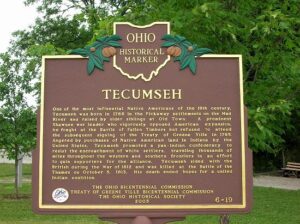
One of the most influential Native Americans of the 19th century, Tecumseh was born in 1768 in the Pickaway settlements on the Mad River and raised by older siblings at Old Town. A prominent Shawnee war leader who vigorously opposed American expansion, he fought at the Battle of Fallen Timbers but refused to attend the subsequent signing of the Treaty of Greene Ville in 1795. Angered by purchases of Native American land in Indiana by the United States, Tecumseh promoted a pan-Indian confederacy to resist the encroachment of white settlers, traveling thousands of miles throughout the western and southern frontiers in an effort to gain supporters for the alliance. Tecumseh sided with the British during the War of 1812 and was killed at the Battle of the Thames on October 5, 1813. His death ended hopes for a united Indian coalition.
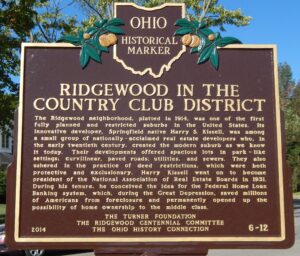
The Ridgewood neighborhood, platted in 1914, was one of the first fully planned and restricted suburbs in the United States. Its innovative developer, Springfield native Harry S. Kissell, was among a small group of nationally-acclaimed real estate developers who, in the early twentieth century, created the modern suburb as we know it today. Their developments offered spacious lots in park-like settings; curvilinear, paved roads; utilities, and sewers. They also ushered in the practice of deed restrictions, which were both protective and exclusionary. Harry Kissell went on to become president of the National Association of Real Estate Boards in 1931. During his tenure, he conceived the idea for the Federal Home Loan Banking system, which, during the Great Depression, saved millioins of Americans from foreclosure and permanently opened up the possibility of home ownership to the middle class.
This hamlet, located one mile southwest from here, was never platted, but was named after William Woods, president of the three-story brick Woodsdale paper mill constructed in 1867. Flanking the mill were the company office and store and several workers’ houses. Previous to this, the area flourished from the presence of two grist mills on the Great Miami River and from the Miami & Erie Canal. Additional enterprises such as a stone quarry, ice cutting company, and grain elevator operated here during the late 19th and early 20th centuries. Woodsdale was also known for the Woodsdale Island Amusement Park and the LC&D Railroad depot. The park, established on an island between the Miami & Erie Canal and the Great Miami River in 1891, was the site of picnics, political rallies, a large dance hall, and amusement rides–including a beautiful swan boat. The great flood of 1913 completely destroyed the park.