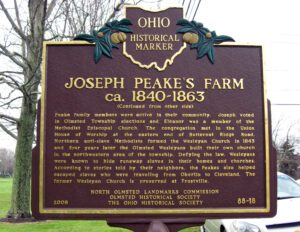
Joseph Peake was born in Pennsylvania in 1792 and came to Ohio in 1809 with his parents and brother. They were the first African Americans to settle permanently in the Cleveland area. He was the son of George Peake, a runaway slave from Maryland, who fought on the British side at the Battle of Quebec in 1759 during the French and Indian War. A man with some means and talent, George Peake invented a stone hand mill for grinding corn, a labor-saving device that endeared the Peakes to their neighbors in western Cuyahoga County. Joseph Peake and his wife Eleanor, an African American from Delaware, bought land in the 1840s on the Mastick Plank Road and built a home near this marker. [Continued on other side]
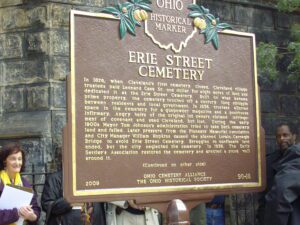
In 1826, when Cleveland’s first cemetery closed, Cleveland village trustees paid Leonard Case Sr. one dollar for eight acres of land and dedicated it as the Erie Street Cemetery. Built on what became prime property, the cemetery touched off a century long struggle between residents and local government. In 1836, trustees allotted space in the cemetery for a gunpowder magazine and a poorhouse infirmary. Angry heirs of the original lot owners claimed infringement of covenant and sued Cleveland, but lost. During the early 1900s Mayor Tom Johnson’s administration tried to take back cemetery land and failed. Later pressure from the Pioneers’ Memorial Association and City Manager William Hopkins caused the planned Lorain Carnegie Bridge to avoid Erie Street Cemetery. Struggles to confiscate land ended, but the city neglected the cemetery. In 1939, The Early Settler’s Association restored the cemetery and erected a stone wall around it. (continued on other side)
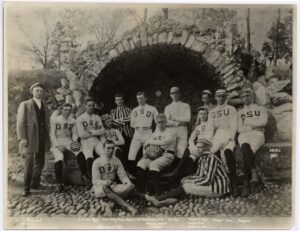
In the fall, life for many in Columbus revolves around Ohio State University football, from the first kickoff in September to the last play in November. O.S.U.’s first home game took place at 2:30 P.M. on November 1, 1890. The Ohio State University played the University of Wooster on this site, which was then called Recreation Park. Just east of historic German Village, the park occupied the north side of Schiller (now Whittier) between Ebner and Jaeger in what is now Schumacher Place. The weather was perfect, and the crowd reportedly included a number of women, who cheered loudly. Nonetheless, O.S.U. lost to Wooster 64-0. Wooster, physically fit for the game, showed O.S.U. that training is critical to winning. The tradition of training continues. Today, on football Saturdays in Ohio Stadium on Woody Hayes Drive, the sound of an O.S.U. home game can be heard around the world.
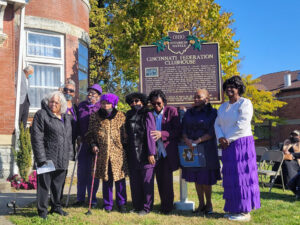
“Lifting As We Climb”: The Cincinnati Federation of Colored Women’s Clubs (CFCWC) was organized May 6, 1904, during a meeting called by Mary Fletcher Ross at the Allen Temple A.M.E. Church. Gathering together eight existing African-American women’s clubs, the CFCWC sought to unite in their work promoting “the betterment of the community.” At a time when both government and private philanthropies overlooked the needs of Black Americans, CFCWC members helped to organize the city’s first kindergartens for Black children, taught in Cincinnati African-American public schools –including the Walnut Hills Douglass and Stowe schools—and raised money for the Home of Aged Colored Women. Since 1904, the Cincinnati Federation of Colored Women’s Clubs has ensured the civic and constitutional rights of all African Americans while meeting the needs of their city.
In 1911 local doctors founded the St. Clair Hospital. The home adjacent to the hospital served as a residence home and training school for nurses. In 1940, the hospital was converted into a convalescent home. In 1948, Mr. and Mrs. William J. Garrett, an African-American couple, transformed the facility into a hotel. The Hotel St. Clair, which closed in 1976, accommodated African Americans who were not permitted to stay in white hotels. It also served as a social gathering place for members of Columbus’ black community.
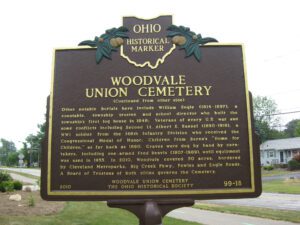
Woodvale Cemetery was established in the mid-1800s, in Middleburgh Township, Ohio. The oldest marked grave holds Fred G. Klink (1835-1858), whose family donated a half acre of land for burials. In 1876, Frank M. Stearns (1832-1911) suggested the unnamed cemetery be called Woodvale, after the wooded vale beside it. In 1908, a fire destroyed the caretaker’s house and many cemetery records. Woodvale became a non-profit, union cemetery in 1931, owned by Berea and the Village of Middleburg Hts. and covering 35 acres at 7535 Engle Road. Pioneer families buried here: Fowles, Kraft, Lovejoy, Sprague, and Stearns. Also buried here: John Baldwin (1799-1884) founder of Baldwin University and James Wallace (1878-1953) founder of German Wallace College (merged in 1913 to become Baldwin Wallace College) (Continued other side)
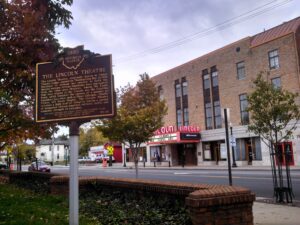
The Lincoln Theatre, originally known as Ogden Theatre Lodge, opened on Thanksgiving Day in 1929. Developer Al Jackson was spurred to build the theatre because African-Americans were segregated from the other area theatres. Among the bands that have played at the Lincoln was the Eckstine Band, which launched the careers of a number of legendary jazz stars such as Dizzy Gillespie, Charlie Parker, and Sarah Vaughn. The Lincoln Theatre retained a high level of integrity during a period of unequaled African-American cultural, social, and economic strength in Columbus.
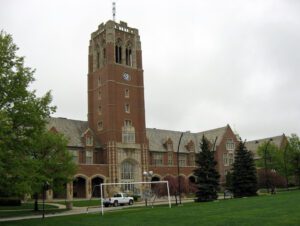
John Carroll University opened its doors as Saint Ignatius College on September 6, 1886. Originally located on Cleveland’s West Side, the College was founded at the request of Bishop Richard Gilmour by German members of the Society of Jesus (the Jesuits, founded in 1540). In 1923, the College was renamed John Carroll University after America’s first bishop. In 1925, the University acquired land in Idlewood Village (now University Heights) and initiated construction of a new campus in 1931. Classes began there in 1935 with 456 students. The institution admitted laywomen to evening and graduate classes in the 1930s and officially became coeducational in 1968. The University’s Jesuit Catholic mission inspires individuals to excel in learning, leadership, and service, both regionally and worldwide. John Carroll University is one of 28 Jesuit institutions of higher learning in the United States.