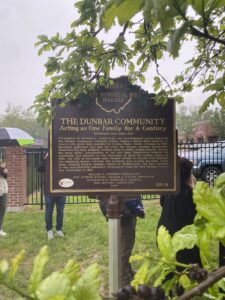
Dunbar, or Corsica Hollow, was an African American neighborhood on the western edge of Madisonville. Its streets and lots were laid out in 1886 after Mahlon and Anna Leonard subdivided their 10-acre tract near Duck Creek and sold lots to African Americans. Many early Dunbar residents were from the South; some born there prior to emancipation. Prominent early citizens included Harriet Deatherage, Elihu Parks, Gandison Embry, Thomas Duett, and James Murphy. Dunbar was home to the New Mission Missionary Baptist Church, founded in 1907. Originally meeting in a one-room building, the extant congregation relocated to Ravenna Street in 1963. By the late 1920s, Dunbar had about forty houses, a grocery run by Henry Lowman, and a hair salon run by Flora Hector. (Continued on other side)
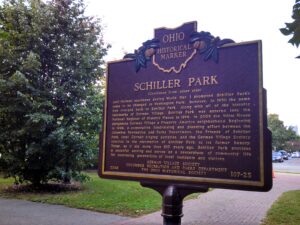
Long a gathering place for residents of Columbus, this area, which became known as Schiller Park, hosted German songfests, Fourth of July festivities, the 1864 and 1865 Ohio State Fairs, and the 1871 peace celebration commemorating the end of the Franco-Prussian War. In 1867, the City of Columbus purchased 23 acres of this area, then known as Stewart’s Grove, for $15,000 and named it City Park. On July 4, 1891, before a crowd of 50,000, the German-American community dedicated the 25-foot tall, 2,640 pound statue of German poet Friedrich von Schiller that had been cast in Munich, Germany and given as a gift to the City of Columbus. In 1905, the Park’s name was changed to Schiller Park. (Continued on other side)
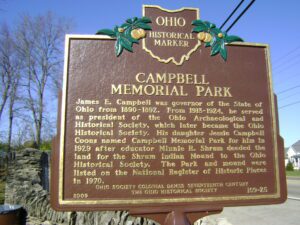
James E. Campbell was governor of the State of Ohio from 1890-1892. From 1913-1924, he served as president of the Ohio Archaeological and Historical Society, which later became the Ohio Historical Society. His daughter Jessie Campbell Coons named Campbell Memorial Park for him in 1929 after educator Minnie R. Shrum deeded the land for the Shrum Indian Mound to the Ohio Historical Society. The park and mound were listed on the National Register of Historic Places in 1970.
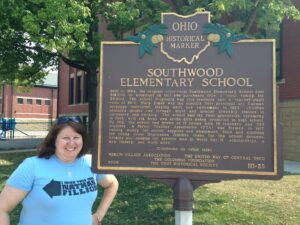
Built in 1894, the original eight-room Southwood Elementary School cost $16,000 to construct on this site purchased from a local family for $3,000. The school originally had five teachers and a teacher-pupil ratio of 50-1. Mary Esper was the school’s first principal and German language instructor, staying until her retirement in 1923. Children attended grades one through eight and special biweekly classes in carpentry and cooking. The school had its first graduation ceremony in 1896, with six boys and seven girls being promoted to high school. By 1912, the school had grown to 17 rooms with 16 teachers and 735 students. A Parent Teacher Association (PTA) was formed in 1917, raising money for school supplies and equipment, food and clothing for needy Great Depression families, trees for the school grounds, cookies and candies for service men in World War II, scholarships, a new library, and much more. [continued on other side]
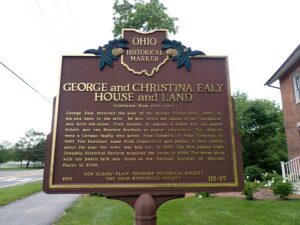
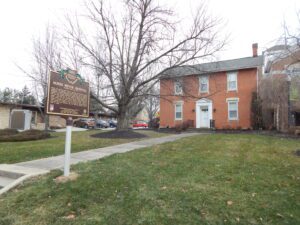
The George and Christina Ealy House is a testament to the prosperity of one of this area’s early residents and the skills of mid-nineteenth-century craftsmen. In 1830, members of the Ealy family moved from Pennsylvania to a 73-acre parcel where the house and six-acre Resch Park surrounding it are located. The Ealys were representative of a second wave of pioneers who settled Plain Township after 1812. The Ealys cleared land for farming and operated a sawmill on Rose Run. George prospered and in 1860 built this fine brick house. Architecturally, the house exhibits the transition between Greek Revival and Italianate styles. Its layout reflects the former; its proportions and decorative detail, the latter. (Continued on other side)
The house at this location, 110 South State Street, was the childhood home of Agnes Meyer Driscoll (1889-1971). Known as “the first lady of naval cryptology,” her career spanned from World War I to the Cold War. Driscoll attended Otterbein University before graduating from the Ohio State University, with majors in physics, math, music, and foreign languages. During World War I, she enlisted in the U.S. Navy as a chief yeoman, the highest rank possible for a woman at the time. After the war, Driscoll rose to become the chief civilian cryptanalyst for the U.S. Navy, breaking major Imperial Japanese Navy codes prior to World War II. (Continued on other side)
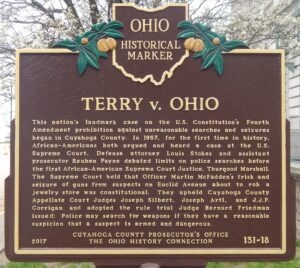
This nation’s landmark case on the U.S. Constitution’s Fourth Amendment prohibition against unreasonable searches and seizures began in Cuyahoga County. In 1967, for the first time in history, African-Americans both argued and heard a case at the U.S. Supreme Court. Defense attorney Louis Stokes and assistant prosecutor Reuben Payne debated limits on police searches before the first African-American Supreme Court Justice, Thurgood Marshall. The Supreme Court held that Officer Martin McFadden’s frisk and seizure of guns from suspects on Euclid Avenue about to rob a jewelry store was constitutional. They upheld Cuyahoga County Appellate Court Judges Joseph Silbert, Joseph Artl, and J.J.P. Corrigan and adopted the rule trial Judge Bernard Friedman issued: Police may search for weapons if they have a reasonable suspicion that a suspect is armed and dangerous.
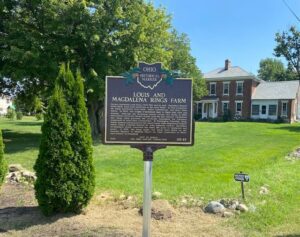
German immigrant Louis Rings (1826-1911) and his wife, Magdalena Wolpert (1835-1924), built their farmhouse in the early 1860s. As they prospered, the Rings purchased more land, added outbuildings, and grew their family. In 1904, the couple transferred land to their sons John and William. Although the farmhouse passed outside the family in 1929, descendants lived and farmed nearby until the 21st century. Farmsteads like Rings Farm provided the economic foundation for European immigrants to build Ohio communities. In Washington Township, Rings family members participated in the school board while Magdalena’s Wolpert family helped establish Dublin’s St. John Lutheran Church. Spreading development slowly converted the farm’s 150 acres to businesses and homes. In 1979, the Rings house and barns were listed on the National Register of Historic Places for their connection to Ohio’s agricultural development.