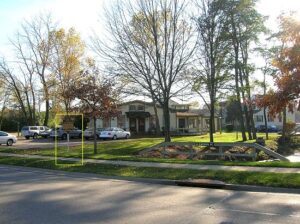
On this site in 1882, Gustave H. Grimm (1850-1914), a German immigrant tinsmith, established the G.H. Grimm Manufacturing Company. His device, the Champion Evaporator revolutionized maple syrup production with the use of a corrugated pan which increased the efficiency of evaporating liquids such as saps. Grimm’s business became the world’s leading manufacturer of maple supplies. His contributions as an inventor, researcher, and manufacturer established him as a leader in the maple sugar industry.
The Erie Terminal Building, constructed 1921-1922, serviced both the Erie and Pittsburgh & Lake Erie Railways and area commerce. The design, by Swiss-born, Youngstown architect Paul Boucherle (1882-1966), is in the Commercial Style with simple classical details. The six-story building housed a passenger railroad station on the first floor and Erie Railway offices on the fifth and sixth floors. A one-story commercial bay faced Commerce Street and was the home of the International Bank and later the Morris Plan Bank. The widening of Commerce Street removed the bay in 1939. Once named the Hamory Building for its financial backer, Gustave Hamory, it was added to the National Register of Historic Places in 1986 and renovated in 2012, creating apartments in the upper floors and restoring the first-story railway spaces.
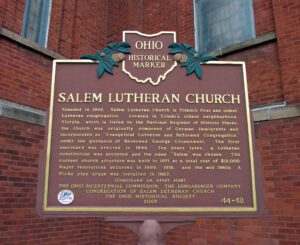
Founded in 1842, Salem Lutheran Church is Toledo’s first and oldest Lutheran congregation. Located in Toledo’s oldest neighborhood, Vistula, which is listed on the National Register of Historic Places, the church was originally composed of German immigrants and incorporated as “Evangelical Lutheran and Reformed Congregation” under the guidance of Reverend George Cronenwett. The first sanctuary was erected in 1844. Ten years later, a Lutheran constitution was accepted and the name “Salem” was chosen. The current church structure was built in 1871at a total cost of $12,000. Major renovations occurred in 1889, 1916, and the mid 1960s. A Wicks pipe organ was installed in 1967. (continued on other side)
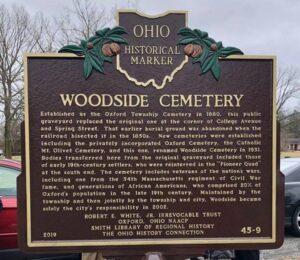
Established as the Oxford Township Cemetery in 1880, this public graveyard replaced the original one at the corner of College Avenue and Spring Street. That earlier burial ground was abandoned when the railroad bisected it in the 1850s. New cemeteries were established including the privately incorporated Oxford Cemetery, the Catholic Mt. Olivet Cemetery, and this one, renamed Woodside Cemetery in 1931. Bodies transferred here from the original graveyard included those of early 19th-century settlers, who were reinterred in the “Pioneer Quad” at the south end. The cemetery includes veterans of the nation’s wars, including one from the 54th Massachusetts regiment of Civil War fame, and generations of African Americans, who comprised 20% of Oxford’s population in the late 19th century. Maintained by the township and then jointly by the township and city, Woodside became solely the city’s responsibility in 2002.
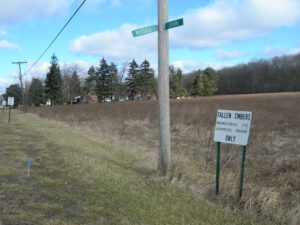
The Battle of Fallen Timbers, fought on August 20, 1794, is one of the most significant events relating to post-Revolutionary War America. Major General “Mad” Anthony Wayne led the Federal Army, known as The Legion of the United States against a confederacy of Native Americans led by Miami Chief Little Turtle and Shawnee war chief Blue Jacket. Defeat in battle and lack of help from their nearby British allies disheartened the tribes and lead to the 1795 Treaty of Greenville. The Treaty secured United States control of the Northwest Territory and ultimately resulted in the formation of five new states-Ohio, Indiana, Michigan, Illinois, and Wisconsin. (continued on other side)
Born in Richmond, Virginia, Powhatan Beaty moved to Cincinnati in 1849, where he spent the majority of his life. Beaty enlisted as a private in the Union Army in June 1863, and two days later was promoted to first sergeant, Company G, 5th United States Colored Troops (USCT). All the officers of Company G were killed or wounded during an attack on Confederate forces at New Market Heights, Virginia, in September 1864. Beaty took command of his company, and for his valor received the Congressional Medal of Honor. Beaty was one of two African-Americans buried in Ohio to receive the Medal of Honor for service in the Civil War. He died on December 6, 1916, leaving two sons, attorney and state representative A. Lee Beaty and John W. Beaty. He is buried in Union Baptist Cemetery along with nearly 150 USCT veterans.
On January 9, 1919, a group of eight men and three women, being led by the Holy Spirit, met at a house on Wallace Street to form a new black Missionary Baptist Church in Hamilton, Ohio. The group quickly raised $150 to make the down payment on a two-story brick building at 333 Chestnut Street being sold for $1,850. The building was occupied on March 25, 1919, and the name Pilgrim Baptist Church was suggested and accepted. On May 11, 1919, a special council requested admittance into the Western Union Baptist Association, a district association now affiliated with the Ohio Baptist General Convention. Requirements for admission were met and Pilgrim Baptist Church was recognized as a Missionary Baptist Church. In 2019, Pilgrim Baptist Church celebrated a centennial of faithfulness in Hamilton.
Here in the Oak Openings Region of northwest Ohio, some of the last Ottawa villages in Ohio lined the banks of Swan Creek during the 1830s. These Native Americans were led by Chief Ottokee (Autokee), a descendant of Pontiac, and half brother to another Ottawa Chief named Wauseon. Known for being honest and friendly, Ottokee was the last Ottawa chief in the Maumee Valley, for years refusing to go when the last of his people were removed to lands west of the Mississippi River.