In 1972, Urbancrest’s Ellen Walker Craig-Jones became the first African-American woman to be elected mayor, by popular vote, of a United States municipality. During her term as mayor (1972-1975), Craig-Jones oversaw the modernization of Urbancrest’s various programs and the village rebuilt three main streets, installed streetlights and street signs, and received approval to start a $3 million housing project. Craig-Jones had many years of experience in service to her community, serving twelve years on the Urbancrest Village Council. She was the recipient of dozens of awards and honors, including Who’s Who Among Black Americans.
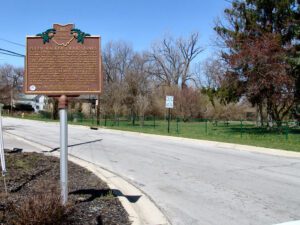
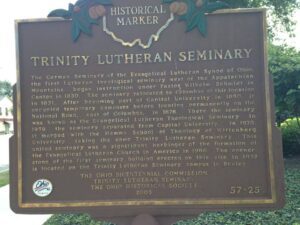
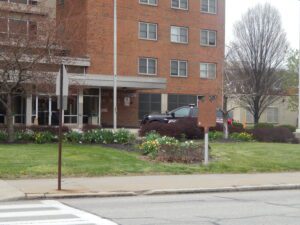
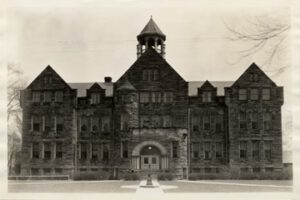
The German Seminary of the Evangelical Lutheran Synod of Ohio, the first Lutheran theological seminary west of the Appalachian Mountains, began instruction under Pastor Wilhelm Schmidt in Canton in 1830. The seminary relocated to Columbus at this location in 1831. After becoming part of Capital University in 1850, it occupied temporary campuses before locating permanently on the National Road, east of Columbus, in 1876. There the seminary was known as the Evangelical Lutheran Theological Seminary. In 1959, the seminary separated from Capital University. In 1978, it merged with the Hamma School of Theology of Wittenberg University, taking the name Trinity Lutheran Seminary. This united seminary was a significant harbinger of the formation of the Evangelical Lutheran Church in America in 1988. The cornerstone of the first seminary building erected on this site in 1832 is located on the Trinity Lutheran Seminary campus in Bexley.
John Malvin (1795-1880) was an operative on the Underground Railroad and an ardent member of anti-slavery and abolitionist causes. Born in Dumfries, Virginia of a free mother and enslaved father, Malvin was apprenticed at an early age to learn carpentry and taught himself to read and write. In 1827, he moved to Cincinnati where he became an ordained preacher and an activist in the cause of freedom. In 1831, with his wife Harriet, he moved to Cleveland where he became a charter member of the First Baptist Church, a sawmill operator, and captain and owner of the canal boat Auburn. (continued on other side)
In 1845, Baldwin Institute, one of the first schools in the area open to all students regardless of gender, race, or creed, was chartered. The wealth generated by the sandstone and grindstone industries of Berea allowed John Baldwin to found the school. Ten years later, officials rechartered the school and renamed it Baldwin University. By the 1880s, the expanding quarries began to encroach on the original campus of the university, forcing it to relocate. In 1891, ground was broken for the new campus at the corner of Front Street and Bagley Road. Recitation Hall, renamed Wheeler Hall, was the first new building, followed by the Philura Gould Baldwin Memorial Library in 1894. In 1905, through the funding of the Carnegie Foundation, the Ladies Hall, renamed Carnegie Hall, was moved stone by stone to the new campus to serve as the science building. Baldwin University merged with German-Wallace College in 1913 to become Baldwin-Wallace College.
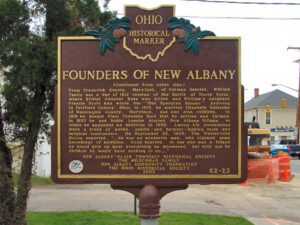
A tavern and inn, for which Noble Landon (1783-1866) obtained a liquor license in 1835, formerly occupied the southeast corner of High and Main streets. In 1837 Landon and William Yantis laid out the town of New Albany in 50-by-100-foot lots, with Landon’s lots lying on the east side and Yantis’ on the west side of High Street. Landon was born in Litchfield, Connecticut, lived as a young man in St. Albans, Vermont, and migrated to Licking County, Ohio, in 1810. He was the first clerk and first Justice of the Peace in St. Albans Township and first postmaster in Johnstown and later in New Albany. In addition to contributions as a builder-developer, Landon gave to the village lore the story of a remarkable conversion. Long known as a heavy drinker, he suddenly ordered kegs of whiskey he owned to be carried into the street and broken. He then attended church regularly. (continued on other side)
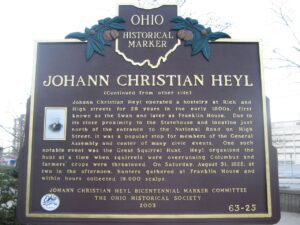
Johann Christian Heyl (1788-1877), the first German and first Lutheran to settle in Columbus, was one of the original 15 settlers of the city. A baker by trade, Heyl came to bake for the soldiers quartered in Franklinton during the War of 1812. He founded the city’s first Lutheran Church and helped financially underwrite the German Theological Seminary, which later became Capital University. An early civic leader, Heyl served on City Council for 14 years, was County Treasurer for 8 years, an associate judge in the Court of Common Pleas for 14 years, was appointed to the first public school board, and was the first Chief of the Fire Department. His Sunbury Road home was a stop on the Underground Railroad. (continued on other side)
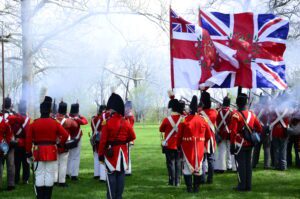
Near this site, in the War of 1812, stood the British encampment during the First Siege of Fort Meigs from May 1-9, 1813. This marker honors members of the 41st Regiment of Foot who died during the engagement. Killed in action on May 5, 1813 were Privates James Barkley, Richard Booth, William Carpmail, Samuel Cartledge, John Cox, Benjamin Dorman, John Dyer, Edward Graves, and Patrick Russell. Private Edward Billing died of wounds from battle May 6 and Private John Chamberlane expired May 20.
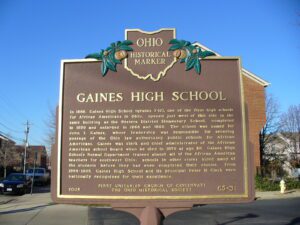
In 1866, Gaines High School (grades 7-12), one of the first high schools for African Americans in Ohio, opened just west of this site in the same building as the Western District Elementary School, completed in 1859 and enlarged in 1866 and 1868. The school was named for John I. Gaines, whose leadership was responsible for securing passage of the Ohio law authorizing public schools for African Americans. Gaines was clerk and chief administrator of the African American school board when he died in 1859 at age 38. Gaines High School’s Normal Department trained almost all of the African American teachers for southwest Ohio; schools in other states hired many of the students before they had even completed their studies. From 1866-1886, Gaines High School and its principal Peter H. Clark were nationally recognized for their excellence.