

, OH
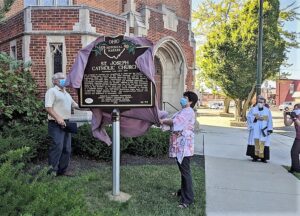
St. Joseph Catholic Church has been located here since the parish’s formation in 1845. Tiffin was established by Josiah Hedges in 1822, and shortly after, many German Catholic families began to settle in the area. They formed part of St. Mary’s parish until 1845, when they obtained permission from Bishop John Purcell of the Diocese of Cincinnati to organize as the separate congregation of St. Joseph. In May 1845, parishioners bought two acres of land at the conjunction of Melmore and South Washington Streets. Within the month, they laid the cornerstone for a 40-foot by 66-foot brick church that would be completed by August of that year. As the congregation grew, Rev. Joseph Bihn, pastor from 1856 to 1873, saw the need for a new church. (Continued on other side)
, OH
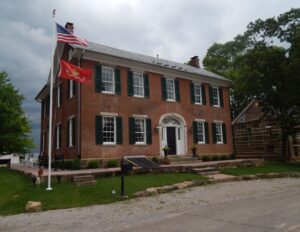
Erected in 1828, the Randolph Mitchell House is a five-bay, Federal-style “I” house. Its facade features a doorway with an Adam-style fan and sidelights. The interior boasts a grand stairway in the foyer and fine woodwork throughout. Randolph Mitchell (1796-1847) was born in Rockingham County, Virginia. In 1819, Mitchell and his mother Sarah (1765-1844), settled in New Reading and he married Lydia Witmer (1798-1872). They had four children. A merchant, Mitchell kept an ample smokehouse and owned a tannery and real estate. He served as a justice of the peace for Reading Township. After Mitchell’s death, his son-in-law, Dr. W.W. Arnold (1818-1872) maintained his practice in the home, where he and Caroline Mitchell Arnold (1825-1888) lived. Their son William Arnold (1858-1948) acquired the house, which remained in the family until 1951. The property was listed on the National Register of Historic Places in 1978.
, OH
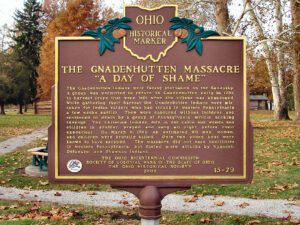
The Moravian Church in America began missionary work among the Delaware and Mohican tribes of North America in the mid-18th century. David Zeisberger, one of the best-known Moravian missionaries, came to the Ohio country with Delaware converts from a mission in western Pennsylvania and founded Schoenbrunn in the Tuscarawas Valley on May 3, 1772. Josua, a Mohican convert and missionary leader, led Mohican and Munsee Christians downriver and settled Gnadenhutten (“Tents of Grace”) on October 9, 1772. Zeisberger served as lead missionary at both villages. By 1775, there was an estimated 200 inhabitants in the village. The British, along with Wyandot and Delaware allies, suspected the Christian Indians of aiding the Americans. To ensure their allegiance to the British, the inhabitants of Gnadenhutten were forcibly removed in 1781 and taken to Captives’ Town on the Sandusky River.
, OH
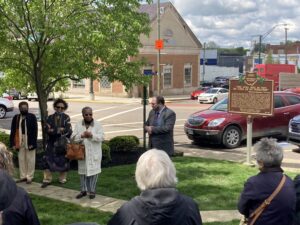
Ellamae Simmons, born and raised in Mount Vernon, became the first African American woman physician to specialize in asthma, allergy, and immunology in the country. Graduating in the top of her high school class, she dreamed of attending Ohio State University to become a nurse but was rejected as that program “did not have the facilities for training” the young black girl. Whenever Simmons encountered a barrier in life she refused to accept rejection, tenaciously steered the course of her own life, and blazed new trails for others. She ultimately earned degrees in nursing (Hampton, 1940), pre-med biological sciences (OSU, 1948), social work (OSU, 1950), and medicine (Howard University, 1959). Dr. Simmons again broke gender and racial barriers when hired by Kaiser Permanente in 1965. She practiced there until retiring in 1989. Simmons died aged 101.
, OH
“I say white brother, because I believe that to be the proper phrase, inasmuch as I believe in the principle of the fatherhood of God and the brotherhood of all mankind no matter what the color of his skin may be.” Richard L. Davis championed the cause of racial equality throughout the eastern coalfields, calling for an end to the color line and for all miners to unite against wage slavery. He was born in Roanoke County, Virginia in 1862 and arrived in racially integrated Rendville in 1882, where he became an organizer for the Knights of Labor. In 1886, a year after the Great Hocking Valley Strike, Davis wrote his first letters to the editor of the National Labor Tribune, establishing himself as voice for miners in the labor movement. (Continued on other side)
, OH
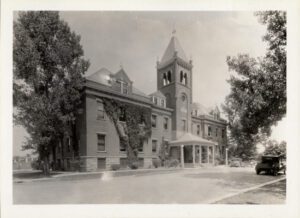
Central State University originated on March 19, 1887, when the Ohio General Assembly passed an act establishing a Combined Normal and Industrial (CN&I) Department at Wilberforce University. Through various transitional changes, it emerged as an independent, state university. In 1941, the General Assembly expanded the CN&I, which offered two-year courses, into the College of Education and Industrial Arts, with four-year programs. In 1947, it separated from Wilberforce University. The history of Central State University tells the history of higher education and advancement for African Americans in Ohio. It is within the walls of these structures, and others unfortunately demolished or destroyed by the 1974 tornado, that thousands of African Americans received valuable training for successful and rewarding careers. Thus, many of the contributions of African Americans to the promotion and betterment of education, medicine, law, social justice, technology, and the arts in Ohio have their roots here on the campus of Central State University.
, OH
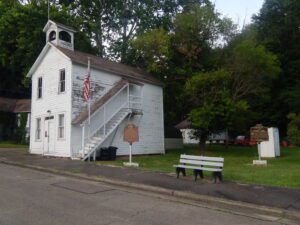
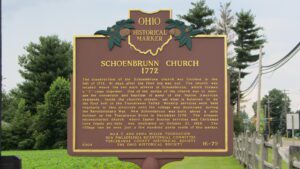
In December 1772, Brother David Zeisberger and his followers began the construction of Schoenbrunn schoolhouse. The school was built in the Tuscarawas Valley on land given to Zeisberger in the spring of 1771 by the Delaware Native Americans as a Moravian mission to the Delaware. With the land, Zeisberger laid out the town of Schoenbrunn or “Beautiful Spring.” The school served Delaware Indian children, who were taught from special textbooks prepared in the Delaware and German languages by Zeisberger. John Heckewelder, who taught at the school, is recognized as the first schoolteacher in Tuscarawas County. The present reconstructed schoolhouse was dedicated on July 29, 1928 on the 155th anniversary of the completion of the school’s construction. The village can be seen just a few hundred yards south of this marker.
, OH
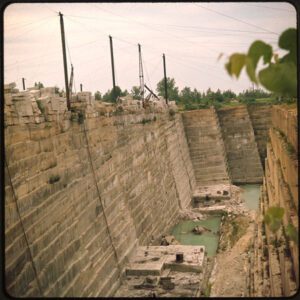
For more than ninety years, this area was the heart and soul of Berea’s sandstone quarries. In the early 1830s, John Baldwin discovered that the area’s sandstone deposits made superb grindstones and building stones. In the 1840s, thriving sandstone quarries developed and became Berea’s lifeblood. Searching for the “American Dream,” German, Irish, Italian, Hungarian, and Polish immigrants, among others, came here to work. The quarries eventually encompassed nearly 250 acres and consumed the fashionable houses of Berea’s “South Side” and the buildings of Baldwin University. The Cuyahoga County Court House, Ohio’s Capitol, and Canada’s parliament buildings are among many structures in North America and Europe constructed of Berea sandstone. Decreasing demand for sandstone and the Great Depression closed the last of Berea’s quarries in the mid-1930s.