

, OH
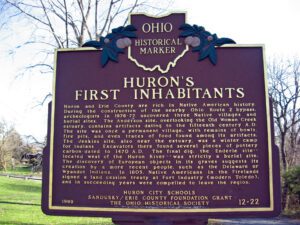
Huron and Erie County are rich in Native American history. During the construction of the nearby Ohio Route 2 bypass, archeologists in 1976-77 uncovered three Native villages and burial sites. The Anderson site, overlooking the Old Woman Creek estuary, contains artifacts dating to the fifteenth century A.D. The site was once a permanent village, with remains of bowls, fire pits, and even traces of food found among its artifacts. The Jenkins site, also near the estuary, was a winter camp for Indians. Excavators there found several pieces of pottery carbon-dated to 1470 A.D. The final dig, the Enderle site — located west of the Huron River — was strictly a burial site. The discovery of European objects in its graves suggests its creation by a more recent people, such as the Delaware or Wyandot Indians. In 1805, Native Americans in the Firelands signed a land cession treaty at Fort Industry (modern Toledo), and in succeeding years were compelled to leave the region.
, OH
One of Ohio’s earliest proponents of women’s rights, Frances Dana Gage (1808-1884) was born in Marietta and married McConnelsville attorney James L. Gage in 1829. She immersed herself in the major social issues of the day – temperance, abolition, and universal suffrage – while raising eight children. At a women’s rights convention in 1850, Gage gained national attention by proposing that the words “white” and “men” be removed from Ohio’s constitution. She later served as the editor of an Ohio agricultural journal, as an educator for newly emancipated African Americans, and wrote children’s tales under the pen name “Aunt Fanny.” An enormously influential woman, Gage led the way for Ohio’s next generation of social activists.
, OH
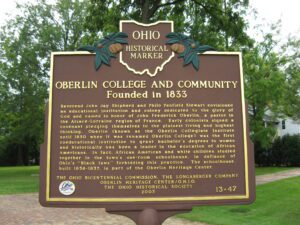
Reverend John Jay Shipherd and Philo Penfield Stewart envisioned an educational institution and colony dedicated to the glory of God and named in honor of John Frederick Oberlin, a pastor in the Alsace-Lorraine region of France. Early colonists signed a covenant pledging themselves to the plainest living and highest thinking. Oberlin (known as the Oberlin Collegiate Institute until 1850 when it was renamed Oberlin College) was the first coeducational institution to grant bachelor’s degrees to women and historically has been a leader in the education of African Americans. In fact, African American and white children studied together in the town’s one-room schoolhouse, in defiance of Ohio’s “Black laws” forbidding this practice. The schoolhouse, built 1836-1837, is part of the Oberlin Heritage Center.
, OH
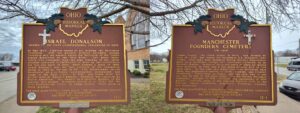
In May 1800, Congress passed an act dividing the Northwest Territory, with the western division becoming Indiana Territory and the eastern called the Territory of the United States northwest of the Ohio River. Two years later, thirty-five delegates from the nine counties of the latter division convened in Chillicothe to draw up the constitution for the new state of Ohio, which became a state in 1803. Israel Donalson was the last survivor of the convention dying in 1860 at the age of 93. This frontiersman served Manchester as a surveyor, schoolteacher, postmaster, and judge in the first court. In 1791, one month after his arrival here at Massie’s Station, Donalson was captured by Native Americans. His memoir is a colorful account of his capture and escape. Donalson served as an Elder for the first Presbyterian church in Adams County, which stood on these grounds.
, OH
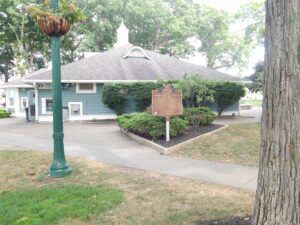
Entrepreneur and philanthropist Joseph (Jose) de Rivera was born in Barcelona, Spain, and built an import business in New York City. In 1854, he bought six Lake Erie Islands and had South Bass Island surveyed and subdivided into ten-acre lots. De Rivera traveled between New York and South Bass Island, initially turning Put-in-Bay into a sheep farm. He encouraged settlement on the island and its wine industry by helping German immigrants purchase land to plant vineyards. He donated five acres for this waterfront park, the site for the first school, and the land for the first church. To promote travel to the island, de Rivera opened the island’s largest cave as a tourist attraction. He is buried in the island’s cemetery, which is on land he donated for that purpose.
, OH
Alexander Sutherland (1767-1845) and his wife Sarah (1768-1836) were the first settlers in Newton Township, Trumbull County, Ohio. Coming from Westmoreland County, Pennsylvania, the Sutherlands acquired 205 acres of land along Duck Creek southward from this site. Alexander was an influential person in the area after the settlement was made at Duck Creek. He was the second Recorder and the first elected Surveyor for Trumbull County. He was an early Mason with Old Erie Lodge, Warren schoolteacher, postmaster at Newton, Newton Township Trustee and Clerk, and Justice of the Peace. Sutherland, along with Ezekiel Hover, marked the first path from this Duck Creek settlement to Youngstown to reach the nearest mill.
, OH
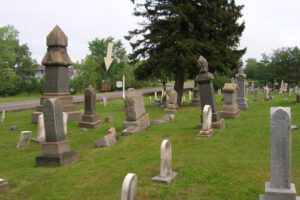
Settlers from Connecticut were the first to come to Canfield Township in the late 1700s, and they were followed by a second wave of immigrants, Swiss-German pioneers who began arriving from Berks and Leigh counties in Pennsylvania in 1804. In 1810, these “Pennsylvania Dutch” established The Zion Lutheran and Reformed Church and built a log church and cemetery on this site. The church was destroyed by fire in 1845 and a new church served the congregation well until it too was destroyed by fire in 1894. The cemetery, known as The Old Dutch and German Burying Ground, German Cemetery, and Lynn Cemetery and now Old North Cemetery, is all that remains. Among the dozens of old stone markers, some in German, are markers for veterans of the American Revolution, War of 1812, Civil War, and other wars.

, OH
Unserheim, meaning “Our Home” in German, is the name of this ante-bellum Queen Anne style home, which was placed on the National Register of Historic Places in 1998. From 1857-1878, it was home to Daniel Howell Hise, a Quaker and ardent abolitionist. On April 8, 1849, Hise wrote, “Welcome! Welcome to the protection I can give, with or without the law.” A major stop on the Underground Railroad, Unserheim’s secret rooms and tunnel provided shelter to slaves on their flight to freedom. Hise’s belief in abolitionism was so strong that following John Brown’s Raid at Harper’s Ferry, he was instrumental in erecting the Edwin Coppock Monument at Hope Cemetery. Coppock had been executed for his participation in the raid. Hise also supported the Women’s Rights Movement and opened Unserheim to such notable guests as famed suffragists Susan B. Anthony and Sojourner Truth.