

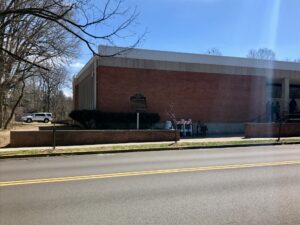
, OH
Virginia Hamilton was an author who was born in Yellow Springs in 1934, living and writing here for much of her life. She referred to her works as “Liberation Literature.” focusing on the struggles and journeys of African Americans. Hamilton published more than forty books in a variety of genres, including realistic novels, science fiction, picture books, folktales and mysteries. Some of her most beloved titles include The House of Dies Drear, M.C. Higgins the Great, Her Stories and The People Could Fly. Her books have had a profound influence on the study of race throughout American history, the achievements of African Americans, and the ramifications of racism. Hamilton received numerous awards for her writing before passing away in 2002. Her work is enshrined at the Library of Congress in Washington, D.C.
, OH
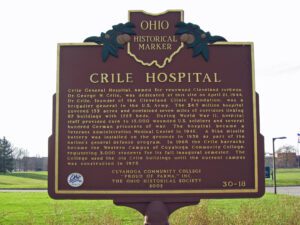
Crile General Hospital, named for renowned Cleveland surgeon, Dr. George W. Crile, was dedicated at this site on April 21, 1944. Dr. Crile, founder of the Cleveland Clinic Foundation, was a brigadier general in the U.S. Army. The $4.5 million hospital covered 153 acres and contained seven miles of corridors linking 87 buildings with 1725 beds. During World War II, hospital staff provided care to 15,000 wounded U.S. soldiers and several hundred German prisoners of war. The hospital became a Veterans Administration Medical Center in 1945. A Nike missile battery was installed on the grounds in 1956 as part of the nation’s general defense program. In 1966 the Crile barracks became the Western Campus of Cuyahoga Community College, registering 3,000 students for its fall inaugural semester. The College used the old Crile buildings until the current campus was constructed in 1975.
, OH
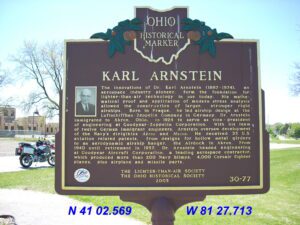
The innovations of Dr. Karl Arnstein (1887-1974), an aerospace industry pioneer, form the foundation for lighter-than-air technology in use today. His mathematical proof and application of modern stress analysis allowed the construction of larger, stronger rigid airships. Born in Prague, he led airship design at the Luftschiffbau-Zeppelin Company in Germany. Dr. Arnstein immigrated to Akron, Ohio, in 1924 to serve as vice-president of engineering at Goodyear-Zeppelin Corporation. With his team of twelve German immigrant engineers, Arnstein oversaw development of the Navy’s dirigibles Akron and Macon. He received 35 U.S. aviation related patents, from designs for hollow metal girders to an aerodynamic airship hanger, the Airdock in Akron. From 1940 until retirement in 1957, Dr. Arnstein headed engineering at Goodyear Aircraft Corporation, a leading aerospace contractor, which produced more than 200 Navy blimps, 4,000 Corsair fighter planes, plus airplane and missile parts.
, OH
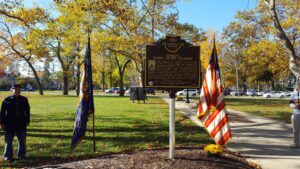
Quincy Adams Gillmore, considered one of the greatest military engineers and artillerists of the Civil War, was born to Quartus Gillmore and Elizabeth Reid Gillmore at this location in 1825. He attended Norwalk Academy and taught high school in Elyria before embarking on a military career. Graduating first in his class at West Point in 1849, he entered the Corps of Engineers. In August 1861, he served in the Union’s Port Royal expedition in South Carolina and later in the reduction of Fort Pulaski, which defended the water approach to Savannah, Georgia. The fort, considered impregnable to artillery, fell to Gillmore’s rifled cannon on April 11, 1862, after a two-day bombardment. His success effectively ended the use of large masonry fortifications. (Continued on other side)

, OH
In 1918, Charles Young made a desperate attempt to convince the U.S. Army that he was fit for duty. The Army’s highest-ranking Black officer, he had been medically retired and not given a command during World War I. To demonstrate his fitness, he rode 497 miles from his home in Wilberforce, Ohio, to Washington, D.C. Leaving on June 6 he made the journey in 17 days, 16 on horseback and 1 resting. Averaging 31 miles each day, he rode 45 minutes and walked 15 minutes every hour. Upon his arrival, Young met with Secretary of War Newton Baker. Pressured by the Black press and the White House, Baker hedged. He recalled Young to active duty a year later and assigned him to Camp Grant, Illinois, just five days before the end of the war.
, OH
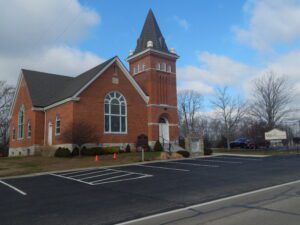
Slifers Presbyterian Church is on land deeded to the local faith community by Philip and Elizabeth Slifer on December 2, 1816. Rev. Thomas Winters of the German Reformed Church and Rev. John C. Dill of the Evangelical Lutheran Church ministered to people of German descent who settled in the area. During the “cold plague” (a malaria-like malady) of 1819, they ministered to the sick and grieving, renewing the faith of many. The community pooled their limited resources and began building their first log church in 1819. It was completed in 1825 and expanded later that year as the congregations grew. They erected their first brick church in 1858 for a cost of $500. Pastors conducted services for both Lutheran and Reformed congregations in German.
, OH
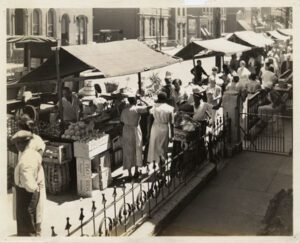
Public markets housing butchers, fish merchants, and produce vendors were once the primary source of perishable foods for residents of America’s cities. Cincinnati operated nine in 1859. Only Findlay Market, built here in 1852, survives. Cincinnati’s lost indoor markets include: Fifth Street Market: 1829 to 1870, Fifth between Vine and Walnut Wade Street Market: 1848 to 1898, corner of Wade and Bauer Avenue Canal Market: 1829 to 1864, Court between Vine and Walnut Court Street Market: 1864 to 1914, replaced Canal Market Jabez Elliott Flower Market: 1890 to 1950, Sixth between Elm and Plum Sixth Street Market: 1895 to 1960, Sixth between Plum and Western Row Pearl Street Market: 1901 to 1934, Market between Sycamore and Broadway
, OH
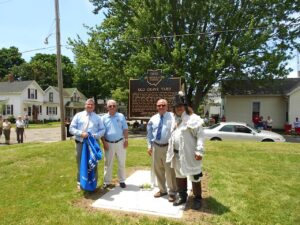
In 1805, a burial ground was dedicated to Champaign County at the intersection of Ward and Kenton Streets, which was then at Urbana’s town limits. It remained open until 1856. Among those interred there was Elizabeth Kenton, eight-year-old daughter of Simon Kenton. When she died in 1810, Kenton, the county jailer, was forbidden from crossing out of the town limits due to his unpaid debts. After following the funeral procession as far as he could, he watched Elizabeth’s burial from across the street. Also buried there were unknown soldiers from the War of 1812; Captain Arthur Thomas and son, who were killed by Native Americans in August 1813; four Bell children, who died in the tornado of March 22, 1830; and numerous early settlers of Champaign County. Many, but not all, were reinterred and rest in Oak Dale Cemetery.