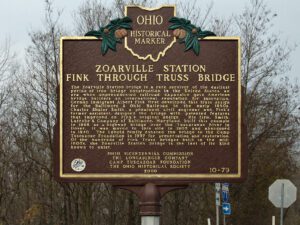
The Zoarville Station Bridge is a rare survivor of the earliest period of iron bridge construction in the United States, an era when unprecedented railroad expansion gave American bridge builders an international reputation for innovation. German immigrant Albert Fink first developed this truss design for the Baltimore & Ohio Railroad in the early 1850s. Charles Shaler Smith, a prominent civil engineer and Fink’s former assistant, designed the bridge with patented features that improved on Fink’s original design. His firm, Smith, Latrobe & Company of Baltimore, Maryland, built this example in 1868 as a highway bridge over the Tuscarawas River in Dover. It was moved to this site in 1905 and abandoned in 1940. The Lebold family donated the bridge to the Camp Tuscazoar Foundation in 1997 for preservation and restoration. Of the hundreds of Fink Truss bridges built in the mid-1800s, the Zoarville Station Bridge is the last of its kind known to exist.
Tah-gah-jute, the Mingo chief named Logan, was a native of Pennsylvania. Logan moved to Ohio in 1770, and settled at the Pickaway Plains. Logan and his father, Shikellimus, had long supported friendships between Native Americans and white men; however, in the spring of 1774, his tribesmen and family were murdered at Yellow Creek, along the Ohio River. Once an advocate of peace, Logan went on the warpath and raided frontier settlements. These and similar raids along the Ohio frontier precipitated Lord Dunmore’s War in October 1774. After the Shawnees and their allies were defeated at Point Pleasant, Virginia governor Lord Dunmore marched up the Hocking River to the Pickaway Plains. Dunmore asked his interpreter, Colonel John Gibson, to assist in negotiations with Cornstalk and other Indian leaders, including Logan. Logan declined to attend the conference, but spoke to Gibson about his anger and betrayal.
When inventor and entrepreneur Garrett Augustus Morgan sold his Traffic Signal patent to General Electric in 1923, he used the $40,000 to purchase a 121-acre farm in Huron County in 1924. Advertising “a village of our own,” Morgan established the Wakeman Country Club — one of Ohio’s early African American recreation clubs — and offered 247 lots for $60 each in “Wakeman Heights.” Located near the intersection of State Route 60 and Chenango Road, the development provided country pleasures to Blacks excluded from the Country Club lifestyle. Club membership, included in the purchase of a lot, offered fishing, hunting, swimming, and horseback riding. A restaurant, dance hall, and amphitheater provided cultural and boxing events. The club waned during World War II and no buildings from the once-thriving Wakeman Country Club remain.
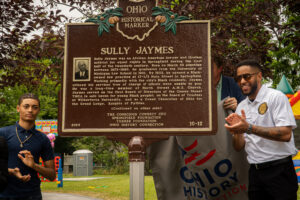
Sully Jaymes was an African American lawyer and tireless activist for equal rights in Springfield during the first half of the twentieth century. Born on March 30 sometime between 1875-1880, he graduated from the University of Michigan Law School in 1901. By 1903, he opened a Black-owned law practice at 17-1/2 Main Street in Springfield. Working primarily with the city’s Black residents, Jaymes offered his services free of charge if clients were unable to pay. He was a long-time member of North Street A.M.E. Church. Jaymes served on the first Board of Directors of the Center Street YMCA (a safe-haven for young Black people), on the Board of Trustees at Wilberforce University, and as a Grand Chancellor of Ohio for the Grand Lodge, Knights of Pythias. (Continued on other side)
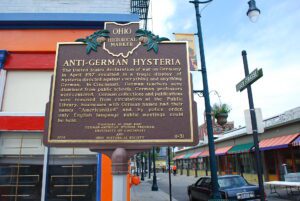
The United States’ declaration of war on Germany in April 1917 resulted in a tragic display of hysteria directed against everything and anything German. In Cincinnati, German teachers were dismissed from public schools, German professors were censored, German collections and publications were removed from circulation at the Public Library, businesses with German names had their names “Americanized” and, by police order, only English language public meetings could be held. (Continued on other side)
Established in 1879 by Chicago industrialist William P. Rend as a coal mining town, Rendville became a place where African Americans broke the color barrier. In 1888, Dr. Isaiah Tuppins, the first African American to receive a medical degree in Ohio, was elected Rendville’s mayor, also making him the first African American to be elected a mayor in Ohio. Richard L. Davis arrived in Rendville in 1882 and became active in the Knights of Labor. He was one of the labor organizers from the Little Cities of Black Diamonds region who helped found the United Mine Workers of America in 1890. An outstanding writer and orator, Davis was elected to UMWA’s national executive board and organized thousands of African Americans and immigrants to join the union. (continued on other side)
Unsatisfied by the terms of the treaty that ended the French and Indian War, Ottawa chief Pontiac led a confederacy of Native American tribes in attacks against British frontier forts during 1763, a campaign known as “Pontiac’s Conspiracy.” In October 1764, Colonel Henry Bouquet led a 1500-man army into the Ohio country from Fort Pitt (present-day Pittsburgh) as a demonstration of British force and to free captives held by several tribes. Informed of possible attack, Bouquet diverted his army overland from his Tuscarawas River valley route and here deployed his forces into three lines: a group of scouts on each ridge and the main force along present Route 93. Evidence of artillery emplacements and infantry breastworks remained visible for many years.
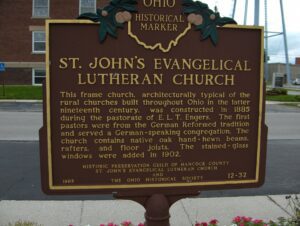
This frame church, architecturally typical of the rural churches built throughout Ohio in the latter nineteenth century, was constructed in 1885 during the pastorate of E.L.T. Engers. The first pastors were from the German Reformed tradition and served a German-speaking congregation. The church contains native oak hand-hewn beams, rafters, and floor joists. The stained-glass windows were added in 1902.