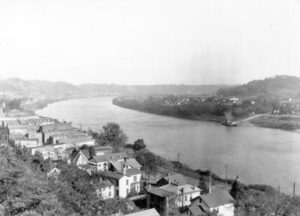
The Ohio River begins at the confluence of the Allegheny and Monongahela rivers in Pittsburgh, Pennsylvania, and flows 981 miles to join the Mississippi River at Cairo, Illinois. The Iroquois called the river “Oyo” or “Ohio,” which the French translated as “La Belle Riviere,” the Beautiful River. It was an important transportation route for countless generations of Native Americans and, beginning in the 1780s, for Euro-American settlers. It was the main route to the opening West and the principal outlet for the region’s growing farm output. Congress first acted to improve navigation in 1824 and, later, by canalizing the river with a series of locks and dams beginning in 1878. River commerce has increased with industrialization, moving up to 150 million tons annually.
The Hancock County Agricultural Society was organized on March 26, 1938. The Society soon purchased an 80 acre farm once owned by Tell Taylor, composer of the song “Down by the Old Mill Stream,” and held its first fair on this site October 13-15, 1938. The county fair has been held here every year since then except for 1942 during World War II.
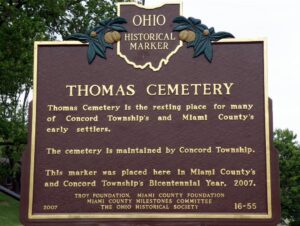
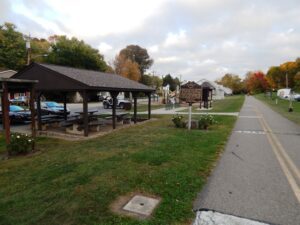
Thomas Cemetery is the resting place for many of Concord Township’s and Miami County’s early settlers. The cemetery is maintained by Concord Township. This marker was placed here in Miami County’s and Concord Township’s Bicentennial Year, 2007.
NE corner of S. Main Street and Zoar Road / Bayou Street
South Lebanon
, OH
Deerfield was laid out around 1795 and in 1802 Major Benjamin Stites, his son Benjamin, Jr., and John Gano officially recorded the village’s plat. A part of the great tide of Americans moving into the Northwest Territory (and Ohio after 1803), Deerfield’s early inhabitants included Revolutionary war veteran Ephraim Kibbey as well as Andrew Lytle, Nathan Kelly, William Snook, and War of 1812 veteran David Sutton. Deerfield was so called because it was a settlement in Deerfield Township, Hamilton County in the 1790s. (Continued on other side)
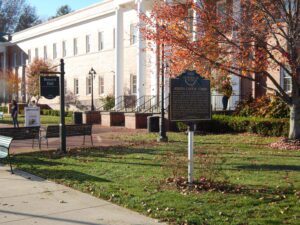
Joseph Carter Corbin’s work in the Reconstruction-era south after the Civil War created many educational opportunities for African Americans. Corbin (1833-1911) was a professor, administrator, journalist, linguist, and musician. Born in Chillicothe, Ohio to free African American parents, he earned his bachelor’s degree and two masters’ degrees from Ohio University, in 1853, 1856, and 1889, respectively. In 1872, Corbin and his wife Mary moved to Arkansas where he served as the state superintendent of public education. In 1875, Corbin was appointed principal of Branch Normal College, which became the University of Arkansas at Pine Bluff. In 1898, he co-founded and became president of the Arkansas Teachers Association. He was also a leader in the Prince Hall Masons, an African American Masonic order. He served as a secretary and Grand Master of the lodge’s Arkansas chapter.
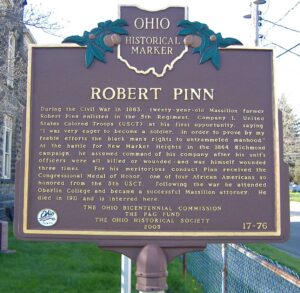
During the Civil War in 1863, twenty-year-old Massillon farmer Robert Pinn enlisted in the 5th Regiment, Company I, United States Colored Troops (USCT) at his first opportunity, saying, “I was very eager to become a soldier, in order to prove by my feeble efforts the black man’s rights to untrammeled manhood.” At the battle for New Market Heights in the 1864 Richmond campaign, he assumed command of his company after his unit’s officers were all killed or wounded – and was himself wounded three times. For his meritorious conduct Pinn received the Congressional Medal of Honor, one of four African Americans so honored from the 5th USCT. Following the war he attended Oberlin College and became a successful Massillon attorney. He died in 1911 and is interred here.
St. John’s Evangelical Lutheran Church was organized in 1838 by German Lutheran immigrants, primarily from Bavaria and Hesse-Darmstadt, who located in this vicinity in the 1830s. The congregation, called Neudettelsau, erected a second log church in 1843 centrally located in the “German Settlement”. A congregational split in 1846 resulted in the conservative members building a separate brick church a half mile away. This church in 1847 became one of the 12 charter members of the Lutheran Church-Missouri Synod. Growing membership required a larger brick church built on this site in 1860. In 1878 the two St. John’s congregations in the settlement reunited.
In April 1784, the Continental Congress adopted the Report of Government for the Western Territory, a broad plan drafted primarily by Thomas Jefferson for organizing the United States’ new western lands that were ceded by the states and purchased from Native Americans. One of the most far-reaching legislative acts in American history, the resulting Land Ordinance of 1785, passed on May 20th, established the public land system by which all federal land was surveyed and distributed. The Ordinance established a rectilinear survey system that divided land into townships of six miles square aligned by north-south and east-west baselines, and set aside certain lands for Revolutionary War veterans and for public schools.