

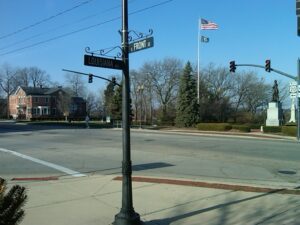
, OH
Following the War of 1812, settlers reestablished the 1810 Maumee River town, Port Miami of Lake Erie, on the land below the deserted Fort Meigs. The inhabitants nicknamed the new town “Orleans of the North” in honor of New Orleans in the Louisiana Territory. Orleans was destroyed twice by the river’s spring ice floes. Consequently, on April 27, 1816, at the suggestion of the town’s founder Amos Spafford, the United States Congress agreed and a new town was platted to the east and up on the bluff. Spafford named the town Perrysburg, formerly spelled Perrysburgh, in honor of Commodore Oliver Hazard Perry’s 1813 victory over the British fleet in Lake Erie. Wood County was founded in 1820 and included Maumee, which separated when Lucas County was formed in 1835. Perrysburg was the county seat from 1823 until 1870 when the county government was moved to Bowling Green.
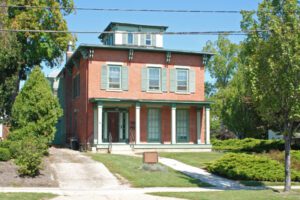
, OH
Aluminum pioneer Charles Martin Hall was born in 1863 in Thompson, Ohio (Geauga County), and moved with his family to Oberlin in 1873. Hall graduated from Oberlin College in 1885, studying chemistry under Professor Frank Fanning Jewett (1844-1926). Jewett, who lived in this house from 1884 to 1923, encouraged Hall’s interest in chemistry and aluminum, then a semi-precious metal. Hall discovered an electrochemical reduction process for producing metallic aluminum from aluminum oxide dissolved in molten cryolite in his woodshed laboratory at his family’s home at 64 East College Street on February 23, 1886. This process, the culmination of research with Jewett, became the basis for the aluminum industry in America. In 1888 Hall co-founded the Pittsburgh Reduction Company, later the Aluminum Company of America (ALCOA). Upon his death in 1914, Hall left one-third of his estate to Oberlin College.
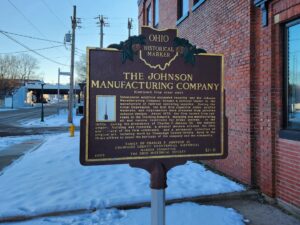
, OH
The Johnson Manufacturing Company was incorporated in 1902 by brothers James B., J. Will, Isaac T., and Charles F. Johnson, all of Quaker heritage. The company manufactured tin and galvanized iron ware for railroad lines across the United States. The initial product was the No. 1 long-spouted locomotive oiler with the patented dripless spout. That was quickly followed by other types of oil cans, signaling equipment, engine buckets, tallow pots, torches, track inspection devices, tin cups, and caboose and cabin car lamps, all carrying the Diamond J trademark. The makers created the patterns and everything was cut, riveted, and soldered by hand. As production expanded, the original frame building at 605 Miami Street was replaced by a brick structure in 1910, the southernmost part of the present building. (continued on other side)
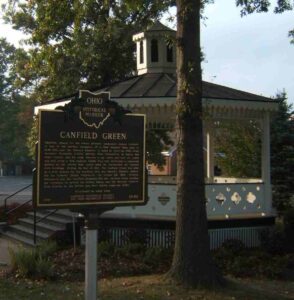
, OH
Canfield, named for the area’s primary landowner Judson Canfield, is one of the earliest examples of a New England town plan in both Ohio and the Western Reserve. It dates to April 20, 1798, when surveyor Nathaniel Church arrived from Connecticut to layout the town. Church and his team erected a log cabin and laid out roads and lots using a New England Green Plan that envisioned a communal ground at the center that would later be surrounded by various civil buildings. During the War of 1812, the Canfield Green was used as a drill ground for the Northern Ohio and Western Reserve militia, led by General Elijah Wadsworth. On August 23, 1812, General Wadsworth and the Canfield Dragoons left the Canfield Green heading for Cleveland to defend the United States and the Western Reserve from attacks by the British and their Native American allies. (Continued on other side)
, OH
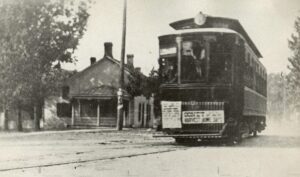
The Rapid Railway began operation in 1903 and was the Interurban Railway and Terminal Company’s (IR&T) northernmost traction line. The IR&T began near Pleasant Ridge and Kennedy Heights in Cincinnati and connected to a street car line that originated downtown, on Sycamore Street, and passed through a total of fourteen municipalities. The interurban cars ran down Main Street through Mason before turning south onto Dawson Street, crossing Muddy Creek, and traveling to Kings Mills. From Kings Mills, the line continued to Lebanon where it terminated. The full ride from downtown Cincinnati to Lebanon took approximately one hour and fifty minutes. (Continued on other side)
, OH
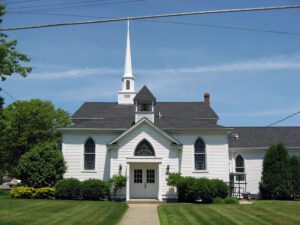
The Canfield Christian Church began as a Baptist congregation in 1822 and church met for worship in William Dean’s home. The Mahoning Baptist Association Meeting of 1826 was held in David Hayes barn. In 1827, Walter Scott was asked by the Association to be the first paid traveling evangelist in the Mahoning Valley area of Ohio. Scott accepted the offer and moved his family to a house next to the Canfield Church. By June of 1829, the Canfield Church voted to lay aside the Baptist name for the name Disciples of Christ. They believed all creeds were unnecessary and took the Bible alone as their sole rule of faith and practice. In 1847, a new church was built. Charter members of the church include James and Sarah Caldwell, Ann Winfield, Mr. and Mrs. Benjamin Caldwell and daughter, Mr. and Mrs. Andrew Flick, Mr. and Mrs. Walter Clark, Mr. and Mrs. John Flick, and Mr. and Mrs. Simmon Sackett and daughter. (Continued on other side)
, OH
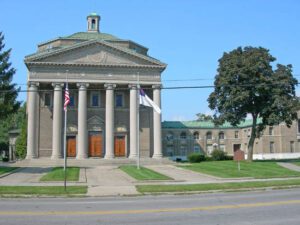
Founded in 1833, this is the oldest congregation organized within Toledo’s original boundaries. From 1844 to 1913 the church occupied a succession of three meeting houses on St. Clair Street. In 1913 First Church merged with Central Congregational Church. The pews and eight stained glass windows from the 1878 church were incorporated into this meeting house which was dedicated in 1916.
, OH
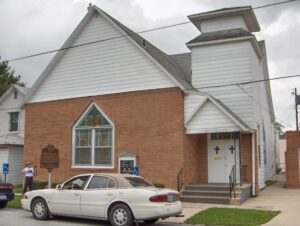
In spite of small numbers and being welcomed by the mostly white congregation of First Methodist Episcopal Church, African Americans in Findlay in the 1880s wanted to express their faith in ways that best reflected their freedoms and traditions. By the mid-1880s, the congregation was meeting in members’ homes and the Odd Fellows Hall, but began fund raising to build their own church in 1885. The congregation was admitted to the North Ohio Conference of the Third Episcopal District of the African Methodist Church in 1885, one of the first churches to be so admitted. The building on Liberty Street was well underway by the end of 1887 on a lot donated by Judge D. J. Cory. The original twenty foot by forty foot building cost $2,000 and immediately became a focal point for religion and social events for Findlay’s African American community. (Continued on other side)