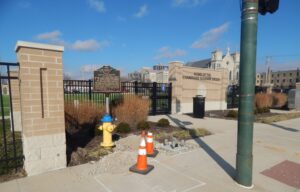
Known by the trade name Henderson’s Printing, the business was a mainstay of Dayton’s African American community for almost 60 years and became a printer of choice for everything from advertising materials, office forms, and a community publications called “housewife savers.” John William Henderson Sr. (1913–1991) purchased his first printing press and founded the business in 1941, bringing to it experience as an instructor of journalism and printing at Wilberforce University. The business’s first location was the family home at 421 Kearney St. After several moves, the business settled at 301 Washington Street in 1958.
Corner of Division Street and East Lakeshore Drive
Kelleys Island
, OH
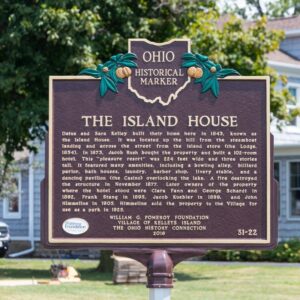
Datus and Sara Kelley built their home here in 1843, known as the Island House. It was located up the hill from the steamboat landing and across the street from the island store (the Lodge, 1854). In 1873, Jacob Rush bought the property and built a 102-room hotel. This “pleasure resort” was 224 feet wide and three stories tall. It featured many amenities, including a bowling alley, billiard parlor, bath houses, laundry, barber shop, livery stable, and a dancing pavilion (the Casino) overlooking the lake. A fire destroyed the structure in November 1877. Later owners of the property where the hotel stood were Clara Fann and George Schardt in 1892, Frank Stang in 1895, Jacob Kuebler in 1899, and John Himmeline in 1905. Himmeline sold the property to the Village for use as a park in 1925.
On this site, the first meetinghouse owned by the Hudson Congregational Church was dedicated March 1, 1820, twenty-one years after David Hudson first came to the Hudson area. Its members met here until they completed their sanctuary on Aurora Street in 1865. In August 1835, church members unanimously adopted a resolution declaring that slavery is”a direct violation of the law of Almighty God.” At a November 1837 prayer meeting, church member and anti-slavery leader John Brown made his first public vow to destroy slavery.
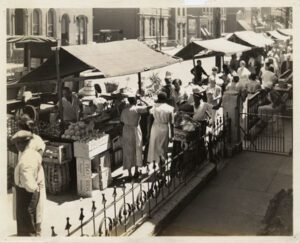
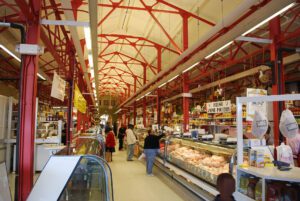
Public markets housing butchers, fish merchants, and produce vendors were once the primary source of perishable foods for residents of America’s cities. Cincinnati operated nine in 1859. Only Findlay Market, built here in 1852, survives. Cincinnati’s lost indoor markets include: Fifth Street Market: 1829 to 1870, Fifth between Vine and Walnut Wade Street Market: 1848 to 1898, corner of Wade and Bauer Avenue Canal Market: 1829 to 1864, Court between Vine and Walnut Court Street Market: 1864 to 1914, replaced Canal Market Jabez Elliott Flower Market: 1890 to 1950, Sixth between Elm and Plum Sixth Street Market: 1895 to 1960, Sixth between Plum and Western Row Pearl Street Market: 1901 to 1934, Market between Sycamore and Broadway
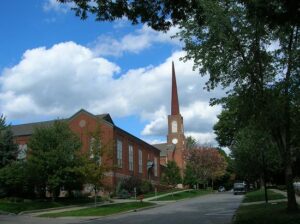
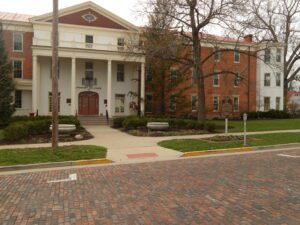
Chartered in 1849, the Institute was the first of three women’s colleges established in Oxford. The original brick building was completed in 1850, and forms the core structure. The Reverend John Witherspoon Scott, a member of Miami University’s early faculty, headed the Institute. In 1867, the Institute merged with Oxford Female College and later became the Oxford College for Women. Miami University acquired the building in 1928; in 1930 the Daughters of the American Revolution rededicated it as the “Caroline Scott Harrison Memorial.” From 1929-1998 it served as a Miami dormitory, nicknamed “Ox College.” Since 2003, the three-story building has housed the Oxford Community Arts Center. The structure is the oldest extant women’s college building in Ohio. It was placed on the National Register of Historic Places in 1976.
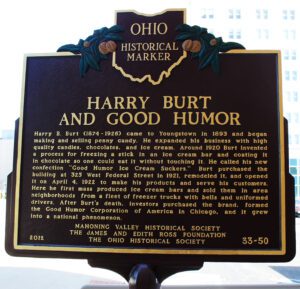
Harry B. Burt (1874-1926) came to Youngstown in 1893 and began making and selling penny candy. He expanded his business with high quality candies, chocolates, and ice cream. Around 1920 Burt invented a process for freezing a stick in an ice cream bar and coating it in chocolate so one could eat it without touching it. He called his new confection “Good Humor Ice Cream Suckers.” Burt purchased the building at 325 West Federal Street in 1921, remodeled it, and opened it on April 4, 1922 to make his products and serve his customers. Here he first mass produced ice cream bars and sold them in area neighborhoods from a fleet of freezer trucks with bells and uniformed drivers. After Burt’s death, investors purchased the brand, formed the Good Humor Corporation of America in Chicago, and it grew into a national phenomenon.
Ohio’s oldest surviving municipal market house, Findlay Market was designed under the direction of City Civil Engineer Alfred West Gilbert (1816-1900). It was listed on the National Register of Historic Places in 1972. The structure was among the first market houses in the United States to use iron frame construction technology. Originally an open pavilion, much of the market was erected in 1852, but disputes with contractors delayed its opening until 1855. The center masonry tower was built in 1902. Soon after, public health concerns prompted enclosure of the market stalls and the addition of plumbing and refrigeration. Until then, vendors found cool storage in deep cellars beneath nearby breweries. The tower bell was brought from Cincinnati’s Pearl Street Market in 1934. Findlay Market was renovated in 1973-74 and again in 2002-03.
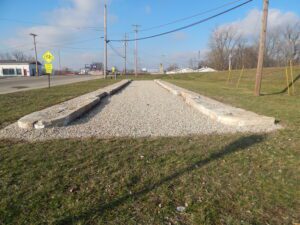
Construction of the Miami Extension of the Miami and Erie Canal, which included Troy, began around 1834. Lock 12 was built in 1836. General William Henry Harrison and other dignitaries officially opened the Troy section on July 4, 1837. The canal brought prosperity to the area, as its products were shipped to new markets and more people moved here. The last canal boat came through Lock 12 in 1912 and the disastrous flood of March 1913 finally ended Troy and Ohio’s canal era. Evidence suggests that in the late 1920s, the Hobart Brothers Company’s building on West Main Street covered part of the lock. The building and lock were razed in 2015. The footprint monument was dedicated June 7, 2017 and includes stones from Lock 12.