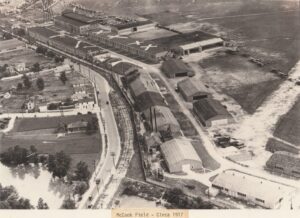
Interest in the new field of aeronautics grew dramatically when the United States entered the World War I in 1917. The army chose Dayton as the site for a research-and-development program for military aviation because of the area’s transportation links to major cities and its engineering and testing facilities. McCook Field, north of downtown between Keowee Street and the Great Miami River, was charged with researching, developing, and testing military airplanes and accessories. For nearly a decade, many advancements in aviation occurred at McCook Field. They included new aircraft, controllable-pitch propellers, bulletproof gas tanks, free-fall parachutes, and night-observation cameras. In the 1920s, larger and more-powerful aircraft overwhelmed the small field, which featured a large sign to warn pilots: “This field is small. Use it all.” In 1927, aeronautical engineering was transferred to newly-created Wright Field, now a part of Wright-Patterson Air Force Base.
The roots of Huntersville began when John and Elizabeth Hilliard purchased this former Shawnee tribal land in 1797 from Ohio’s largest land speculator Judge John Symmes. When Symmes defaulted on his payments, the Hilliards found themselves repurchasing their own land from the federal government. These uncertain land claims defeated their 1799 attempt to found “Hilliardstown.” David Hunter purchased the abandoned village site in 1833. He re-surveyed the land in 1838 creating an eighteen lot, two street village that he named Huntersville. The village incorporated in 1848, but was annexed by the neighboring city of Piqua in 1893. At the time Huntersville had a population of over 760, its own school system, a volunteer fire department, gas lights, and an assortment of saloons, boarding houses, and grocery stores.
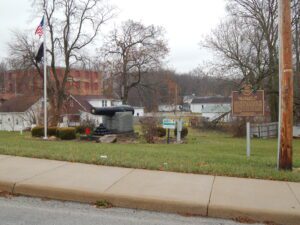
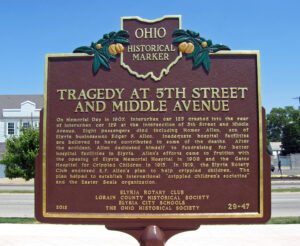
On Memorial Day in 1907, interurban car 123 crashed into the rear of interurban car 129 at the intersection of 5th Street and Middle Avenue. Eight passengers died including Homer Allen, son of Elyria businessman Edgar F. Allen. Inadequate hospital facilities are believed to have contributed to some of the deaths. After the accident, Allen dedicated himself to fundraising for better hospital facilities in Elyria. Allen’s efforts came to fruition with the opening of Elyria Memorial Hospital in 1908 and the Gates Hospital for Crippled Children in 1915. In 1919, the Elyria Rotary Club endorsed E.F. Allen’s plan to help crippled children. The plan helped to establish international “crippled children’s societies” and the Easter Seals organization.
In late March 1913, a series of three severe rainstorms inundated the already saturated and frozen ground of the Miami Valley, causing one of Ohio’s greatest natural disasters, the Flood of 1913. On March 25, the Great Miami River overflowed its banks at Miamisburg, fed by runoff from Bear and Sycamore creeks. Homes, businesses, and the bridges at Linden Avenue and Sycamore Street were swept away or wrecked by floodwaters reaching as high as eleven feet on Main and First streets. Early reports indicated that six people in the area died. Cleanup and recovery efforts took approximately a year. (Continued on other side)
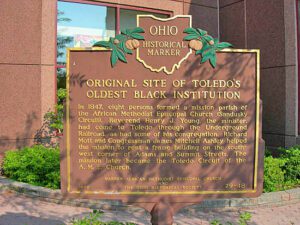
In 1847, eight persons formed a mission parish of the African Methodist Episcopal Church (Sandusky Circuit). Reverend Henry J. Young, the minister, had come to Toledo through the Underground Railroad, as had some of his congregation. Richard Mott and Congressman James Mitchell Ashley helped the mission to rent a frame building on the southwest corner of Adams and Summit streets. The mission later became the Toledo Circuit of the A.M.E. Church.
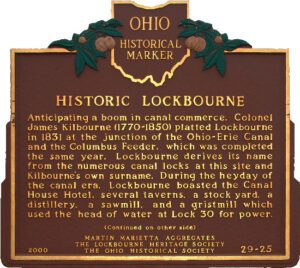
Anticipating a boom in canal commerce, Colonel James Kilbourne (1770-1850) platted Lockbourne in 1831 at the junction of the Ohio-Erie Canal and the Columbus Feeder, which was completed the same year. Lockbourne derives its name from the numerous canal locks at this site and Kilbourne’s own surname. During the heyday of the canal era, Lockbourne boasted the Canal House Hotel, several taverns, a stock yard, a distillery, a sawmill, and a gristmill which used the head of water at Lock 30 for power. (continued on other side)
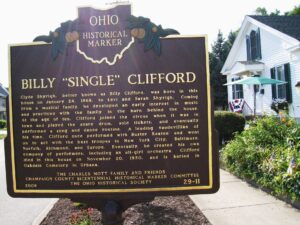
Clyde Shyrigh, better known as Billy Clifford, was born in this house on January 24, 1869, to Levi and Sarah Shyrigh. Coming from a musical family, he developed an early interest in music and practiced with the family in the barn behind the house. At the age of ten, Clifford joined the circus when it was in town and played the snare drum, sold tickets, and eventually performed a song and dance routine. A leading vaudevillian of his time, Clifford once performed with Buster Keaton and went on to act with the best troupes in New York City, Baltimore, Norfolk, Richmond, and Europe. Eventually, he created his own company of performers, including an all-girl orchestra. Clifford died in this house on November 20, 1930, and is buried in Oakdale Cemetery in Urbana.
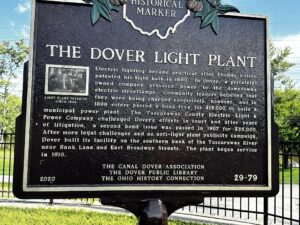
Electric lighting became practical after Thomas Edison patented his light bulb in 1880. In Dover, a privately-owned company provided power to the downtown’s electric streetlamps. Community leaders believed that they were being charged excessively, however, and in 1898 voters passed a bond levy for $15,000 to build a municipal power plant. The Tuscarawas County Electric Light & Power Company challenged Dover’s efforts in court and after years of litigation, a second bond issue was passed in 1907 for $35,000. After more legal challenges and an anti-light plant publicity campaign, Dover built its facility on the southern bank of the Tuscarawas River near Bank Lane and East Broadway Streets. The plant began service in 1910 and, with the Northern Ohio Traction & Light Company, supplied electricity to Dover.