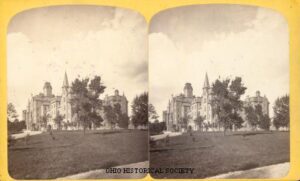
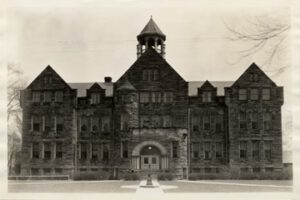
In 1835, Dr. William Awl of Columbus and Dr. Daniel Drake of Cincinnati presented recommendations to the Ohio General Assembly to establish a school for the blind. Legislation, signed by then governor of Ohio Duncan McArthur on April 3, 1837, provided funding to create the first state-supported residential school for the blind in the United States. The Institution for the Education of the Blind opened July 4, 1837, with five students. A year later, the first permanent structure, housing 60 students, was built on a nine-acre tract of land on the eastern edge of the city, and that was followed in 1874 with a larger facility near Fulton and Main streets. The school was honored and recognized in 1937 as being one of the finest schools for the blind in the country. In 1953, a new school for the blind was built at its present location at 5220 North High Street.
In 1845, Baldwin Institute, one of the first schools in the area open to all students regardless of gender, race, or creed, was chartered. The wealth generated by the sandstone and grindstone industries of Berea allowed John Baldwin to found the school. Ten years later, officials rechartered the school and renamed it Baldwin University. By the 1880s, the expanding quarries began to encroach on the original campus of the university, forcing it to relocate. In 1891, ground was broken for the new campus at the corner of Front Street and Bagley Road. Recitation Hall, renamed Wheeler Hall, was the first new building, followed by the Philura Gould Baldwin Memorial Library in 1894. In 1905, through the funding of the Carnegie Foundation, the Ladies Hall, renamed Carnegie Hall, was moved stone by stone to the new campus to serve as the science building. Baldwin University merged with German-Wallace College in 1913 to become Baldwin-Wallace College.
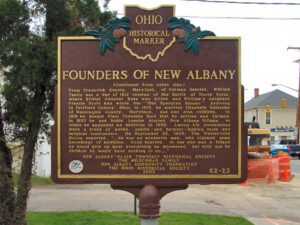
A tavern and inn, for which Noble Landon (1783-1866) obtained a liquor license in 1835, formerly occupied the southeast corner of High and Main streets. In 1837 Landon and William Yantis laid out the town of New Albany in 50-by-100-foot lots, with Landon’s lots lying on the east side and Yantis’ on the west side of High Street. Landon was born in Litchfield, Connecticut, lived as a young man in St. Albans, Vermont, and migrated to Licking County, Ohio, in 1810. He was the first clerk and first Justice of the Peace in St. Albans Township and first postmaster in Johnstown and later in New Albany. In addition to contributions as a builder-developer, Landon gave to the village lore the story of a remarkable conversion. Long known as a heavy drinker, he suddenly ordered kegs of whiskey he owned to be carried into the street and broken. He then attended church regularly. (continued on other side)
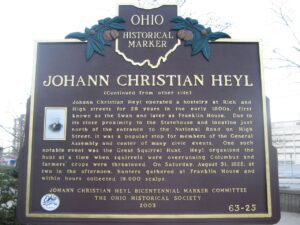
Johann Christian Heyl (1788-1877), the first German and first Lutheran to settle in Columbus, was one of the original 15 settlers of the city. A baker by trade, Heyl came to bake for the soldiers quartered in Franklinton during the War of 1812. He founded the city’s first Lutheran Church and helped financially underwrite the German Theological Seminary, which later became Capital University. An early civic leader, Heyl served on City Council for 14 years, was County Treasurer for 8 years, an associate judge in the Court of Common Pleas for 14 years, was appointed to the first public school board, and was the first Chief of the Fire Department. His Sunbury Road home was a stop on the Underground Railroad. (continued on other side)
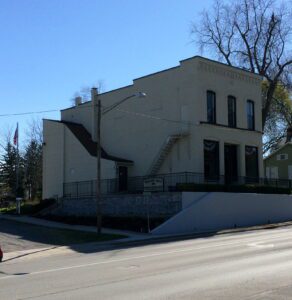
Henry Hanford Wakeman (1840-1879) of New York came to Waterville and became a successful businessman. He conceived the idea of a local Masonic Lodge, which became Wakeman Lodge No. 522 Free and Accepted Masons in 1879, and bequeathed $1,000 toward the construction of a meeting place. In 1880, a cornerstone was laid and this building was dedicated on October 21, 1881. For over 100 years, the Masons held their meetings upstairs while the lower floor was often rented out to a succession of businesses or used for public gatherings. Rising maintenance expenses and lower membership numbers caused the Masons to put Wakeman Hall up for sale in 1995. The Waterville Historical Society purchased the building in 1997 and spent several years rehabilitating it to serve as a local history archive and the Historical Society’s meeting place.
Saint Lucas Evangelical Lutheran Church, 745 Walbridge Ave
Toledo
, OH
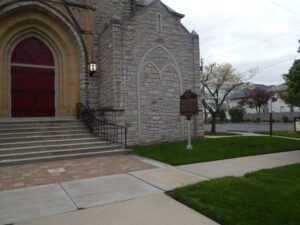
In 1886, thirty-six members from Toledo’s downtown Lutheran church, St. Paul’s, met to form a German-speaking Lutheran congregation for immigrants from Pommern, Mecklenburg and Hanover. Initially worshipping at St. Stephen’s at the corner of Harrison and Oliver Street, the congregation built a frame church on this site in 1887. That same year St. Lucas pioneered an early form of health insurance, The Mutual Sick Benefit Society, that later became a larger fraternal organization called The Mutual Sick Benefit Society for Ohio and Other States. In 1999, after joining a program called Reconciling in Christ, St. Lucas became the first Lutheran congregation in northern Ohio to publicaly welcome the LGBT communities. Named after Saint Luke, the patron saint of physicians, the church’s history is one of healing.
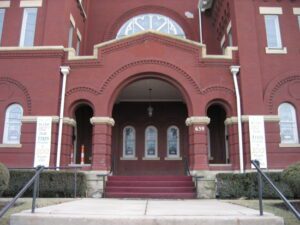
Organized in 1823 as Bethel African Methodist Episcopal Church, St. Paul A.M.E. Church is the oldest congregation of African descent in Columbus. The church, founded by Moses Freeman and 13 other members from the Town Street Church, was originally located on the east side of Lazelle Street. Several buildings were erected to meet the needs of the growing congregation. The present edifice, located at 639 E. Long Street, was completed in 1906. St. Paul has several outreach ministries, including The Prison Ministry, Alzheimer Ministry, Karen’s House, Community Development Corporation, Health Concerns Committee, St. Paul Tutorial and Enrichment Program (STEP), St. Paul Scholarship Program, St. Paul Drama Ministry, Jam’N Jefferson Park Festival, and Church Without Walls.
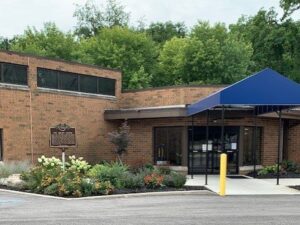
The Rotary Club of Toledo founded the “Toledo Society for Crippled Children” in 1920 to care for and treat children with disabilities, primarily those with polio. After a decade of fundraising and a substantial bequest from Edward Drummond Libbey, the Society opened a convalescent home in 1931 and moved to its own state-of-the-art facility in 1938. As the 1950s Salk vaccine reduced the prevalence of polio and the needs of Toledo’s disabled changed, the Society shifted focus to offer preschool care, adult rehabilitation, and independent living. The Society relocated to the 17-acre Monroe Street Campus in 1980 and adopted the name “The Ability Center of Greater Toledo” in 1990. The Ability Center proudly celebrated 100 years of “service above self” in 2020 and continues to create a disability-friendly Toledo.