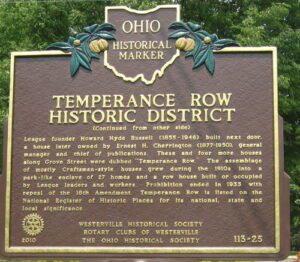
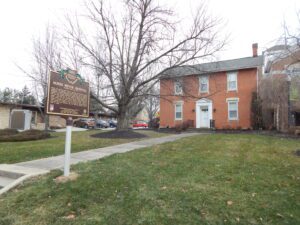
Here lived the reformers of the Anti-Saloon League of America who led the movement that turned the United States “dry” in 1920 with the 18th Amendment prohibiting the manufacture, sale or transportation of intoxicating liquor. Moving its headquarters to Westerville in 1909, the League built a publishing house that buried the liquor industry in a 10-year avalanche of books, pamphlets and periodicals that helped win Prohibition and made Westerville the “Dry Capital of the World.” Rev. Purley A. Baker (1858-1924), the League’s general superintendent, bought 11 acres and erected his rustic home at Park and Grove streets in 1910. (Continued other side)
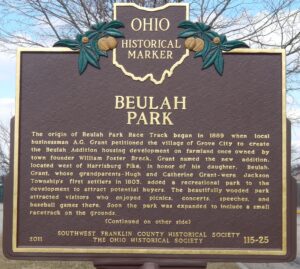
The origin of Beulah Park Race Track began in 1889 when local businessman A. G. Grant petitioned the village of Grove City to create the Beulah Addition housing development on farmland once owned by town founder William Foster Breck. Grant named the new addition, located west of Harrisburg Pike, in honor of his daughter, Beulah. Grant, whose grandparents, Hugh and Catherine Grant, were Jackson Township’s first settlers in 1803, added a recreational park to the development to attract potential buyers. The beautifully wooded park attracted visitors who enjoyed picnics, concerts, speeches, and baseball games there. Soon the park was expanded to include a small racetrack on the grounds.
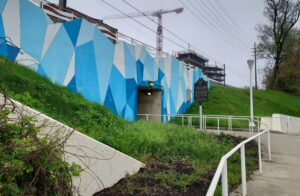
7650 W. Cleveland Memorial Shoreway at W. 76th Street Tunnel
Cleveland
, OH
The W. 76th and W. 65th Street tunnels survive today and symbolize the power of community action. In 1911, Cleveland City Council approved construction of elevated tracks by Lake Shore & Michigan Southern Railway Company. The tracks separated Cleveland’s neighborhoods from Lake Erie. In protest, West Side residents petitioned the council and the mayor to demand that safe access to the lakefront be restored. Council passed Ordinance 23308 to issue $85,000 in bonds to extend W. 76th Street and build a “subway” for vehicles and pedestrians. Obligating the railway company to pay half, the council approved Ordinance 28043 in February 1913 to construct pedestrian subways at E. 79th, W. 65th and W. 76th for $126,000. The E. 79th and W. 65th subways were constructed the same year, and W. 76th completed in 1914.
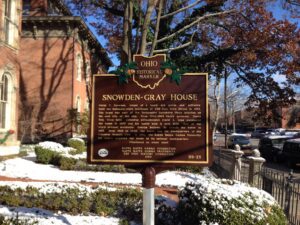
Philip T. Snowden, owner of a fancy dry goods and millinery, built the Italianate-style residence at 530 East Town Street in 1852. The house was part of the fashionable University Place addition on the east side of the city. From 1862-1864 Ohio’s governor, David Tod, lived here. Columbus philanthropist David S. Gray purchased the house in 1870 and his family held it until 1922. One of the city’s premier architects, George Bellows, Sr. rebuilt the house in 1872. From 1923 to 1940, the house was the headquarters of the Columbus Women’s Club. In 1951, the Kappa Kappa Gamma fraternity for women acquired the house as its national headquarters. (Continued on other side)
Near the Intersection of W Rich Street and W. Main Street
Columbus
, OH
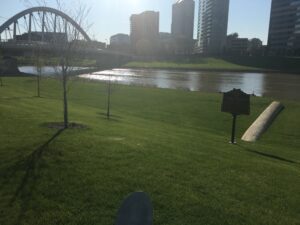
The historic district extends from the former Main Street Bridge to Long Street and encompasses the public buildings on either side of the Scioto River. The 580 foot long low-head concrete arch Main Street Dam was constructed in 1918 in response to the catastrophic 1913 flood. The dam helped reshape the Downtown Columbus Scioto River basin into a reflecting pool for the monumental riverfront buildings of teh Civic Center, which were influenced by the City Beautiful movement of the 1890s and early 1900s. Nearly a century after its construction, however, the dam had contributed to an unhealthy environment for aquatic life and was removed in late 2013 as part of teh Scioto Greenways river restoration project.
Puritas Mineral Spring Company bottled and sold mineral water from the natural springs in the area. In 1894, the Cleveland and Berea Street Railway bought Puritas Springs and expanded the area into a picnic grove with a dance hall and pavilion to increase passenger traffic on the inter-urban line. Puritas Springs Park opened June 10, 1900- the first day the railways operated all the way to the entrance gates. John E. Gooding bought Puritas Springs in June 1915 and added and indoor roller rink, amusement rides, and the mighty Cyclone roller coaster. Labor Day 1958 the park closed, and on May 9, 1059 a fire destroyed many parts of the abondoned park.
The house at this location, 110 South State Street, was the childhood home of Agnes Meyer Driscoll (1889-1971). Known as “the first lady of naval cryptology,” her career spanned from World War I to the Cold War. Driscoll attended Otterbein University before graduating from the Ohio State University, with majors in physics, math, music, and foreign languages. During World War I, she enlisted in the U.S. Navy as a chief yeoman, the highest rank possible for a woman at the time. After the war, Driscoll rose to become the chief civilian cryptanalyst for the U.S. Navy, breaking major Imperial Japanese Navy codes prior to World War II. (Continued on other side)
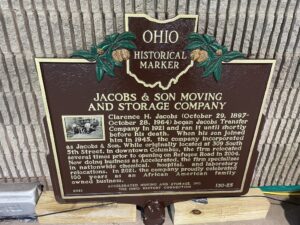
Clarence H. Jacobs (October 29, 1897?October 28, 1964) began Jacobs Transfer Company in 1921 and ran it until shortly before his death. When his son joined him in 1945, the company incorporated as Jacobs & Son. While originally located at 309 South 5th Street, in downtown Columbus, the firm relocated several times prior to opening on Refugee Road in 2004. Now doing business as Accelerated, the firm specializes in nationwide chemical, hospital, and laboratory relocations. In 2021, the company proudly celebrated 100 years as an African American family owned business.