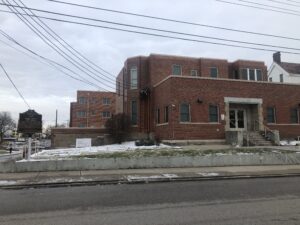
Walnut Hills has been home to a significant middle- and working-class Black community since the 1850s. In 1931, African American entrepreneur Horace Sudduth bought 1004 Chapel Street and then the row of buildings across Monfort, naming them the Manse Hotel and Annex. Throughout the 1940s, hotel dinner parties could move to the Federation of Colored Women’s Clubs house next door for dancing. A large addition to the Manse in 1950 created its own ballroom, 24-hour coffee shop, upgraded Sweetbriar Restaurant, and more guest rooms. It appeared in the Negro Motorist’s Green Book between 1940-1963, providing local, transient, and residential guests both catered meetings and top entertainment during the last decades of segregation. It closed in the late 1960s when the economic need for a first-class segregated hotel disappeared in the age of Black Power.
The Breathing Association was founded in 1906 as the Tuberculosis Society under the leadership of public health advocate Carrie Nelson Black. The society provided nutrition, medical care, and sanitorium services to people who could not afford proper medical care. A tuberculosis dispensary was operated at 40 South Third Street in Columbus for Ohioans needing consultation and treatment. Tuberculosis, known as the White Plague, killed one out of nine persons in Columbus during the early 1900s. An Open Air School was established on Neil Avenue in 1913 for children in homes where there were one or more cases of tuberculosis. In 1931, the Nightingale Cottage was opened on Brice Road as a tuberculosis preventorium for children. As tuberculosis became controllable, the agency became focused on emerging lung health issues. Today, The Breathing Association continues as a leading resource on lung health issues and preventing lung disease.
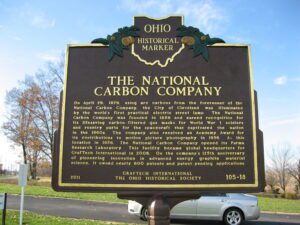
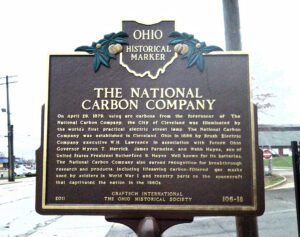
On April 29, 1879, using arc carbons from the forerunner of the National Carbon Company, the City of Cleveland was illuminated by the world’s first practical electric street lamp. The National Carbon Company was founded in 1886 and earned recognition for its lifesaving carbon-filtered gas masks for World War I soldiers and reentry parts for the spacecraft that captivated the nation in the 1960s. The company also received an Academy Award for its contributions to motion picture photography in 1956. At this location in 1956, The National Carbon Company opened its Parma Research Laboratory. This facility became global headquarters for GrafTech International in 2006. On the company’s 125th anniversary of pioneering innovation in advanced energy graphite material science, it owned nearly 800 patents and patent-pending applications.
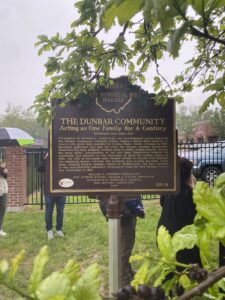
Dunbar, or Corsica Hollow, was an African American neighborhood on the western edge of Madisonville. Its streets and lots were laid out in 1886 after Mahlon and Anna Leonard subdivided their 10-acre tract near Duck Creek and sold lots to African Americans. Many early Dunbar residents were from the South; some born there prior to emancipation. Prominent early citizens included Harriet Deatherage, Elihu Parks, Gandison Embry, Thomas Duett, and James Murphy. Dunbar was home to the New Mission Missionary Baptist Church, founded in 1907. Originally meeting in a one-room building, the extant congregation relocated to Ravenna Street in 1963. By the late 1920s, Dunbar had about forty houses, a grocery run by Henry Lowman, and a hair salon run by Flora Hector. (Continued on other side)
On April 29, 1879, using arc carbons from the forerunner of The National Carbon Company, the City of Cleveland was illuminated by the world’s first practical electric street lamp. The National Carbon Company was established in Cleveland, Ohio in 1886 by Brush Electric Company executive W.H. Lawrence in association with future Ohio Governor Myron T. Herrick, James Parmelee, and Webb Hayes, son of United States President Rutherford B. Hayes. Well known for its batteries, The National Carbon Company also earned recognition for breakthrough research and products, including lifesaving carbon-filtered gas masks used by soldiers in World War I and reentry parts on the spacecraft that captivated the nation in the 1960s.
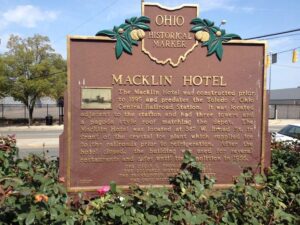
The only remaining Columbus railroad station, The Toledo & Ohio Central (T&OC) Railroad Station was constructed in 1895 and was the departure point for William McKinley when he left for Washington D.C to be sworn in as president. Designed by noted Columbus architects Joseph Warren Yost & Frank L. Packard, the pagoda style roof and tower have become Columbus icons. By 1900, the T&OC was purchased by the rival Hocking Valley Railroad and in 1911 the tracks were elevated above Broad Street. Later the New York Central Railroad gained control and used the station until 1930 when passenger service was transferred to Union Station in Columbus. Restored after the 1913 Flood and major fires in 1910 and 1975, the station was headquarters for the Central Ohio Volunteers of American from 1930 to 2003. The building was placed on the National Register of Historic Places in 1973.
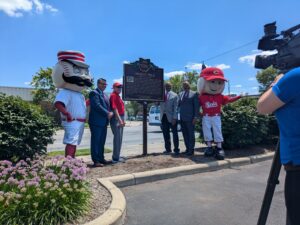
Crosley Field was the home of the Cincinnati Reds for almost 58 years. Opened in 1912 as Redland Field, the ballpark was renamed in 1934 when famed Cincinnati industrialist Powel Crosley Jr. purchased the team. Over its years of service, Crosley Field was home to Reds teams that won National League Championships in 1919, 1939, 1940, and 1961, and World Series titles in 1919 and 1940. The park also played host to the Major League Baseball All-Star Game in 1938 and 1953. Crosley Field famously held what was then acknowledged as the first night game under lights on May 24, 1935. Such visiting legends as “Shoeless” Joe Jackson, Babe Ruth, Joe DiMaggio, Willie Mays, and Jackie Robinson played at Crosley Field. (Continued on other side)
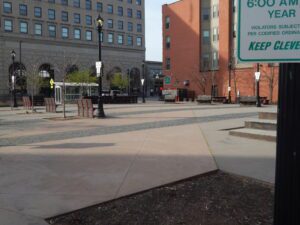
Market Square, home to the Pearl Street Market, was located on the corner of Pearl and Lorain Streets (now West 25th St. and Lorain Ave.) in what was then known as the City of Ohio. The land that Market Square occupies was donated by local businessmen Josiah Barber and Richard Lord in 1840 for the public’s use. Farmers and food vendors gathered to sell their wares after a public market moved here in 1859. In 1868, an enclosed wood-framed Pearl Street Market building was erected.