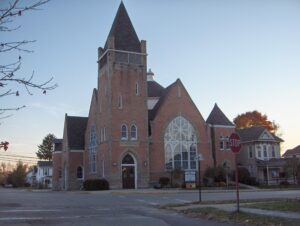
The Mechanicsburg United Methodist congregation was founded in the early nineteenth century and met first in open-air camp meetings before moving into a small log school building. In 1820 the congregation built a wood framed church on East Sandusky Street and that building was replaced with a brick structure in 1838. The congregation split in 1853 into Trinity Methodist and First Methodist with both groups serving the village of Mechanicsburg for 103 years before coming back together in 1956. The current United Methodist Church was built in the early 1890s and dedicated in 1894 on the corner of Main and Race Streets. The Gothic Revival style church was placed on the National Register of Historic Places in 1985.
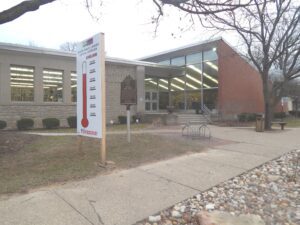
The American Sheet and Tin Plate Company founded the first Dover Public Library for the benefit of its employees at the corner of Front Street and Factory Street in 1902. Five years later, the library moved to a residence on Cherry and Fifth Streets. In 1916 the city dismantled “the old Downey residence” and built a high school in its place, with the public library occupying the basement. In 1934, the library moved to a converted residence at 417 North Walnut Street. Over time, however, the building became inadequate to house this beloved institution. In 1953 the city of Dover passed a bond issue to build a new library for the community. The new building, located at this site, opened in 1955.
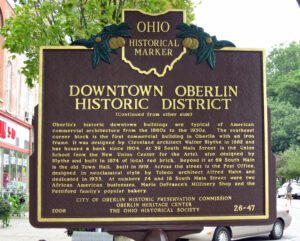
The intersection of Main and College streets has been the center of Oberlin since the town and college were founded in 1833. The first downtown buildings were made of wood and were destroyed by a series of spectacular fires. The first college building, Oberlin Hall, stood on the southwest corner of College and Main and included recitation rooms, a dining hall, chapel, offices, and lodging. In 1887, Akron architect Frank Weary designed the large brick building at numbers 5 to 13 West College. Number 23 West College (Gibson Block) once housed a silent movie theater on the second floor. East College Street’s historic buildings include the Apollo Theater, which showed Oberlin’s first talking movie on May 11, 1928. From 1897 to 1929, an interurban streetcar line connected Oberlin’s downtown to Cleveland. Oberlin’s downtown historic district was placed on the National Register of Historic Places in 2003.
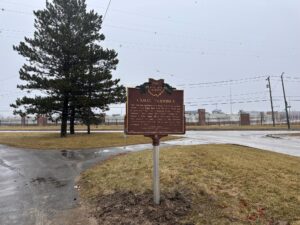
The original northernmost lock in a canal system which linked Lake Erie with the Ohio River was located near the foot of LaSalle Street. Indiana’s Wabash & Erie Canal (1843-1874) joined Ohio’s Miami & Erie Canal (1845-1913) near Defiance and shared the same course to this location. Toledo’s Swan Creek side cut became the northern terminus in 1864.
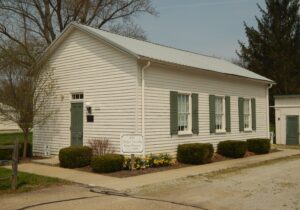
On April 20, 1857, the trustees of Morgan Township met in Okeana to obtain a lot for the township house. From a quarter mill tax levy, $850 was budgeted for a house and lot. Money expended on the project included $50 for the lot, $650 for the construction of the building, $41 for fencing, $12.60 for twelve chairs, and $10.25 for a table. Since its completion in 1858, this meeting house has been used for trustee meetings, a voting precinct, village singing schools and concerts, public school, bank, and township garage. The trustees moved to a new building across the street in 1972 and into their Chapel Road complex in 2000.
NW corner of N Tuscarawas Avenue and W Front Street
Dover
, OH
Christian Deardorff (1781-1851) with his brother-in-law Jesse Slingluff (1775-1836) platted and founded Dover and built the area’s first gristmill on Sugar Creek. With the coming of the Ohio and Erie Canal to Dover, Deardorff lobbied successfully to make Dover a toll stop for the canal and the be afforded a source of water power for his mill. A dam built on Sugar Creek obstructed for the mill there. Deardorff received access to the canal near Tuscarawas Avenue, and there erected a mill, later named the Cascade Mill by the Hardesty brothers when they purchased it in 1872. The Hardestys, from Carroll County, came to Dover in the 1860s and began operating a large mill on the Calico Ditch, near the foot of 2nd Street. The Dover Milling Company bought the last Hardesty-owned mill in 1951.
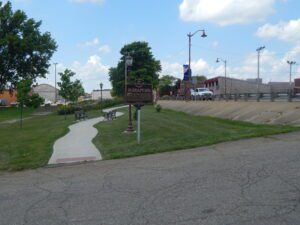
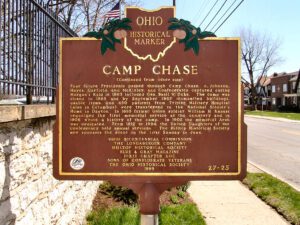
Camp Chase was a Civil War camp established in May 1861, on land leased by the U.S. Government. Four miles west of Columbus, the main entrance was on the National Road. Boundaries of the camp were present-day Broad Street (north), Hague Avenue (east), Sullivant Avenue (south), and near Westgate Avenue (west). Named for former Ohio Governor and Lincoln’s Secretary of the Treasury Salmon P. Chase, it was a training camp for Ohio soldiers, a parole camp, a muster-out post, and a prisoner-of-war camp. As many as 150,000 Union soldiers and 25,000 Confederate prisoners passed through its gates from 1861-1865. By February 1865, over 9,400 men were held at the prison. More than 2,000 Confederates are buried in the Camp Chase Cemetery.
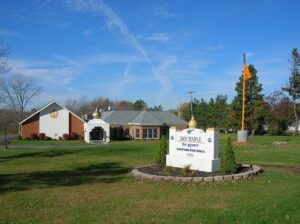
This marks the site of the first Sikh Gurdwara in the state of Ohio. Sikhs began to arrive in Ohio after India’s freedom from British rule in 1947. They came for advanced education at universities in the state. With liberalization of immigration laws in the 1960s, many Sikhs settled in metropolitan areas and set up organizations to hold congregational prayer. The Guru Nanak Foundation of Greater Cleveland Area was named after Guru Nanak, the founder of Sikh Faith. The Foundation, which at first used rental facilities for religious activities, was incorporated in 1976. However, by 1980 it was able to purchase a building at 3305 West 25th Street in Cleveland. Membership swelled during the 1980s, and in 1991 the congregation decided to move the Gurdwara to its present location in Richfield.