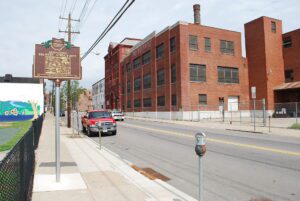
The Brewery District contains the majority of Cincinnati’s remaining breweries and associated structures such as icehouses, bottling buildings, offices, and stables. With the first brewery north of Liberty Street founded in1829, German immigrants fueled the growth of the brewing industry; by 1891, Cincinnati breweries produced over four barrels of beer per resident annually, almost twice as much as any other city in the nation. The brick breweries were typically designed in the Romanesque Revival style, and larger complexes often covered multiple city blocks. To produce the lager style beer common by 1860, typically very deep basements were dug or tunnels were cut into hillsides for the lagering process. At the height of production, 18 of the 36 breweries in greater Cincinnati were operating in Over-the-Rhine and the West End. Prohibition in 1919 closed most of the breweries permanently.
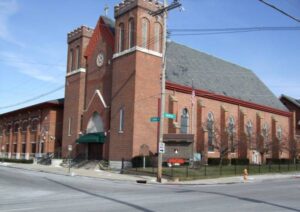
Built in 1852 and dedicated a year later, St. Patrick Church is the second oldest Roman Catholic Church in Columbus. Founded as the English speaking parish, this church of Norman Gothic design served as the home for three future bishops. Located on Naghten Street, the “Irish Broadway” of the nineteenth century, St. Patrick’s parish provided a vital place for the acculturation of the neighborhood Irish immigrants into mainstream American society. The Irish heritage is remembered through the shamrocks that emblazon the heads of each pew. Severely damaged by “the Great Fire” in 1935, the church was quickly restored and serves today as a vibrant religious center for central Ohio. The Dominican Fathers have staffed St. Patrick Church since 1885.
Small park at corner of University Road and W 10th Street
Cleveland
, OH
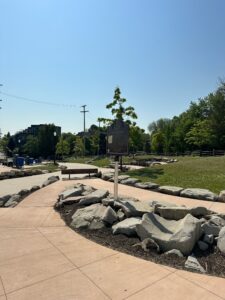
Opened in July 1862, the 35 1/2-acre site here in Brooklyn Township’s University Heights served as the largest Civil War army camp of rendezvous, organization, and training in northeast Ohio. It was bordered by Hershel (now West 5th) and University (now West 7th) streets and Railway and Marquard avenues. A wartime high of 4,151 volunteers occupied the barracks here on December 5, 1862. Lieutenant William Dustin of the 19th Ohio Volunteer Artillery wrote, “It was a table land above the city and admirably suited to the use of a camp of instruction. It was as level as a floor and carpeted with grass. The capacious pine barracks held about 25 each of the battery’s men.” A total of 15,230 men trained here during the war–4.9 percent of the 310,646 enlistments in Ohio. More than 11,000 soldiers were discharged here at war’s end. It closed in August 1865. (continued on other side)
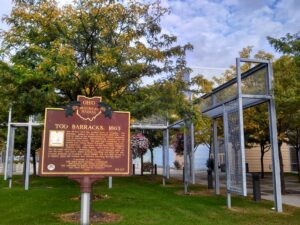
One of five Civil War military posts in Columbus, Tod Barracks, named in honor of Governor David Tod, was built in 1863 as the headquarters for military administration in central Ohio. Necessitated by Lincoln’s call for 300,000 new troops, the post was constructed in two months with United States Engineer, Captain John Tod, as supervisor. Carpenters of the 88th Ohio Volunteer Infantry from Camp Chase, three miles west, built it. Tod Barracks served as a recruiting depot, a rendezvous point for new recruits, and place where soldiers mustered-out after the war. Located adjacent to Columbus’ Union Station, the post also served as a transfer point for soldiers and officers traveling through Ohio. (continued on other side)
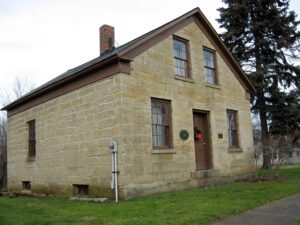
This rare sandstone house was built for Austin (c. 1788-1848) and Roxanna (Sears) Lilly (c. 1793-1868). They came to Dover Township (now Westlake) in 1832 from Ashfield, Massachusetts, an area from which many Dover settlers originated. This lot had been owned by Ozias and Hiram Smith. The Lillys erected this house in about 1844 and lived here until 1867. It is made with sandstone blocks two feet thick, finely tooled and dressed in the front and less elaborately on the sides and rear. The basement is constructed with massive rectangular stone blocks. Thick hewn timbers support the massive roof structure. A brick wing was attached to the east side in about 1850. After 1867, the lot and house had several owners, including George Weston, James Beardsley, and August Trudel. Eventually, Alice (Mrs. Dezso) Ladanyi, the great granddaughter of George Weston, deeded the house to the city of Westlake for use as a museum.
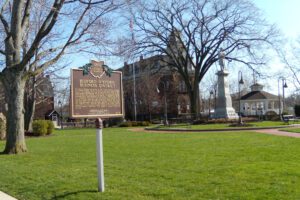
The town of Bedford was settled in 1837. Early residents, Hezekiah and Clarissa Dunham donated the land that serves as Bedford Public Square. The Dunhams built one of the area’s first homes in 1832, which stands at 729 Broadway with the letters H & D above the doorway. Early settlers were attracted to the area by the abundance of natural resources and a large waterfall for mill sites. Bedford also served as a stagecoach stop on the route from Cleveland to Pittsburgh. The road or Turnpike Road as it was called was originally part of the Mahoning Indian Trail. By 1895 the road was renamed Main Street (and later Broadway) when the Akron, Bedford, and Cleveland Railway Company (ABC) traversed the middle of the street carrying passengers. The interurban is called “America’s first high speed long distance electric interurban” with speeds in excess of 60 miles per hour. [continued on other side]
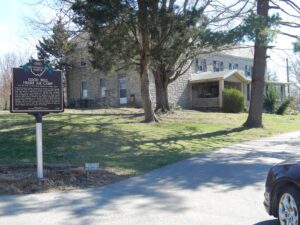
Reverend Richard E. Scully, founder of the Cincinnati Goodwill operated a Fresh Air Camp for women and children in the 1930s and 40s. The camp was part of a 100-acre site with vegetable fields, a swimming pool, tennis courts and horseshoe pits. The farm house on site was used as lodging for visitors. Men who worked at the camp received food and other forms of relief for their families. Vegetables produced on site were distributed at the Goodwill location at Ninth Street and Freeman Avenue in Cicinnati. According to family stories, Ruth Ann Eldridge, the frist child of Edison and Anna Eldridge, was buried on the site of the camp in 1933. Rev. Scully had officiated at Edison and Anna’s wedding and was a friend of the family.
Sisters of Notre Dame de Namur, 701 East Columbia Avenue
Reading
, OH
The Sisters of Notre Dame de Namur were founded in 1804 by Saint Julie Billiart to spread the message “Ah, how good it is to serve God.” In 1840, at the request of Bishop John B. Purcell in 1840, the Sisters travelled to Cincinnati, Ohio to help educate the city’s growing Catholic population. Choosing to serve the poor, the Sisters turned down land in Brown County and instead founded schools at Sixth Street in Cincinnati. Since the start of the 21st century, the Sisters serve in twenty-seven other states, the District of Columbia, and in South America, Europe, Africa and Asia. Sister Dorothy Stang, while working for land reforms for the poor in Brazil, was martyred in 2004.