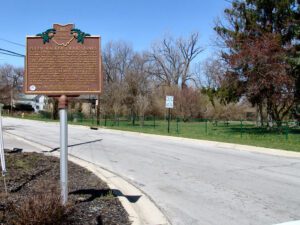
In 1972, Urbancrest’s Ellen Walker Craig-Jones became the first African-American woman to be elected mayor, by popular vote, of a United States municipality. During her term as mayor (1972-1975), Craig-Jones oversaw the modernization of Urbancrest’s various programs and the village rebuilt three main streets, installed streetlights and street signs, and received approval to start a $3 million housing project. Craig-Jones had many years of experience in service to her community, serving twelve years on the Urbancrest Village Council. She was the recipient of dozens of awards and honors, including Who’s Who Among Black Americans.
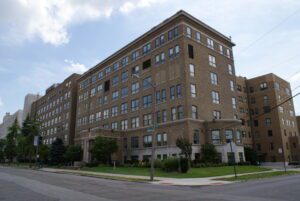
In late 1911, the Right Reverend Joseph Schrembs, Toledo’s first Bishop, corresponded with Sister Mary Bernardine McMullen and two companions, Sister Mary Anthony McMullen and Sister Mary DeChantel Lyons, and asked them to come to Toledo to establish the second of three Catholic hospitals in the new diocese. Land was purchased in 1916 on the corner of Madison Avenue and 23rd Street to build what would become a seven-story hospital. Noted Chicago architect, Meyer J. Sturm, was hired to design and construct the hospital using up-to-date methods of hospital construction. Costing approximately $300,000, Mercy Hospital of Toledo was completed in 1918. Bishop Schrembs dedicated and blessed the hospital on June 21 in a grand ceremony involving clergy of the diocese and the Mercy Hospital Guild as guests of honor.
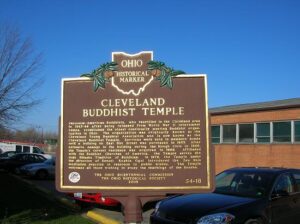
Japanese-American Buddhists, who resettled in the Cleveland area in 1943-44 after being released from World War II internment camps, established the oldest continually meeting Buddhist organization in Ohio. The organization was originally known as the Cleveland Young Buddhist Association and is now known as the Cleveland Buddhist Temple. Services were held in members’ homes until a building on East 81st Street was purchased in 1955. After extensive damage to the building during the Hough riots in 1966, the Temple’s current residence was acquired in 1968. Affiliated with the Buddhist Churches of America, the Temple serves the Jodo Shinshu Tradition of Buddhism. In 1979, the Temple under the direction of Sensei Koshin Ogui introduced the Zen Shin meditation practice in response to public wishes. The Temple welcomes all those wishing to study the teachings of the Buddha.
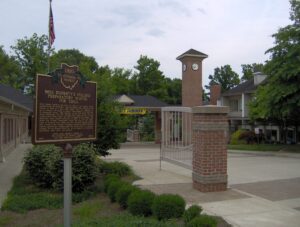
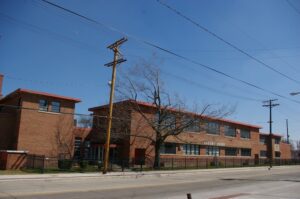
Mary Harlan Doherty was born in 1862 in the Dayton Street neighborhood of Cincinnati. She graduated from Woodward High School in 1880 at a time when women were not expected to go to college, but rather to marry, raise children, and take care of household duties. Miss Doherty, as she was known, saw the world differently. She felt strongly that women should not only possess solid social skills, but also be prepared for college. She graduated from Cornell University in 1899. In 1906 she established the College Preparatory School for Girls in the former home of Superior Court Judge and Ohio Governor George Hoadley, with a class of 125 students. Enrollment doubled by 1920, with Miss Doherty guiding her students under the school’s motto, Ad Summum, meaning “To the Highest Point,” or, as she viewed it, to strive for excellence, hard work, and service.
Karamu House, Incorporated was established in 1915 as the Playhouse Settlement, one of Cleveland’s many settlement houses for migrant and immigrant communities. Initiated by the Men’s Club of the Second Presbyterian Church, in 1915 Oberlin College and University of Chicago social work graduates, Russell and Rowena Woodham Jellliffe were hired as the founding directors. Originally located at 2239 East 38th Street, the Playhouse Settlement offered children’s theater and other social, recreational, and educational activities. It soon developed a partnership with the Dumas Dramatic Club, a local African American theater company that later became known as the Gilpin Players. (continued on other side)
In the early 1900s, Ohio led the nation in interurban track mileage. The electrically powered interurban was favored over steam railroads for short distance passenger travel and the transport of local freight. Incorporated in 1899, the Columbus, Buckeye Lake, and Newark Traction Railway served Bexley from a terminal on Gay Street in downtown Columbus. Running south on High Street and then east on Mound Street, the line crossed Alum Creek into Bexley, went north up Pleasant Ridge Avenue past Capital University, and continued to the National Road (Main Street). Interurban cars stopped at the northeast corner of Main Street and Remington Road and thence sped on to Buckeye Lake, Newark, and later Zanesville. The popularity of the automobile spelled doom for the interurban. Service on the line ended in 1929.
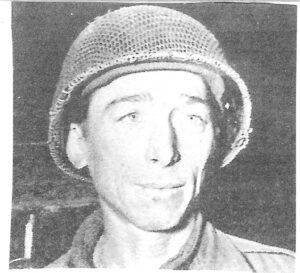
Alexander Albert Drabik was born here, in a log cabin, on December 28, 1910 to John Drabik and Frances Lewandowski, Polish immigrants from Szymborze, Germany, now Poland. Alex, youngest son of 14 children, attended Door Street School. A meat cutter, he enlisted in the United States Army in October 1942. Drabik fought in the Ardennes, Central Europe and Rhineland Campaigns of World War II. He received a Purple Heart during the Battle of the Bulge. On March 7, 1945, Sergeant Drabik led 10 Company A soldiers of the 27th Armored Infantry Battalion of the 9th Armored Division across the Ludendorff railroad bridge from Remagen, Germany to the Rhine River east bank. (Continued on other side)
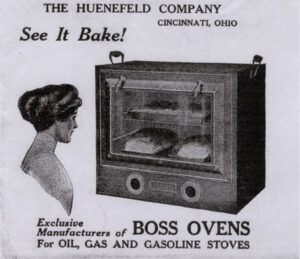
The first full-size glass door oven was invented and manufactured here by Ernst H. Huenefeld of The Huenefeld Company in 1909. Specially designed and patented sheet metal frames in the door allowed for expansion and contraction of the glass. The large window, guaranteed against steaming up or breaking from heat, allowed users to view their baking without opening the oven door. Huenefeld had acquired this property in 1903 for a new factory. The Huenefeld Company, established in 1872 on Pearl Street, moved its manufacturing here in 1904 from its downtown Cincinnati locations. The company, in operation until its sale in 1966, was widely known as a manufacturer of ranges, stoves, ovens, heaters, furnaces, refrigerators, washing machines, and other household products. A standard feature in homes today, the glass door oven was a technological breakthrough in 1909.