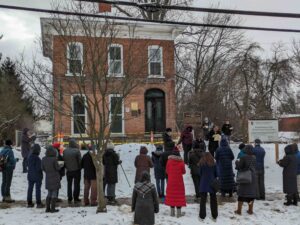
The Wilson Bruce Evans House, 33 East Vine Street, is a rare example of a residence built and occupied by an African American abolitionist and Underground Railroad operative. Free-born in North Carolina, Wilson Bruce Evans (1824-1898) moved to Oberlin in 1854. A skilled cabinetmaker, he opened a carpentry shop with his brother, Henry (1817-1886). Together they completed the original house by 1856. At the center of Oberlin’s interracial antislavery politics, Evans defied the Fugitive Slave Act of 1850, and was indicted for his part in the 1858 Oberlin-Wellington Rescue. During the Civil War, Evans enlisted in the predominantly white 178th O.V.I., serving August 1864-June 1865. The Wilson Bruce Evans House was added to the National Register of Historic Places in 1980, and named a National Historic Landmark in 1997. (Continued on the other side)
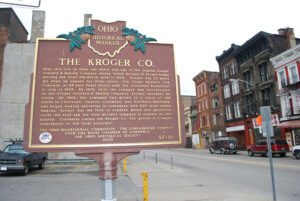
Near this site in Over-The-Rhine was one of the original Kroger Grocery & Baking Company stores, where Bernard H. Kroger began serving the Over-the-Rhine area in 1902. Kroger was 23 years old when he opened his first store, The Great Western Tea Company, at 66 East Pearl Street near the Cincinnati Riverfront in July of 1883. By 1902, when the company was incorporated as the Kroger Grocery & Baking Company, Kroger operated 40 stores. By 1908, the company had grown to a chain of 136 stores in Cincinnati, Dayton, Columbus, and Northern Kentucky, and began making deliveries to customers with 200 mule-drawn wagons. Kroger was the first to combine meats and groceries under one roof and the first grocery company to operate its own bakery. Currently called the Kroger Co., the grocer is a major contributor to the local economy.
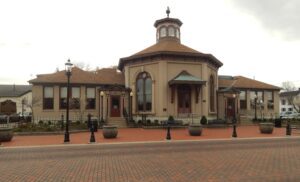
Clark Lane (1823-1907), industrialist and philanthropist, was a son of John Lane (1793-1880) and Rosanah Crum (1795-1877). John came with his family to the Ohio Country when it was still part of the Northwest Territory. As a young man, Clark worked in his family’s blacksmith shop, and eventually helped found Owens, Lane & Dyer Machine Company in 1854. It built agricultural machinery, sawmills, papermaking machines, and other products, initiating Hamilton’s prominence in metals manufacturing. Lane funded the Butler County Children’s Home, an orphanage for over a century, and constructed an octagon house as his residence on Third Street. He built this library in 1866, also as an octagon, and donated it to the people of Hamilton. A 19th century admirer wrote, “The name and generous deeds of Clark Lane will never fade from the memories of a grateful people who have been recipients of his favor.”
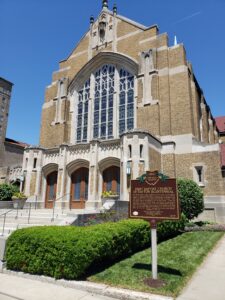
First Baptist Church of Dayton organized on May 29, 1824. A council met on the porch of William Huffman’s home at Third and Jefferson and approved 9 members as a congregation. The next day Lydia Huffman was baptized in the Great Miami River, the first recorded Baptist immersion in the city. Their first church building was erected in 1827 on Main Street. In 1829 the congregation suffered a Campbellite schism. Those resolved to remain Baptist incorporated on February 25, 1837, as The First Regular Baptist Church of Dayton, Ohio. The foundations for the Monument Avenue building were begun prior to the 1913 Dayton flood and the cornerstone was laid May 31, 1914. The building was completed, furnished, and ready for worship on June 26, 1915. (Continued on other side)
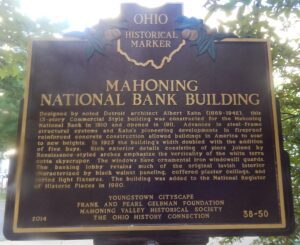
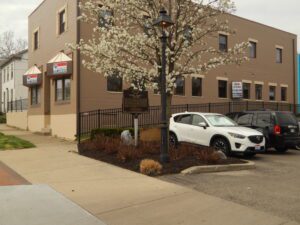
Designed by noted Detroit architect Albert Kahn (1869-1942), this 13-story Commercial Style building was contructed for the Mahoning National Bank in 1910 and opened in 1911. Advances in steel-frame structural systems and Kahn’s pioneering developments in fireproof reinforced concrete construction allowed buildings in America to soar to new heights. In 1925 the building’s width doubled with the addition of five bays. Rich exterior details consisting of piers joined by Renaissance-styled arches emphasize the verticality of the white terra cotta skyscraper. The windows have ornamental iron windowsill guards. The banking lobby retains much of the original lavish interior characterized by black walnut paneling, coffered plaster ceilings, and period light fixtures. The building was added to the National Register of Historic Places in 1980.
Raised and educated in St. Louis, author Fannie Hurst (1885-1968) was born in Hamilton at 918 Central Avenue, the home of her maternal grandparents. She was the daughter of Rose Koppel and Samuel Hurst. Already a writer as a student at Washington University (Class of 1909), Fannie moved to New York in 1910 to begin her career. Success came after repeated rejection. Stories for popular magazines brought her attention in the mid-1910s; by the mid-1920s she had become a best-selling, highly-regarded, and well-paid author. Between 1912 and 1964, Hurst wrote 18 novels, eight short story collections, and many other pieces. Hurst’s short story “Humoresque” (1919) and the novels Back Street (1931) and Imitation of Life (1933) were three of 32 films based on her writings. The film adaption of Imitation of Life received an Oscar nomination for Best Picture in 1934. (Continued on other side)
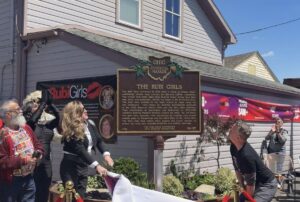
The Rubi Girls originated in 1984 when a group of friends began performing comedy drag routines for Dayton’s LGBTQ+ community. The troupe took their name from Rubicon Street where they first met, lived, and performed. During the height of the HIV/AIDS crisis, The Rubi Girls decided to use their talents to raise funds for the community. They began by donating performance proceeds to the Ohio AIDS Coalition and volunteering as performers and facilitators at the Ohio AIDS Coalition Healing Weekend Retreats. By the 1990s, The Rubi Girls expanded their fundraising efforts to include such annual benefit galas as Kweenz with Kause, Masquerage, and The Show Must Go On. For almost four decades, the Rubi Girls have shared their comedy while raising millions of dollars for local and regional HIV/AIDS and LGBTQ+ charities.
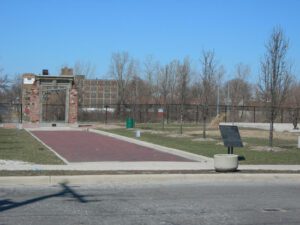
In 1934, workers at the Electric Auto-Lite Company and other automotive-related manufacturers secretly organized the Automobile Workers Federal Union Local 18384, American Federation of Labor (AFL), which became the United Auto Workers (UAW) Local 12. Anti-unionism, broken pledges by management, and abuse of workers had festered locally for generations. Workers bitterly resented the fact that management took advantage of the Depression’s high unemployment to decrease wages. In February, workers struck at Auto-Lite, Bingham Stamping, Logan Gear, and Spicer Manufacturing Company. When management refused to negotiate in good faith, the workers, including a large number of women, struck the Auto-Lite in mid-April. Auto-Lite management secured a court order limiting the number of strikers to twenty-five. The strike appeared to be lost until the Lucas County Unemployed League organized fierce resistance to the court injunction as the crowd around the plant grew to ten thousand. (continued on other side)